Showing posts with label Kay Jamison. Show all posts

Friday, December 15, 2006

Kraepelin

Little known outside of professional psychiatric circles, the work of German psychiatrist Emil Kraepelin has by now gained a far more pervasive influence on the current practice of psychiatry than that of either of his contemporaries, Sigmund Freud or Carl Jung, or even for that matter the later behaviourist B.F. Skinner. It was he who, assuming mental illness to be of biological origin, evolved the diagnostic categories -- depression, manic depression, and dementia praecox (later called schizophrenia) -- that form the basis of all major diagnostic systems in use today, in particular the American Psychiatric Association's DSM-IV and the World Health Organization's ICD (With his colleague Alois Alzheimer, he also is credited with co-discovering Alzheimer's Disease.)

Part of the reason K. never caught on with the public is that his writings are far more pedestrian than those of Freud or Jung; his notions, such as he enunciated them in the early '20s, lacked paradigmatic appeal. It would require the development of Big Pharma starting in the '50s to give Kraepelin the almost ubiquitous significance he has today.

But such as it is, his detailed work on manic depression, even by today’s standards, is truly impressive. He not only mapped out the poles of bipolar, but also the less well-known mixed states (agitated depression, racing paranoid or suicidal thoughts while lying on the couch, etc.) in considerable detail. He was a great empiricist: he had a talent for amassing huge quantities of seemingly contradictory data and laying it out in broad, compelling categories.

And yet, there is something disquietingly cold-blooded in Kraepelin’s descriptions of his patients (rather, subjects). That cold-bloodedness is representative of much of what goes on in psychiatry today: medical professionals who for the most part have never been touched by the symptoms they treat, smug in their assumptions of superiority, generally slighting of those with a condition that, while it can be, in extreme cases, truly debilitating if not downright fatal, has also truly enriched humankind, particularly in the realm of the arts.

Manic Patients are (his writings, taken from Godwin and Jamison’s Manic Depressive Illness)

convinced of their superiority to their surroundings…Towards others they are haughty, positive, irritable, impertinent, stubborn… unsteadiness and restlessness appear before everything. They are accessible, communicative, adapt themselves readily to new conditions, but soon they again long for change and variety. Many have belletristic inclinations, compose poems, paint, go in for music. . . Their mode of expression is clever and lively; they speak readily and much, are quick at repartee, never at a loss for an answer or excuse…

Their life is invariably a chain of thoughtless and extraordinary, not infrequently also nonsensical and doubtful activities… Many patients join new movements with fervent zeal which rapidly flags…make purchases far beyond their circumstances… (1921)
K. goes on to discuss a milder form of manic temperament within the domain of the normal but still a link in the long chain of manic-depressive disposition, a form that progressed to what he called the "irritable temperament". This too is perhaps as revealing of K. as the subjects he purports to describe:
It concerns here brilliant, but unevenly gifted personalities with artistic inclinations. They charm us by their intellectual mobility, their versatility, their wealth of ideas, their ready accessibility and their delight for adventure, their artistic capability, their good nature, their cheery, sunny mood. But at the same time they put us in an uncomfortable state of surprise by a certain restlessness, talkativeness, desultoriness in conversation, excessive need for social life, capricious temper and suggestibility, lack of reliability, steadiness, and perseverance in work, a tendency to building castles in the air… periods of causeless depression and anxiety… (1921)
Sounds rather like -- who guessed it? (My castles, though, are real, he he)

It is said that Ludwig Van Beethoven refused to move into a flat on a treeless street, declaring, "Sometimes I prefer a tree to a man." As long as men like Kraepelin remain in the ascendant, people like me are likely to prefer trees as well.

Sunday, November 19, 2006

Bipolar buddies

Jamison in the chapter on Artists in Manic Depressive Illness (1990) writes that of 36 American poets in the most recent Oxford Anthology of the time, more than a fifth exhibit well-documented histories of manic depressive illness severe enough to have warranted at least one hospitalization: namely, Hart Crane, Theodore Roethke, Delmore Schwartz, John Berryman, Randall Jarrell, Robert Lowell, Anne Sexton, Sylvia Plath. Of these five committed suicide.

Among the romantics, of course, we need only think of Shelley, Byron, Coleridge, Clare.

In the 18 century, the so-called "Age of Reason", we have Christopher Smart, William Collins, William Cowper, Robert Fergusson, Thomas Chatterton, and William Blake, to name a few likely candidates.

Of course accounts are purely anecdotal about these fellas, plus of course their literary traces. These do provide quite strong indications, however...

Are poets more likely than others to have bipolar affective disorders, as they are called? Assuming a general population rate of 1 to 2 percent, well, it's a question that scarcely needs to be asked. And its almost a tautology to show, as Jamison does, that poets as a group are more likely live out (and die out of) these conditions than biographers or research scientists.

Friday, November 17, 2006

Linguistic affective flattening

Attributions once made to the gods or the muses (Gerard Manley Hopkin’s “sweet fire the sire of the muse,” Emerson’s “all poetry is first written in the heavens”) have been transformed into the 20th century’s rather more prosaic constructions of “primary process,” “prelogical thought”, and “bisociative thinking.”
-- Manic Depressive Illness, p. 337

This process of toning down -- a kind of linguistic affective flattening -- has become so pervasive as to be preemptive. It certainly doesn't make the world easier for poets, not to mention receptivity to poetry. There is an enrichment in the shift of point of view, in the addition of terms. We have more at our disposal. But we are losing direct and easy access to whole ranges of emotion. More and more of our verbiage has become simply disposable, like newspapers: to be scanned on the way to the garbage can.

Thursday, November 16, 2006

Inspiration's pathogens...

Extreme mood swings, when removed from the sphere of poets and historians and placed in the more modern, analytical clinics of psychologists and psychiatrists, loose their association, however tumultuous, with growth, sensuality, creativity and other positive attributes, becoming instead representations of psychopathology. This is, in many ways, understandable. Clinicians are called on to treat symptoms, not to mystify them, and clinical objectivity is essential to avoid the risks of overlooking or minimizing the patient’s pain and suicide potential. For these and many other reasons, a psychopathological approach to mood disorders has resulted in a psychiatric literature generally slighting the positive aspects of affective illness, especially manic-depressive illness and its variants.

Frederick Kay Goodwin and Kay Redfield Jamison, Manic Depressive Illness, Oxford University Press, 1990.
p. 332

Monday, November 13, 2006

People go mad in idiosyncratic ways. Perhaps it was not surprising that, as a meteorologist's daughter, I found myself, in that glorious illusion of high summer days, gliding, flying, now and again lurching through cloud banks and ethers, past stars, and across fields of ice crystals. Even now, I can see in my mind's rather peculiar eye an extraordinary shattering and shifting of light; inconstant but ravishing colors laid out across miles of circling rings; and the almost imperceptible, somehow surprisingly pallid, moons of this Catherine wheel of a planet. I remember singing Fly Me to the Moon as I swept past those of Saturn, and thinking myself terribly funny. I saw and experienced that which had been only in dreams, or fitful fragments of aspiration.

Was it real? Well, of course not, not in any meaningful sense of the word real. But did it stay with me? Absolutely. Long after my psychosis cleared, and the medications took hold, it became part of what one remembers forever, surrounded by an almost Proustian melancholy. Long since that extended voyage of my mind and soul, Saturn and its icy rings took on a elegiac beauty, and I don't see Saturn's image now without feeling an acute sadness at its being so far away...

-- Kay Redfield Jamison, An Unquiet Mind

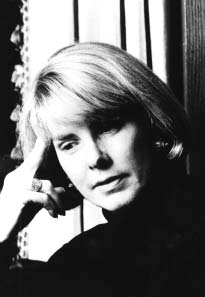
Kay Redfield Jamison

Because of my partner's recent plight (she is much better now -- but still rather fragile... as is to be expected), I have been seeing councellors and attending seminars at AMI Quebec (The Alliance for the Mentally Ill, the advocacy group for the mentally ill and their families), and besides, reading voraciously literature dealing with bipolar disorder (a term I never liked, for its misleading blandness. Sounds more like something that came from the freezer -- or something wrong with the planet Earth.). In the process I discovered a major author: Kay Redfield Jamison. Professor of Psychiatry at Johns Hopkins School of Medicine and co-author of Manic Depressive Illness (Oxford University Press, 1990), a standard medical text, she is not only one of the foremost authorities on manic-depressive illness, but has experienced it firsthand. Her memoir, An Unquiet Mind, is firey, passionate, beautifully written, candid and wise -- one of my best reads all year. She has also written Touched with Fire: Manic-Depressive Illness and the Artistic Temperament, and recently a book on suicide. A manic-impressive, one might say. But rather than go on with bookjacket superlatives (yes, I admit, I glanced over the book jacket to pluck out some of those adjectives from Washington Post, New York Times, et al. review quotes), I'll quote from some of her writing myself.