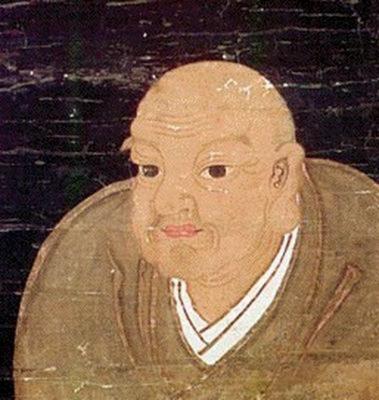
 Nichiren Daishonin
It's funny how blinded we are when theorizing about art without art actually in front of us. Rather like drawing a human figure without a model... the result will be frequently more than just a tad distorted. Just placing the Joseph Cornell boxes in my last post (I did it for decorative purposes...I just liked them) rather undermined my own arguments about dangers of "systematically random" art lacking heart. Clever, whimsical, his boxes are elegant and tasteful juxtapositions compared to sausage-grinding of disparate morsels exemplified by Flarf poetry (which can actually have plenty of heart -- in rare instances). They show possibilities for the juxtaposition of found materials that my own remarks don't acknowledge at all... that I find interesting. So much in one's generalizations depend on what one has recently been reading and impressed by. I would reckon that Thomas Basboll -- in saying "I much prefer poems that clever people put together out of things lying around in plain view to poems that creators found in their hearts" -- hasn't read Plath or Vallejo or Franz Wright for a long while....I was just reading them last week.
What got me going below was David's reference to Peter Matthiessen's conflicts between what he perceived as the egotism of his writing and his Buddhist beliefs, and his parry that "elimination of ego" and "forgetting of self" wasn't necessarily "phony" or "arrogant." Clearly I wasn't explaining where I was coming from -- a perspective derived from my own 9-year practice of Nichiren Daishonin's Buddhism, which is actually quite different from the monastic tradition of Zen (as interpreted by Watts and Suzuki) that forms so much the dominent impression of Buddhism here in North America. For that alone, I think the following, from our discussion on David's blog, has value:
What got me going below was David's reference to Peter Matthiessen's conflicts between what he perceived as the egotism of his writing and his Buddhist beliefs, and his parry that "elimination of ego" and "forgetting of self" wasn't necessarily "phony" or "arrogant." Clearly I wasn't explaining where I was coming from -- a perspective derived from my own 9-year practice of Nichiren Daishonin's Buddhism, which is actually quite different from the monastic tradition of Zen (as interpreted by Watts and Suzuki) that forms so much the dominent impression of Buddhism here in North America. For that alone, I think the following, from our discussion on David's blog, has value:
What's on my mind right now is how am I to eat my words, particularly "arrogant" and "phony". I suppose with a zesty vinegrette of humour, and a side-order of humble pie.
As a practicing Buddhist myself (gloop, gloop) for the past 9 years (mmmm, but the pie is delicious), I have no trouble with freely admitting that there I was projecting the arrogance (and yes, elements of phoniness) in myself on the project you propose, and indeed, it actually feels like quite an accomplishment to still have such balls & bombast after so much time. Horray for Balls & Bombast!!
But then, the Lotus Sutra gives me special dispensation to Still Be Crazy After All Those Years. (Do we need such special dispensation? I’d say anything helps in this Politically Correct, hypocritical era…)
Be that as it may… a few remarks about “elimination of ego”, and “forgetting of self” in what I know of Buddhism, to give some indication of where I was coming from in previous remarks. The sutras of provisional Buddhism (that is, prior to the Lotus Sutra) propose the renunciation of desire (& I suppose ego, that lovely Freudian concept, is bound up in desire) as the way of eliminating fundamental darkness of human nature that is singled out as the source of suffering. But on any close examination such a project goes at cross purposes with itself, as the desire to renounce desire is itself a desire, so of course any result in that direction will still result a desire-filled state…. even if it appears as a serene contentment with self-enlightenment through direct perception of one’s own mind (a pitfall of Zen, by the way). A dogmatic belief in the elimination of desire is in the end undesirable to living beings, as we need desire to eat, procreate, survive, appreciate this life and achieve happiness. A fighting spirit has its uses, particularly in a world full of injustice, where the strong step all over the weak, etc. The ultimate Buddhist – that is, an ultimately enlightened Bodhisattva -- may well emerge as ultimately alert, courageous with an indomitable fighting spirit, but have the wisdom (and reserves of gentleness) to know when and how to employ his power to confront evil (yes, evil, it does exit) in any given circumstance. This of course requires supreme intuition based on wisdom acquired through Buddhist practice. Wisdom is an inscrutable thing… but the Mutual possession of the ten subjective worlds, a concept I have no time to get into, would suggest that where there is life, there is desire and this is by no means a bad thing (or bastard to escape, as you put it). Ultimately, the best way to go may be to, as Nichiren Dishonin puts it, to “suffer what there is to suffer, enjoy what there is to enjoy, and chant Nam Myoho Renge Kyo no matter what happens.” Not to endeavour to eliminate desire, but refine desire through practice, cause your desire to naturally embrace suffering of others through acts of warmth, compassion (and yes, humour – why be so serious about it all?), gentle or not so gentle, as appropriate.
Poetically, the upshot of all this is that someone like Franz Wright or Vallejo or even Plath may be closer to Buddhist enlightenment than someone who to “eliminate ego” tries to cut himself off of his feelings & play around with words in a superficially “egoless” way. The latter could be construed as false -- & “phony”, and & “arrogant” -- however angry-sounding those words may seem. So am I eating my words? Well, yes, but as far as I’m concerned they still have nutritional value. (Gloop, gloop.)
P.S. I appreciate your concern about the artist being “present in his art”. And maybe a line or two from your google search might be useful for a poem...
Welcome to the Death Clock.
Do you have some Hallmark Ornaments you don't want anymore?
etc.
More to come...


As Jean Clay writes somewhere in his great critical study of Modern Art 1890-1918, the introduction of "systematic randomness" left art virtiginously free. The trouble is, a process where the heart is absent for the creater offers little or nil for the heart of, in this case, the reader. Ibid for the rigidly stylized illusionist products of the Institute and the Salon. Contrast with, say, the poetry of Ilya Kaminsky.
P.S. Thanks for the flarf link. I think we have the makings of a blog post chez moi...
Brian, you might be right about pure randomness (and randomness in art is nothing new) will ultimately fail, or run its course, as an aesthetic project. So can a poem be whittled down from this raw material (which I think is what Basboll is suggesting)? Would the creator then be present in such a process?
However, randomness does create some interesting juxtapositions? Also, does it serve to eliminate the ego, the arrogance of the creator? Something Mac Low explored using chance. Does art, art we usually conceive it, depend on the ego, the individuality of the creator? Is art ego?
Of course, randomness does create interesting juxtapositions, and to the extent that life is random, there is a place for randomness in art. I really doubt though that the systematic use of randomness in art eliminates ego, and indeed believe the project of "eliminating ego" is not only impossible and undesirable, but the most phony and arrogant assumption behind such an aesthetic project. (Notice too how some of the purveyors of such "art" are so adept at promoting themselves and climbing into the art establishment...)
To me art only grabs me when it expresses the whole human being who created it -- ego, heart, lungs, belly, balls (or vagina), aspirations, cosmos. I'm not talking about any quality you can measure -- just the feeling you get when you read a poem by say Vallejo that "his whole life went into this poem". If my whole being is there to appreciate a given work of art, it is up to the being of the creator to be all there in his art, wouldn't you say? Personally, I have no choice in the matter: I just can't have it any other way. (And I don't think you can either, David...)
Interesting stuff.
 but, you're right, the trick is to see where workshopping them might lead, not simply to present the Google searches as poems.
To my mind, the Google searches you've done here are a bit too random (or arbitrary),
As Gary Sullivan notes, 'Not too long after 9/11, people began posting again, though now all of the flarfs-many of which were parodies of AP News items-in some way shape or form addressed the aftermath of 9/11, including media portrayal of same. I remember, for instance, Katie's "We'll rebuild the Twin Towers-on your Pizza" (which I think was published in the latest online edition of Arras). I started a "sadness" series-doing searches on "The horrible sadness," "the awful sadness," "the unending sadness," etc., in response to what was becoming a kind of stifling national(ist) mourning.'
There is nothing especially "random" about that procedure and part of the utility of Google lies in using it precisely as a search engine.
Since the poet will be "sculpting" the final material and will have made decisions (search terms) in finding it, there is no reason to think that Flarf poems have "no ego" or are unrelated to "the whole life of the poet". But there are specific reasons not dwell on the relation between a poem and the poet's biography.
Flarf is way of avoiding (though not a sure way) that "the feeling you get when you read a poem" is not taken as a representation of the feeling the poet had when writing it.
That said, I think Brian's idea that we use our "whole beings" to appreciate works of art is a bit unrealistic. Or maybe I would qualify it by saying I use my whole being such as it is to read poetry and I much prefer poems that clever people put together out of things lying around in plain view to poems that creators found in their hearts.
Thomas, what makes “the clever people’s” poem interesting? Is it just its cleverness? Or is there also something else that makes the poem tick/click/work whatever word you choice? From corresponding with Brian in the past, I think he is suggesting that poetry, and art in general, works on many different levels, not just on the level of intellect, an idea I agree with. Of course, if we had the definitive answer about how poetry works we wouldn’t be having this conversation, which is what made your original post so interesting – the implications of reshaping existing language in our own image.
Brian, I agree that you can never actually remove the “ego”, the “self” from art. That’s why I ended the last comment with that question. Art is ego, or at least the production of art, even the CHOICE to produce something randomly, evolves the “ego”/”the self.” But I’m not sure the desire to “eliminate ego,” even if it is in the end impossible, is always “arrogant” or “phony.”
 For instance, Mac Low was Buddhist and influenced by the teachings of D.T. Suzuki. And “randomly” opening Suzuki’s “An Introduction to Zen Buddhism” I saw this passage, which I had underlined:
“Life is an art, and like perfect art it should be self-forgetting.”
I think Mac Low was genuinely attempting to explore the possibility of “eliminating ego,” forgetting the self in the Buddhists sense. And as someone influenced by Buddhists thought I find the idea intriguing as well, even if, at least in my hands, it would be a project doomed to failure. I remember Peter Matthiessen writing about his conflicts between what he perceived as the egotism of his writing and his Buddhists beliefs. Maybe the only real way to eliminate ego from art is silence, to produce no works at all. Or is that also a choice involving the “ego?” Ah, it seems there is no escaping the bastard.
As for randomness as a technique I do find it interesting less for its ability, or lack there of, to mask the ego (the creator) but as a way to examine how language interacts, how surprising juxtapositions may create the shock of art and what that teaches us about how art works, and about the role of the artist.
Which I think is what Basboll was ultimately interested in. I think he was interested in how a poem is edited down/whittled/”workshoped.” Can the poet shape the raw material provided by the information age into a poem, the “ego”/”self” still very much involved in the process? I introduced the randomness as a way to generate the raw material, but not to really be the end product (though I think it was worth at least examining). Just as an experiment would you be up to (and any other poet could try it as well) attempting to create a poem from the mass of language I generated? Maybe choose the language from one search or from all three. I’ll give it a try over the next week – I’m traveling for work all this week, so I will have limited time to work on it, but will see what I come up with by the weekend. I’m not expecting this to be earth-shattering, nor just some sort of cheap “workshop” gimmick/exercise, but an exploration.