Of all the various words bandied about yesterday for submission (and thanks, David, AD, and Lorna for your refreshing suggestions), right now I'm favouring, of all things, circulation. Assertion is forceful -- it has a raised finger -- but doesn't one get tired of raising one's finger all the time, especially if one is repeatedly turned down or ignored? (Same for presentation, invitation, permission, emission, etc.) Circulation is emotionally neutral, yet healthy for the breath and blood. It suggests traffic, pedestrians, flowing water. The idea is to keep those poems circulating. So I've replaced the word Submissions with Circulations on my computer files having to do with such things. (And if I don't like what I'm circulating, it can always go into the circular file.)
Now, as for that other downer-word, "rejections". As I said, it could use a facelift... even if the face falls down after a while. (It's the while that counts here...who knows how long my own while will last?)
Let's see. Without going to absurd lengths of euphemistic dishonesty (or, on the other hand, feeding fulminations of anger) -- Delays. Deferments. Oversights. Bidings for time. Passes. Passovers. Elisions. Skips. Deflections. Suggestions?
Friday, September 30, 2005

Thursday, September 29, 2005
SUBMISSIONS -- ASSERTIONS?
That last Anna Akhmatova post was so gorgeous I couldn’t resist leaving it up top for a few days. Now I suppose I’ll be pushing it swiftly down into oblivion.
The next few days, though, I’ve resolved to focus not on blogging – which can get pretty consuming – but on writing and on submissions. Submissions-wise, it's high time for another round.
I'll make a confession though: I’ve never been all that good about submitting.
My wont to submit waxes and wanes, but has mostly remained in a kind of waxing/waning gibbous phase in some dim, twilit, irritated corner of my consciousness.
Why I have this block – and it is a block, I have a lifetime of non- and minimal submission to show for it – is the result of a complex blend of attitudes, aptitudes, and temperament that would take a while to get into, and is probably not worth getting into here.
Whatever the reasons, I take the longest time to do submissions, and even a longer time to get around to doing them.
It’s not even as if I’ve been all that unsuccessful when I’ve set my mind to it.
Probably the number of submissions I’ve made altogether you could count on ten pairs of hands. The number of acceptances, one pair.
That’s not too bad an average.
One thing, though, editors won’t have to worry much about those dreaded multiple submissions they always talk about from me. If I could get one copy of all that I deem “submittable” out at any given time, it would be a major accomplishment.
Today, rather than submit, I thought a bit about the word “submit”. (And wrote about it here -- another good way to stall the process.)
Why do we call them “submissions” anyway? It always struck me as … well… submissive.
Why not “assertions”?
I’m asserting my poems, asserting my manuscript.
That feels much better.
Other possibilities: Circulations. Unleashings. Bestowals. Reincarnations. Transliterations. Transpositions. Transubstantiations. (Practically anything with trans.). Irradiations. Anything but submissions.
Does anybody have further suggestions? (I'm thinking positive here... adjectives referring to bodily functions etc. I'll leave for the inevitable REJECTIONS, another common term in this process that could use a facelift...).
The next few days, though, I’ve resolved to focus not on blogging – which can get pretty consuming – but on writing and on submissions. Submissions-wise, it's high time for another round.
I'll make a confession though: I’ve never been all that good about submitting.
My wont to submit waxes and wanes, but has mostly remained in a kind of waxing/waning gibbous phase in some dim, twilit, irritated corner of my consciousness.
Why I have this block – and it is a block, I have a lifetime of non- and minimal submission to show for it – is the result of a complex blend of attitudes, aptitudes, and temperament that would take a while to get into, and is probably not worth getting into here.
Whatever the reasons, I take the longest time to do submissions, and even a longer time to get around to doing them.
It’s not even as if I’ve been all that unsuccessful when I’ve set my mind to it.
Probably the number of submissions I’ve made altogether you could count on ten pairs of hands. The number of acceptances, one pair.
That’s not too bad an average.
One thing, though, editors won’t have to worry much about those dreaded multiple submissions they always talk about from me. If I could get one copy of all that I deem “submittable” out at any given time, it would be a major accomplishment.
Today, rather than submit, I thought a bit about the word “submit”. (And wrote about it here -- another good way to stall the process.)
Why do we call them “submissions” anyway? It always struck me as … well… submissive.
Why not “assertions”?
I’m asserting my poems, asserting my manuscript.
That feels much better.
Other possibilities: Circulations. Unleashings. Bestowals. Reincarnations. Transliterations. Transpositions. Transubstantiations. (Practically anything with trans.). Irradiations. Anything but submissions.
Does anybody have further suggestions? (I'm thinking positive here... adjectives referring to bodily functions etc. I'll leave for the inevitable REJECTIONS, another common term in this process that could use a facelift...).
Sunday, September 25, 2005
Anna Akhmatova
 Portrait by Nathan Altman, 1914
The freak autumn built a high vault in the sky,
the clouds were ordered not to darken the vault.
The people marvelled: September is passing
and where are the chill, damp days?
The murky canal waters turned emerald,
the nettles smelled like roses, only stronger.
The air was sultry with sunsets, unbearable, devilish, crimson,
we will all remember them to the end of our days.
The sun was like a rebel forcing the capital,
and the spring-like autumn caressed it so thirstily
that it seemed the transparent snowdrop would blossom white...
That was when you, cool and calm, came to my door.
-- circa 1922
-- Translation by Richard McCane, Anna Akhmatova: Selected Poems (Penguin, 1969)
Saturday, September 24, 2005
RITA VEERS ROUND HOUSTON
So it would seem the prayers worked (ha ha). Houston was spared, and so was David.
Friday, September 23, 2005
DAVID LEFTWICH RIDING OUT THE STORM
David Leftwich, and on-again off-again poet blogger I like, has decided to ride out the storm in Houston and is giving an account of the experience on his blog. It makes gripping, poignant reading. On the news, we get the impression that the town is deserted and everybody is on the highway, but as he reports, thousands have decided to hunker down as he has. Fortunately he has plenty of food & supplies, and lives in a neighbourhood on relatively high ground. Dave-- let's hope you've made the right decision, buddy. Send prayers, good intentions, thoughts his way. I'll stay frequently tuned until (I assume) the power goes off and hope it comes comes on soon -- with a report that he's safe and sound.
Wednesday, September 21, 2005
MISREADING JOSEPH CAMPBELL
 Decapitator God of the Moché of Peru. (Serpent forms surrounding the head like hair)
In Hawaii some four or five years ago there was an extraordinary event that represents this problem. There is a place there called the Pali, where the trade winds from the north come rushing through a great ridge of mountains. People like to go up there to get their hair blown about or sometimes to commit suicide – you know, something like jumping off the Golden Gate Bridge.
One day, two policemen were driving up the Pali road when they saw just beyond the railing that keeps the cars from rolling over, a young man preparing to jump. The police car stopped, and the policeman on the right jumped out to grab the man but caught him just as he jumped, and he himself was being pulled over when the second cop arrived in time and pulled the two of them back.
Do you realize what had suddenly happened to that policeman who had given himself to death with that unknown youth? Everything else in his life had dropped off – his duty to his family, his duty to his job, his duty to his own life – all his wishes and hopes for his lifetime had just disappeared. He was about to die.
Later, a newspaper reporter asked him, “Why didn’t you let go? You would have been killed.” And his reported answer was, “I couldn’t let go. If I had let that young man go, I couldn’t have lived another day of my life.” How come?
Schopenhauer’s answer is that such a psychological crisis represents the breakthrough of a metaphysical realization, which is that you and that other are one, that you are two aspects of the one life, and that your apparent separateness is but an effect of the way we experience forms under the conditions of space and time. Our true reality is in our identity and unity with all life. This is a metaphysical truth which may become spontaneously realized under circumstances in time. This is a metaphysical truth which may become spontaneously realized under circumstances of crisis. For it is, according to Schopenhauer, the truth of your life.
The hero is the one who has given his physical life to some order of realization for that truth. The concept of love your neighbour is to put you in tune with this fact. But whether you love your neighbour or not, when the realization grabs you, you may risk your life. That Hawaiian policeman didn’t know who the young man was to whom he had given himself. Schopenhauer declares that in small ways you can see this happening every day, all the time, moving life in the world, people doing selfless things to and for each other.
MOYERS: So when Jesus says, “Love thy neighbour as thyself,” he is saying in effect, “Love thy neighbour because he is yourself.”
CAMPBELL: There is a beautiful figure in the Oriental tradition, the bodhisattva, whose nature is boundless compassion, and from whose fingertips there is said to drip ambrosia down to the lowest depths of hell.
MOYERS: And what is the meaning of that?
CAMPBELL: At the very end of the Divine Comedy, Dante realizes that the love of God informs the whole universe down to the lowest pits of hell. That’s very much the same image. The bodhisattva represents the principle of compassion, which is the healing principle that makes life possible. Life is pain, but compassion is what gives it the possibility of continuing. The bodhisattva is one who has achieved the realization of immortality yet voluntarily participates in the sorrows of the world. Voluntary participation in the world is very different from just getting born into it. That’s exactly the theme of Paul’s statement about Christ in his Epistle to the Philippians: that Jesus “did not think godhood something to be held but took the form of a servant here on the earth, even to death on the cross.” That’s a voluntary participation in the fragmentation of life.
MOYERS: So you would agree with Abelard in the twelfth century, who said that Jesus’ death on the cross was not as ransom paid, or as a penalty applied, but that it was an act of atonement, at-one-ment, with the race.
CAMPBELL: That’s the most sophisticated interpretation of why Christ had to be crucified, or why he elected to be crucified.
…………………
MOYERS: You have written that “the sign of the cross has to be looked upon as a sign of an eternal affirmation of all that ever was or shall ever be. It symbolizes not only the one historic moment on Calvary but the mystery through all time and space of God’s presence and participation in the agony of all living things.”
The Power of Myth, pp. 110-12, 116
______________________________
This is one of the many high points in The Power of Myth. When I first read it (it was 2 in the morning, and my eyes were getting bleary), I thought it read that “from the bodhisattva’s fingertips dripped ambrosia from the lowest depths of hell.” This to me was quite thrilling, as anyone who studies Buddhism for any length of time knows (particularly through the sangha of the Soka Gakkai) if one journeys through Hell, the lowest of the Ten Worlds, it blazes the surest path to the second highest world, Bodhisattva. So it would seem appropriate that from the bodhisattva’s fingertips ambrosia dripped from the lowest depths of hell. Such misreadings, proceeding from a subconscious rendered accessible by bleary-eyedness, can be productive. (That’s why I often do my best writing late at night, before I go to bed, or first thing in the morning, when I have just pulled myself out of it.)Here’s another pie-eyed reading, that same evening: I thought that in Paul’s epistle Jesus “took the form of a serpent here on earth.” How surprising, until I rubbed my eyes again and saw it was servant. The snake, of course, is a sidewinding intestine, life eating itself, as Campbell says elsewhere. Satan, tempter in the Garden. I wonder if the Bible anywhere makes such a link? Doubt it... (There is of course the link of Adam and Christ – but if, speaking in the language of that theology for a second, if God made all and the Son is God, then the Son should be the serpent too, as well as redeemer.) The only place I can remember is the bronze serpent held by Moses as he lead the Isrealites through the wilderness to the promised land.
Not surprisingly, I went to bed shortly after. Perhaps I should have opened The Book of Revelations instead and misread it.
There is something else I can read into my misreadings: a subconscious (semi-conscious) need to balance Campbell’s seemingly boundless optimism with the potion (elixir?) of my own darkness. While he describes in evocative terms the tragedy and suffering of the world, Campbell compulsively puts a positive spin on it all; of course that’s why we love him. Life does have this positive spin; that’s why we live, why even the word life is so invigorating. But I couldn’t help but thinking that for every person who risks his life for another as that policeman did, how many would just watch in transfixed uncertainty, and how many would actually help the poor sot with a push. Psychopaths also abound, and in small ways you can see this happening every day, all the time, pushing death around in the world, people doing psychopathic things to each other.
Oh well, I’ll shut up now -- rather than dwell too long on my own den of vipers. (Was that vespers?)
Tuesday, September 20, 2005
More good news (or rather, finger-crossed prospects)
Everything is very tentative here. It all depends on whether funding comes through. On Friday, I got a call from a certain Oscar-nominated film producer (yes I looked up this person, and she was indeed nominated for an Oscar one year) who is working on a film about Guatemala to compose a poem and possibly read it for a documentary short to be funded (if funding is awarded) by a certain cable station up here. Seems she Googled me, found my Guatemalan connection (it seems my Guatemala & Other Poems came up first in her search for Poems Guatemala), read this blog and accompanying poetry blogs, and the connection was made. I wrote a letter expressing my desire to participate in the project, it's become part of the project proposal, and now my fingers are crossed for a certain uncertain funding decision to be made a few months down the road. What surprises come from the internet!
Monday, September 19, 2005
Sunday, September 18, 2005
FASHION PARADE
Jim Behrle's doing a great job spilling red ink all over this year's BAP -- and highlighting for any and all the shabby fashion bein' strutted down that particular catwalk. Available at your local library, he says... not mine, thank the fates.
Saturday, September 17, 2005
THE DARK SIDE OF US POETS/TELEVISION VIEWERS/CHIMPS ETC.
The other day Gina wrote in an entry entitled "saw this yesterday on national geographic while avoiding the world and all I could think was I was trying to get away from the news":
In 1994 a small child in western Uganda was attacked and partially eaten by a wild chimpanzee. This was the first casualty in a spate of horrifying attacks which were found to be the work of one rogue chimp. Nicknamed "Saddam", he was no match for a posse of angry villagers who tracked and shot him, quelling the attacks for two years. Now another killer terrorizes the villages around neighboring Lake Kifruka. The Dark Side Of Chimps is the story of these chimps and what compells them to attack humans. Through the eyes of the local chimp tracker who studied the attacks, and the scientists who watched on in horror, we explore the dark nature of our closest relatives, chimpanzees. What we discover is that chimpanzees are xenophobic, aggressive and violent predators, even towards their own kind, killing not only for meat, but over territory and power.
Friday, September 16, 2005
Some more good news
I just got the news that Undressing the Night, the bilingual edition of poems by Francisco Santos translated by yours truly, has been printed at last, that it looks beautiful, and that advance copies have been mailed and should be at my doors within a week or two. Copies can be ordered at boolisbook@yahoo.com (Price as yet to be determined.)
At first, we had been aiming for a Spring release, but as with any project there were lots of unforseen delays. Norberto Salinas, editor of the Costa Rican press Editorial Lunes, has been as careful and conscientious as he could be under the circumstances-- that is, that he was publishing several other books while coordinating el festival de Poesía de Costa Rica, an international festival wherein 15 of his house's titles were being launched. More than a hundred emails, ten generations of PDF files of the text and seven generations of the cover had to be sent back and forth through the summer before all the details were ironed out...not to mention plenty of phone calls. (So much easier it would have been had we been able to get together personally by his computer to design the content and layout -- doing things long distance and in Spanish posed special challenges...) This became my little "summer project" while teaching 30 hours a week in an ESL immersion program. As with all my creative productions, this one seemed to take forever being born, with plenty of obstacles along the way, along the classical lines of man against nature, man against technology, man against himself. One week we were in suspense because San Salvador, where Norberto was attending a conference, was hit by a hurricane that knocked out communications and delayed his return by a few days. What a relief when we got that email saying he was safe! Everything was ready to go in late August when Norberto's printer suffered a major mishap, cutting off a finger on his cutter. (The only fortunate thing for us perhaps was that it wasn't on our job). The poor fellow just got back to work a few days ago, so here we are. I'm sure many of you out there can tell similar stories. In any case... here we are, here we are. (I'm still waiting for my copies though...so it won't feel quite real yet until I have them in my hands!)
At first, we had been aiming for a Spring release, but as with any project there were lots of unforseen delays. Norberto Salinas, editor of the Costa Rican press Editorial Lunes, has been as careful and conscientious as he could be under the circumstances-- that is, that he was publishing several other books while coordinating el festival de Poesía de Costa Rica, an international festival wherein 15 of his house's titles were being launched. More than a hundred emails, ten generations of PDF files of the text and seven generations of the cover had to be sent back and forth through the summer before all the details were ironed out...not to mention plenty of phone calls. (So much easier it would have been had we been able to get together personally by his computer to design the content and layout -- doing things long distance and in Spanish posed special challenges...) This became my little "summer project" while teaching 30 hours a week in an ESL immersion program. As with all my creative productions, this one seemed to take forever being born, with plenty of obstacles along the way, along the classical lines of man against nature, man against technology, man against himself. One week we were in suspense because San Salvador, where Norberto was attending a conference, was hit by a hurricane that knocked out communications and delayed his return by a few days. What a relief when we got that email saying he was safe! Everything was ready to go in late August when Norberto's printer suffered a major mishap, cutting off a finger on his cutter. (The only fortunate thing for us perhaps was that it wasn't on our job). The poor fellow just got back to work a few days ago, so here we are. I'm sure many of you out there can tell similar stories. In any case... here we are, here we are. (I'm still waiting for my copies though...so it won't feel quite real yet until I have them in my hands!)
Thursday, September 15, 2005
Some Good News
Two of my poems have been accepted for the upcoming issue of Dusie; actually, to be precise, a prose-poem and a collaborative effort consisting of twenty-four variations on a verse by Francisco Santos, composed by Allen Sutterfield, Francisco and myself.
One of the nice things about an internet review is that there are no real constrictions on length: all you have to do is scr0ll down. The twenty-four variations could run anywhere from say, six to twenty-four pages, depending on presentation: how many print reviews would publish that?
One of the nice things about an internet review is that there are no real constrictions on length: all you have to do is scr0ll down. The twenty-four variations could run anywhere from say, six to twenty-four pages, depending on presentation: how many print reviews would publish that?
Wednesday, September 14, 2005
OUR PULLULATING SELVES
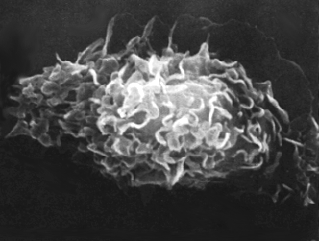 Macrophage (one of those lumenal critters inside YOU)
Though you may not realize it, you have a highly complex and diverse microbial ecosystem living in the deepest recesses of your bowels.
The adult human body contains an estimated 1 * 10^14 cells (a 1 followed by 14 zeros..), 10% of which actually belong to us!! Thus, we have roughly 10 times more cells living in us than we do cells that make up our own bodies. Most of these 'outside' cells are bacteria living in the gastrointestinal tract. More than 400 species of microbes live in the colon alone, and can reach a density of 1 * 10^11 organism per milliliter of 'intestinal lumenal contents.'
-- Courtesy of madsci.org
Sunday, September 11, 2005
BLACK ELK
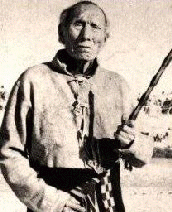
CAMPBELL: … what happened … was that he had a prophetic vision of the terrible future of his tribe. It was a vision of what he called "the hoop" of the nation. In the vision, Black Elk saw that the hoop of his nation was one of many hoops, which is something that we haven't learned at all well yet. He saw the cooperation of all the hoops, all the nations in grand procession. But more than that, the vision was an experience of himself going through the realms of spiritual imagery that were his culture and assimilating their import. It comes as one great statement, which for me is a key statement in the understanding of myth and symbols. He says, "I was myself on the central mountain of the world of the world, the highest place, and I had a vision because I was seeing in the sacred manner of the world." And the sacred central mountain was Harney Peak in South Dakota. And then he says, "But the central mountain is everywhere."
That is a real mythological realization. It distinguishes between the local cult image, Harney Peak, and its connotation as the center of the world. The center of the world is the axis mundi, the central point where stillness and movement are together. Movement is time, but stillness is eternity. Realizing how this movement of your life is actually a moment of eternity, and experiencing the eternal aspect of what you're doing in temporal experience - this is the mythological experience.The central mountain of the world. Olympus. Sinai. Fuji. Sumeru. Elbrus. Horeb. Tabor. Carmel. Gerizim. Kailus. Tlaloc. Gerizim. Uluru. Blanc. Sauvage. The Sermon on the Mount. Golgotha. (Mount as hill.) Temple mounts: the ziggurats of Mesopotamia, Tikal, Palenque, Tibet. (Can anyone out there name others? I'm in a naming mood...)
So, is the central mountain of the world Jerusalem? Rome? Benares? Lhasa? Mexico City?
MOYERS: This Indian boy was saying there is a shining point where all lines intersect.
CAMPBELL: That's exactly what he was saying.
MOYERS: And was he saying God has no circumference.
CAMPBELL: There is a definition of God which has been repeated by many philosophers. God is an intelligible sphere - a sphere known to the mind, not to the senses - whose center is everywhere and whose circumference is nowhere. And the centre, Bill, is right where you're sitting. And the other one is where I'm sitting. And each of us is a manifestation of that mystery. That's a nice mythological realizaiton that sort of gives you a sense of who and what you are.
Power of Myth, pp. 88-89
As for the intelligible sphere, here, there, everywhere: for some reason this puts in mind (at least my mind today) Cantor's paradox: that in an infinite set of numbers, there are as many odd numbers as numbers. Likewise, in an infinite number of beings, there would be as many odd beings as beings. Which makes an odd being like myself feel less alone. I think I'll go back to my reading now.
(For more on the life of that Sioux shaman Black Elk, see here and here. For a translation/scription of Elk's Earth Prayer and Mountain Vision (and poetic these are, indeed), see here.)
Thursday, September 08, 2005
JOSEPH CAMPBELL: THE POWER OF MYTH
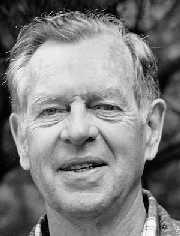 MOYERS: Human beings subscribe to one or more of these stories of creation. What do you think we are looking for when we subscribe to one of these myths?
CAMPBELL: I think what we are looking for is a way of experiencing the world that will open to us the transcendent that informs it, and at the same time forms ourselves within it. This is what people want. That is what the soul asks for.
MOYERS: You mean we are looking for some accord with the mystery that informs all things, what you call that vast ground of silence which we all share?
CAMPBELL: Yes, but not only to find it actually in our environment, in our world -- to recognize it. To have some kind of instruction that will enable us to experience the divine presence.
---------------------------------------
MOYERS: You say that mythology is the study of mankind's one great story. What is that one great story?
CAMPBELL: That we have come forth from the one ground of being as manifestations in the field of time. The field of time is a kind of shadow play over a timeless ground. And you play the game in the shadow field, you enact your side of the polarity with all your might. But you know that your enemy, for example, is simply the other side of what you would see as yourself if you could see from the position of the middle.
MOYERS: So the one great story is our search to find our place in the drama?
CAMPBELL: To be in accord with the grand symphony that this world is, to put the harmony of our own body in accord with that harmony.
MOYERS: When I read these stories, no matter the culture or the origin, I feel a sense of wonder at the spectacle of the human imagination groping to try to understand this existence, to invest in their small journey these transcendent possibilities. Has that ever happened to you?
CAMPBELL: I think of mythology as the homeland of the muses, the inspirers of art, the inspirers of poetry. To see life as a poem and yourself participating in a poem is what the myth does for you.
-- Joseph Campbell with Bill Moyers: The Power of Myth pp. 53-55
I've had The Power of Myth on my shelves for a good 15 years now, after picking up a remaindered copy in Toronto for $10. After I flipped through its pages, looked at the beautiful illustrations, read the odd bit here and there, it went back on my shelves and remained there (although those same shelves have been moved at least 6 times, with my address). I also have The Hero With a Thousand Faces (half read) and a volume of his Masks of God series (unread), and a rare treasure picked up at a garage sale, tapes of a pair of lectures he made at Big Sur two weeks after the moon landing in 1969: fabulous walkman listening that made washing dishes a most stimulating exercise for a good week or so.
For a poet I've had only an intermittent passion for this kind of material. Curious. But after reading much of Bly's American Poetry: Wildness and Domesticity, I decided I had to become more conversant with that stuff, even if in a most casual, inexpert way. The Power of Myth was an obvious place to begin.
Consisting of transcripts of interviews with Bill Moyers about a year before Campbell's death and aired on PBS in 1986, I'm sure the book has been characterized as a "dumbing down" for the public. But as you can see from the excerpt above, its contents are not so dumb as all that. Indeed, I would describe it as not only a good primer for his earlier and more elaborate works, but a fabulous re-crystallization and final summing up of his ideas. Some day this book may be ranked with Plato's Dialogues and Ouspensky's In Search of the Miraculous as one of the great written discussions between a teacher and student about the problems and mysteries of life. For me, there's no need for the passive tense here -- it already is. (Can anybody out there suggest any others?)
Looking around the net, I see that Campbell has his detractors. (I feel like I'm writing about myself here …) His work is now considered dated, critics have chipped away at his theory of the monomyth (i.e. the hero that underlies all myths), exposed a number of faulty sources, and taken him to task for his anti-monotheistic bias; a few have gone so far as to accuse him (I think unfairly) of anti-Semitism. It would stand to reason, though, that to open himself up to Eastern and Aboriginal traditions to the extent that he did, a man born in America in 1904 would have had to decisively tear aside the oppressive mantle of the religious traditions -- not to mention prejudices -- he grew up with. And like the scientist Aristotle who apparently didn't know how many teeth were in a woman's head, this great generalist occasionally let accuracy fall in his pursuit of breadth and depth. But Campbell had a poet's vision. He was a true academic visionary. His knowledge was encyclopaedic, and his ability to perceive parallels with the present day was -- well, unparalleled. For a poet living in North America in 2005, his works still serve as perhaps the best way to familiarize oneself with that mythological material, much as Frazer's Golden Bough served Eliot, Pound, and Yeats almost century earlier. (Again, can anybody suggest any others?)
Wednesday, September 07, 2005
Amazing Colours...
I can't help but admire his analogy, although my own reading of what I understand to be "post-avant" poetree is so limited I wouldn't capable of coming up with such a sweeping characterization...yet...
...But then I don’t think that a lot of what the post-avant is doing is poetry at all, so much must be judged on its own merits as wordplay and semantically meaningless mouth-music and relatively artless concoctions of sound and syllables bereft of sense. Which can be nice, in a way, in the same way that oily scum floating in puddles can, for brief moments, reflect amazing colors. But I wouldn’t want to drink it and I sure couldn’t live on it.-- Chris Lott, Cosmopoetica, August 20
Tuesday, September 06, 2005
MORE ON KATRINA
Ron Silliman's post yesterday on the Katrina disaster is probably the best summation of the underlying socio-political problem I've read, Seth Abramson not withstanding. A number of you have doubtlessly already read this, but as Silliman posts so much and I can't seem to link to a specific date on his blog, I quote here:
Vis-a-vis my remarks abouit "not lifting a finger" a couple of posts back: My heart goes out to the victims, whose plight I see on the news every day, so those remarks now pain me more than ever (and they pained me at the time). Money, however, is not exactly lacking south of the border. I continue to believe that my personal $$ contributions, small as they could be, are better sent elsewhere. But I do send daimoku... and this I'd say is rather more than "lifting a finger".
...I will say one thing, though, at this early stage. The fault for this disaster doesn’t belong entirely to George W. Bush, even tho he and his thugocracy of a cabinet seem to have blundered for days before they understood that they had a problem. Nor is it entirely those of state and local officials. The levees in New Orleans were built to withstand a level 3 hurricane. Who among us doesn’t believe that every location on the Gulf of Mexico and Southeastern U.S. isn’t going someday to have to deal with a direct hit from a level 5?Whew! So true. For those who wish to donate, here's a link to the American Red Cross (also courtesy of Ron Silliman's site.)
Who in San Francisco doesn’t believe that the city will someday be hit with an earthquake every bit as large as the 9.0 that struck southeast Asia last December, setting off the tsunami? Yet there are thousands of San Franciscans living today in brick buildings. In a major earthquake, the mortar between bricks crumbles and the building simply falls on your head, World Trade Center style. That’s another disaster just waiting to happen. Nobody does anything about it because nobody wants to displace the 30,000 or so people who are – let’s face it – the least economically viable people in San Francisco, the least able to cope with that sort of dislocation. Every metropolitan area in the country has some pending disaster on a like level just waiting to happen. On a clear day, you can see the steam plumes from the Limerick nuclear power plant’s cooling towers in our skies here. In case of a meltdown, all the refugees from Pottstown & Phoenixville are supposed to crowd into our high school auditorium. Good fucking luck.
In the 1970s, a very evil man by the name of Howard Jarvis started the tax revolt that has driven the political right’s economic platform from Ronald Reagan – the president who claimed that government was the problem, not the solution – to George W. In between, more than a few others, such as Bill Clinton, have found it convenient to pander to the same general forces. All governmental institutions in the U.S., regardless of level or purpose, are underfunded. We have troops in Iraq buying armor with their own meager funds. We have a space program today that couldn’t safely land a man on the moon if it tried. We have a president who cut flood relief funds for New Orleans by 44 percent. In the 27 years since California put into place Proposition 13, it has seen its education programs – the very state institution on which California’s wealth has been built – nearly starved to extinction.
The disaster in New Orleans was not unforeseeable. But nobody has ever put the resources in place that would be capable of responding to something on this scale, even if it were done correctly. That it was done badly only exacerbates the catastrophe that was lurking all along.
It’s not just the politicians here who are to blame. It’s the fearful, greedy, inner tyrant in every one of us. Every politician – and every voter – who ever voted for a tax cut has blood on their hands this week. Those who have built careers on this may have a little more, as do those who have funded them, but it’s a problem for which we all have to take responsibility. The stench of it is the smell of death rising up from southern Louisiana & Mississippi, rubbing our own noses in our collective handiwork.
Vis-a-vis my remarks abouit "not lifting a finger" a couple of posts back: My heart goes out to the victims, whose plight I see on the news every day, so those remarks now pain me more than ever (and they pained me at the time). Money, however, is not exactly lacking south of the border. I continue to believe that my personal $$ contributions, small as they could be, are better sent elsewhere. But I do send daimoku... and this I'd say is rather more than "lifting a finger".
Sunday, September 04, 2005
PABLO - LAS VIDAS DE UN POETA
 Two days ago at the Montreal Film Festival, saw Pablo -- The Poet's Lives, an impressionistic documentary of his life as seen through the eyes of friends of the poet, other poets and artists, and people of Chile. A warm, earthy Chilean/Italian production directed by Dario Baldi (movie credits in Italian, oddly enough, with voice over/subtitles in English). Good views of the desert at Palo Alto, the ocean at Isla Negra, Santiago and Valparaiso accompanied by voiced over readings of Neruda's poetry. Loved his poem about the stairs of Valparaiso, accompanied by panning of those stairs and the breathaking views of that cliffside city and the sea. (Never knew, though, that Valparaiso was so seedy -- it looks about as bad as Havana or Managua...)
I of course have lots of bilingual editions of Neruda -- translated by Bly, Wright, Belitt, Walsh, Merwin, Reid, etc. It was because the power and richness of Neruda's and Vallejo's poetry that I went down to Mexico and Guatamala umpteen years ago -- actually 19 years ago now -- to learn Spanish, so I could appreciate those poets in the original, and get a taste of the tremendously variagated world that inpired them. Neruda was one of those hugely prodigious geniuses, comparable to Balzac or Beethoven or Michealangelo: his collected works amount to over 3000 pages, much of it fabulous, none of it weak. I think it was Bly who described him as a skindiver of the subconscious who never needed to surface for air, so confident and rich his surrealistic mastery, from the lush and dense Residence on Earth to the spare and simple Elemental Odes. He did it all -- fantastic love poems, ferocious political poems, the history of all of Latin America in verse, + poems about socks or shoes or a watermelon -- a poet whose expression came out of his entire being. One of the commentators in the movie -- his biographer, forgot his name -- said he was an extremely useful poet: that people quoted lines of his poems to seduce their lovers. How many poets can call themselves useful? One reader, though, evidently had hanged himself over a copy of one of Neruda's darkest poems -- this, the film said, drove home a lesson to the poet about his responsibility. I guess it would... (I do have trouble, though, that Mr. Neruda accepted the Stalin Prize, and remained strangely silent about the abuses of the USSR -- where was his entire being then? Or as Irving Layton put it in one of his poems, Pablo, what happened to your bullshit detector? Neruda, though, was what I'd call an oyster communist: a communist who loved oysters....)
On the way down to the movie, I took and read a copy of his Captain's Verses, just to get in the mood. What struck me once again was that through all the highs and lows and passions he expresses, was the peculiar even-temperedness, an absence of vulnerability. It's like riding on a journey through mountains and jungles on a Rolls Royce with the most cushy shock absorbers imaginable. Or like watching a cartoon character who has ten ton weights crush him, runs up mountains, falls off cliffs, and yet comes out in the next scene bouncing along as exuberant as ever. A huge contrast can be made with, for instance, a Vallejo or Jiminez. I'd like to illustrate that with an example or two, but I'm getting tired, and have a long -- but pleasant -- day tomorrow. (After a Buddhist meeting, I'm taking off to a cottage again for a couple of days...) Be it known that the film was a somewhat tedious pleasure -- all these people praising the poet to the skies! I'm reminded though of one of the charms of Latin America. Tell a pretty, unread girl you're a poet, and she's likely to say, "You must be a very sensitive person." (This actually happened to me, in Guatemala.) How often will you get that in North America?
Saturday, September 03, 2005
Leaves my heart feeling so cold...
Beyond posting the links below, I haven't lifted a finger, nor intend to. Figure the world's richest nation really ought to take care of their own.
Friday, September 02, 2005
For a thought-provoking critique on the Bush government's & media's poor handling of the Hurricane Katrina catastrophe, see here. (Thanks to Josh's blog.) David Leftwich at Eclectic Refrigerator also returns after a long absence to weigh in with his comments, informative links, and breaking news from Houston, where he lives.
Thursday, September 01, 2005
DEATH
It is a white frame house, freshly painted, on a gentle hill. It has no windows, except a little room at top with two tiny round portholes, curtains closed, like shut eyes. Around the house, yellow grass. There are no trees, no neighbours. We are standing in front. "This is our house." These words come as a thought, not from you, not from me. It is understood that here is where we will spend our lives. We go inside, me leading the way. In the darkness, we see ornate heirloom furniture, heavy grandmothery armchairs and sofas with doilies on their backs. The air is musty, suffocating. We need to get out - fast.
We are outside. The sunlight is brilliant. The house is blinding white, too white to look at. All around, an empty yellow plain, leading to a flat, featureless horizon. We have set up a table. On it we have gathered remaining things from our previous life - file folders, candles, some pots, a few odd mugs, two broken pencils, a clock with no hands. We intend it as a garage sale. But it is clear that no one will come to buy.
-- published in The New Quarterly #95 (Summer, 2005)
Subscribe to:
Posts (Atom)
All of which is to say that we have a choice between:
a) here, bend over while I preen the lice out of your fur, and
b) HOO HOO HOO HA HA HA HEE HEE HEE YAAAAOOOOW (GNASH GNASH GNASH)!!!