Although books outnumber chapbooks on my shelves by at least two dozen to one, the chapbook has always struck me as a format most germane to poetry: the intensity of the form lends itself to short draughts. Looking at all the unfinished collections on my shelves, as well as all those I have read in full to which I might return to reread a handful, I could easily say that in every full-length book of poetry, I find a chapbook I could call my own.
Eric Folsom's Northeastern Anti-Ghazals is a chap I picked up at the last League of Poets' AGM in Edmonton. I read the poems with great interest a couple of months ago, and now am rereading them and enjoying them all the more. Especially arresting is the diamond-like particularity of many of those couplets, i.e. observations like:
Inside where I stand, one cobweb on the ceiling
Delicately twists when the furnace comes to life.
or the suggestiveness of
Labouring with love for love, the wedding ring
On the spice shelves while I do the dishes.
... and the frequently mysterious leaps between those couplets.
The Ghazal, according to my Dictionary of Poetic Terms, is a Near Eastern verse form, celebrating love and drinking, composed of 5 to 12 couplets, the last of which contains the author's name. One feature of them is a spirit of intensity and compression that brings to mind the haiku; according to Kate Braid & Sandy Shreve's In Fine Form, traditional ghazal couplets are never enjambed; and in fact were so independent of each other that their order could be changed without damaging the poem.
Eric tells me (we corresponded by e-mail) that the “Anti” part in the title "is a nod to Phyllis Webb, who first used the term to acknowledge that she was really writing a highly westernized version of the ghazal, not recognizable to most Arabic poets, and one might presume Persian, Urdu, or Hindi." (Possibly English haikus could be called an anti-haikus for the same reason.) His poems tend to take the form of understated, sharp observations: drinking is not a primary feature of them, although definitely love figures prominently, in a restrained sort of way; I see no enjambment between couplets, however, and although none of the poems includes his name, many of the poems end with a first-person self-reference.
Speaking of those leaps between couplets, I am reminded of a passage by one Idis Parry quoted in Alan Watt's The Book:
What guarantee is there that the five senses, taken together, do cover the whole of possible experience? They cover simply our actual experience, our human knowledge of facts and events. There are gaps between the fingers; there are gaps between the senses. In these gaps is the darkness which hides the connection between things... This darkness is the source of our vague fears and anxieties, but also the home of the gods.
In a number of the poems, one is left guessing about why the various couplets are sewn together. In others, a multiplicity of connections is possible. In their cryptic construction, ambiguities abound. Clearly, this is a form that takes risks, but can also bring great rewards. In the following poem, for instance, the reader is forced to shift gears emotionally as well as logistically with the shifts in points of view. It is the mind’s hunger for context that finds an implied narrative in the juxtapositions:
THE WISE
She wore a scent like blue light bulbs,
Wore her coat the way trees wear hills.
After the bloodiest campaign in years,
His heart smouldered like an old cigar.
His eyes put down roots for the first time,
The light of crows in his hair.
Every influence caught her off-guard:
A vaginal infection, the phone calls.
He courted his own grief,
He thought she would be his second wife.
No angry objects on this table,
No jack-in-the-box anger from your lips.
I love your failure to communicate,
I love your naked back facing me.
Each of these couplets, of course, could be a separate epigram: a hallmark of the form. The second one, for instance, could be about Donald Rumsfeld. But considering that the first five couplets shift between a man and a woman, a very intense war between the sexes is set up. The second last couplet is a particularly brilliant one: it can be taken as both a climax of the implied narrative, and negation of the tension, depending on whether one takes it as a command or an observation. Considering the intensity of the previous couplets, and of that image of “jack-in-the-box anger” that quite literally shoots out from the page, it commands attention, in any case; even when one says “there is no anger”, presence of anger is invoked. Similarly the title, “The Wise”: is it ironic? Does it suggest the process these characters must go through to become wise? The denouement is a lovely one, a celebration of beauty, and yet an unresolved tension: it could be taken as playfully tender, or deeply ironic, all at once.
Googling Eric and ghazals, I found this link, where you can read articles by Eric and others about the form, as well as a couple of other poems from the collection, including a personal favourite, "Just Another Yuppie Raising Children".
North-Eastern Anti-Ghazals is (on the surface of it) a plain production on ordinary paper comprising 15 poems; it is, as with all chapbooks, one of those instant rarities. Published by above/ground press in Ottawa, it can be obtained here.
Showing posts with label Dictionary of Poetic Terms. Show all posts
Showing posts with label Dictionary of Poetic Terms. Show all posts
Tuesday, December 25, 2007

Thursday, March 08, 2007
Like a Sponge, or rather, Ponge...
 Francis Ponge
Thursday, February 15, 2007
Rooms with views
According to my Dictionary of Poetic Terms (right now I'm nearing the end of "S"), the word stanza comes from the Italian for "stopping place" or "room".
I've thought of stanzas (verse paragraphs, if you will) as "frames", but not inns or rooms.
Inn is a little hard to get one's mind around. Where will the reception desk be, and will there be a bar? Where the sleeping quarters? Does one even want sleeping quarters in a poem? Or alternatively -- would stopping place mean snack bar, bus shelter? A nook, mountain lookout? (That appeals to me.)
Rooms: I like that, creating rooms -- or a series or rooms -- with words. Let's see, how high will the walls be? Will the floors be level with the ceilings? As one walks into house that is the poem, will the rooms get bigger, or smaller, or all stay the same size? And what's a one-line stanza -- a crawl-space?
Sunday, October 29, 2006
The Unstated Cliché
The following is from a lengthy mini-essay on effective uses of cliché, in the Dictionary of Poetic Terms:
The Unstated Cliché
Sometimes a poem will have a cliché as its unstated theme. In the following poem by Thomas James, there lurks in the background the aphorism “Silence is Golden”, but the way in which James expresses this clichéd statement is utterly new and beautiful.
LETTER TO A MUTE
If I could reach you now, in any way
At all, I would say this to you:
This afternoon I walked into a thicket
Of gold flowers that had no idea
What they were after. They couldn’t hear a thing.
I walked among a million, small, deaf ears
Breaking their gold into the afternoon.
I think they were like you, golden, golden,
Unable to express a single thing.
I walked among them, thinking of you,
Thinking of what it would be like
To be completely solitary. Once I was alone like that.
All the field was humming, brimming
With some brazen kind of song, and I
Thought that somehow I could disappear
Into the empty hall of your right ear.
Wandering through the slender bones of you.
But I know that I could never let you know
That it is late summer here, that I
Can hear the crickets every evening
Hollowing out the darkness at my window
That you have vanished into a dark tunnel
Where I have tried to reach you with my mouth
Till my mouth ran gold, spilling over everything.
Tonight I looked into your face, tenderly,
Tenderly, but I could never find you there.
I could only touch your quiet lips.
If I could stick my pen into your tongue,
Making it run with gold, making
It speak entirely to me, letting the truth
Slide out of it, I could not be alone.
I wouldn’t even touch you, for I know
How you are locked away from me forever.
Tonight I go out looking for you everywhere
As the moon slips out, a slender petal
Offering all its gold to me for nothing.
Friday, October 27, 2006
Anticipatory line endings
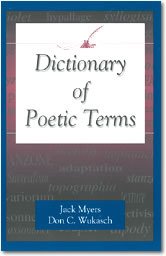 During the last few weeks I've been reading -- on an almost daily basis -- the Dictionary of Poetic Terms by Jack Myers and Don. C. Wukash, which I ordered direct from U. of North Texas Press back in September. I'm really enjoying it, and yes, I've decided to read it straight through from A to Z, with little side trips up into higher ranges of the alphabet to follow up cross-references that pique my curiosity. Right now I'm in the middle of letter C. I suppose at the rate I'm going I'll be finished by mid-March. Then I will know everything there is to know about poetry, and stop writing then and there. (Right?)
The entries are well-written and as broad in scope as you can imagine -- on history, poetics, devices, etc. featuring citations from the ancients to contemporary poets quite young. At times whole poems are cited, most of them superb and a number by poets I've never had the pleasure to read before. Included are excellent mini-essays on things like Fractured Narrative, Free Verse, Clichés, Cinematic Techniques (this would interest Charles), Juxtaposition, Meter, etc.
Here is a useful entry I found under the letter A:
anticipatory line ending (see LINE ENDING), a type of ENJAMBMENT in which the information is purposely delayed in order to heighten the reader's expectations. The a.l.e. can be formed by any part of speech when a sentence, phrase, or syntactical unit is cut off from completion. "He went into/the store of/his/desires." The device can be overused, become annoying, or appear illogical if it occurs too soon or too consistently in a poem.Funny, it was the effective use of a.l.e. that I was admiring in a review of Barbara Pelman's poetry a little over a year ago, but in a rather round-about way, because I was frankly unaware that a term had been coined for the device. I wonder though how many other poets and even academics are unaware of that term? (The review ended up being published -- in refined form -- in the Pacific Rim Review of Books, so obviously it didn't suffer too much from my ignorance.)
A, by the way, was heavy going at times. with all kinds of arcane -- and highly forgettable -- rhetorical and otherwise technical terms to wade through: antimetabole, antiphrasis, antirhesis, antisagoge, autonomasia, aphaeresis, apocarteresis, apomnemonysis, apophasis, etc. (Enough to give one apoplexy, in other words.) What it did prove to me is that whatever attitude or emotion a poet may express, the rhetoricians have identified and found some label for it, a ready tool to brand, delimit, and dissect.
All this to a practitioner of the art can be rather disconcerting.
I'm told that the experts of Japanese martial arts over the centuries compiled terms for more than 60 different kinds of kicks below the knee. Of what use could all that knowlege have been to a working samouri warrior? Ultimately, like oriental kicking terms, the rhetorical terms are, as I said, highly forgettable, best looked at and for the most part forgotten. Of what use were they to the likes of Shakespeare, Shelley, Plath, and Thomas, who without knowing them provided the most shining examples?
Subscribe to:
Posts (Atom)