Showing posts with label American Poetry. Show all posts
Showing posts with label American Poetry. Show all posts
Sunday, December 15, 2013
SUNDAY POEM
MY SKELETON
by Jane Hirshfield
My skeleton,
you who once ached
with your own growing larger
are now,
each year
imperceptibly smaller,
lighter,
absorbed by your own
concentration.
When I danced,
you danced.
When you broke,
I.
And so it was lying down,
walking,
climbing the tiring stairs.
Your jaws. My bread.
Someday you,
what is left of you,
will be flensed of this marriage.
Angular wristbone,
cracked harp of ribcage,
blunt of heel,
opened bowl of the skull,
twin platters of pelvis–
each of you will leave me behind,
at last serene.
What did I know of your days,
your nights,
I who held you all my life
inside my hands
and thought they were empty?
You who held me all my life
inside your hands
as a new mother holds
her own unblanketed child,
not thinking at all.

Sunday, October 13, 2013
SUNDAY POEM
W.S. MERWIN
___________________________________________________
THANKS
Listen
with the night falling we are saying thank you
we are stopping on the bridges to bow from the railings
we are running out of the glass rooms
with our mouths full of food to look at the sky
and say thank you
we are standing by the water thanking it
smiling by the windows looking out
in our directions
back from a series of hospitals back from a mugging
after funerals we are saying thank you
after the news of the dead
whether or not we knew them we are saying thank you
over telephones we are saying thank you
in doorways and in the backs of cars and in elevators
remembering wars and the police at the door
and the beatings on stairs we are saying thank you
in the banks we are saying thank you
in the faces of the officials and the rich
and of all who will never change
we go on saying thank you thank you with the animals dying around us
our lost feelings we are saying thank you
with the forests falling faster than the minutes
of our lives we are saying thank you
with the words going out like cells of a brain
with the cities growing over us
we are saying thank you faster and faster
with nobody listening we are saying thank you
we are saying thank you and waving
dark though it is
___________________________________________________
THANKS
Listen
with the night falling we are saying thank you
we are stopping on the bridges to bow from the railings
we are running out of the glass rooms
with our mouths full of food to look at the sky
and say thank you
we are standing by the water thanking it
smiling by the windows looking out
in our directions
back from a series of hospitals back from a mugging
after funerals we are saying thank you
after the news of the dead
whether or not we knew them we are saying thank you
over telephones we are saying thank you
in doorways and in the backs of cars and in elevators
remembering wars and the police at the door
and the beatings on stairs we are saying thank you
in the banks we are saying thank you
in the faces of the officials and the rich
and of all who will never change
we go on saying thank you thank you with the animals dying around us
our lost feelings we are saying thank you
with the forests falling faster than the minutes
of our lives we are saying thank you
with the words going out like cells of a brain
with the cities growing over us
we are saying thank you faster and faster
with nobody listening we are saying thank you
we are saying thank you and waving
dark though it is
Monday, May 31, 2010
Thanks to Peter Pereira, an excellent article written by David Biespiel. Check it out:
Now consider the balkanized world of American poetry. Like Americans everywhere, America's poets have turned insular and clustered in communities of aesthetic sameness, communicating only among those with similar literary heroes, beliefs, values, and poetics. Enter any regional poetry scene in any American metropolis or college town, and you will find the same cliquey village mentality with the same stylistic breakdowns. Over here you have the post-avant prose poets, over there the kitchen-sink confessionalists, and across the road are the shiny formalists--and no one ever breaks bread together. As with politics, where you have "I'm voting for That One" liberals and "Time for a Tea Party" conservatives, poetry has evolved into a self-selected enclave, and also--exactly like other sectors of American life--it has stratified into enclaves within enclaves that are hyper-specific and self-referential.
Is the Canadian poetry world as balkanized? Precisely because there aren't as many of us here, the blurring of distinctions between us is more apparent than in the US, where, owing to sheer numbers, the illusion of self-referential, polarized camps is more easily maintained.
Now consider the balkanized world of American poetry. Like Americans everywhere, America's poets have turned insular and clustered in communities of aesthetic sameness, communicating only among those with similar literary heroes, beliefs, values, and poetics. Enter any regional poetry scene in any American metropolis or college town, and you will find the same cliquey village mentality with the same stylistic breakdowns. Over here you have the post-avant prose poets, over there the kitchen-sink confessionalists, and across the road are the shiny formalists--and no one ever breaks bread together. As with politics, where you have "I'm voting for That One" liberals and "Time for a Tea Party" conservatives, poetry has evolved into a self-selected enclave, and also--exactly like other sectors of American life--it has stratified into enclaves within enclaves that are hyper-specific and self-referential.
Is the Canadian poetry world as balkanized? Precisely because there aren't as many of us here, the blurring of distinctions between us is more apparent than in the US, where, owing to sheer numbers, the illusion of self-referential, polarized camps is more easily maintained.
Thursday, September 20, 2007
BAP: Best American what???
The 2007 BAP is out, and Jim Behrle shows us how hilarious it can be. This guy can be a riot -- and his posts on this volume show him at his best. (As for the BAP, this year, by the looks of it, shows it at its worst.) For the record (since Behrle posts a lot) I especially like this one, this one, this one and most of all, this one. "He's invented a new kind of poem for people who HATE poetry: PROSE POEMS! Short enough for stoned readers. A cute little emotional twinkee!!" When I read this, I almost fell off my chair laughing.
Jeffery Bahr, meanwhile, breaks down the BAP socio-economically, demographically, in terms of batting averages and bases on balls. (No kidding -- well, almost.) He even has an overall team standing: this ongoing breakdown of literary journals with relation to BAP.
So if you want to make a name for yourself & get on the USA poetry scoreboard, these are the ones to send to.
I wonder if Bahr'll tackle the Norton next? (The posterity scoreboard.)
These links courtesy of C Dale Young, by the way.
Jeffery Bahr, meanwhile, breaks down the BAP socio-economically, demographically, in terms of batting averages and bases on balls. (No kidding -- well, almost.) He even has an overall team standing: this ongoing breakdown of literary journals with relation to BAP.
So if you want to make a name for yourself & get on the USA poetry scoreboard, these are the ones to send to.
I wonder if Bahr'll tackle the Norton next? (The posterity scoreboard.)
These links courtesy of C Dale Young, by the way.
Sunday, July 29, 2007
Introspections
 I just finished Introspections: American Poets on One of Their Own Poems, edited by Robert Pack and Jay Parini. (Believe it or not, I read this book from cover to cover over the space of three years. I ordered it when Charles highly recommended it in a comment on this blog.) In it some 55 poets -- some eminent, others established, still others "up-and-coming" -- select a poem and then write a brief article on some aspect of writing it. How illuminating! How insightful about the creative process! It also introduced me to a number of excellent poets and poems.
The contents highlights contain a number of famous names, but as in many an anthology or literary revue, some of the stellar contributions are by relative unknowns. My personal highlights (poems and essays that quite set my mind on fire) include -- following the alphabetical order format of the book -- David Baker, "Still-Hildreth Sanatorium, 1936"; Stephen Dunn, "The Guardian Angel"; David Huddle, "Basket", Erica Jong, "The Buddha in the Womb"; J.D. McClatchy, "My Mammogram"; Wyatt Prunty, "The Ferris Wheel", Sue Ellen Thompson, "What Happened After"; Eric Trethewey, "Scar"; Nancy Willard, "Questions My Son Asked Me, Answers I Never Gave Him"; Miller Williams, "Adjusting to the Light", and Clara Yu, "Little Purple".
Still others wrote excellent expository pieces about poems that made them much more accessible and memorable -- i.e. , Thomas Swiss on "On a Stanza by Rilke", Richard Wilber on "Bone Key", Robert Pinsky on "Desecration of the Gravestone of Rose P.", Catherine Soniat on "The Captain's Advice to Those Heading for the Trees". Some poets shed light on pieces so private in nature that they would otherwise been quite hermetic: Ellen Bryan Voight's "Kyrie", W.D. Snodgrass's "Lifelong", Lynne McMahon's "For Gabriel, Falling Through Glass and Ice". Peter Balakian's "The Oriental Rug" is in many ways a marvelous poem, but rendered all the more so by "Falling into a Rug", an essay I actually liked better, which filled us in on the biographical and historical importance of that rug. In a number of cases I liked the essays far better than the poems they were written for. I should add too that there were a number of duds (and as luck would have it, most of these are in the first half of the volume, one reason it took me so long to go through it) -- prosy poems and stuffy expositions which one might expect of professor poets. A.R. Ammons and Mark Strand, poets I admire, disappointed with rather perfunctory contributions.
The glory and woe of poetry is its implicitness of context, or even lack thereof: poems make great demands on the reader to bring cultural and even personal context to them. All too often the intensity of that demand, even for me, can be too much. Prose makes sure it fills us in on what's going on. That's why I often like prose to be included in a book of poems: it gives a breather. A volume like this one gives the lie to the notion, popularized by the New Critics, that only the poem counts, and that the poet's experience is of little relevance to a critical appreciation of the poem. The blog format offers the opportunity for poets to provide valuable commentary on their own work -- and this book, as far as I'm concerned, serves as a model.
Wednesday, July 18, 2007
Easy Readin' Poet #2: Robert Creeley
 Famous for pared-down poems wherein every word, every syllable counts (and usually in more ways than one), Creeley is nevertheless an easy read. I ordered his Selected shortly after he died in 2005, and started reading it in earnest last September. (Death and big prizes are the only mainstream PR poets get, and I must admit I'm as affected as any). I haven't finished yet -- set the book aside after reading about two-thirds of its 350-odd pages -- but for a while I was reading and savouring one poem after another during waits for buses, short subway rides, coffee breaks and even commercials on The National and The Daily Show. Considering how fragmented our attention spans have become, poets like him make me wonder why more folks don't read poetry these days. But then, most people, I'm afraid, really don't like to think that intensely, even if only for a few minutes.
Speaking of that commercial -- or rather anti-commercial -- connection, here's a quote from an obit in the Guardian:
Rejecting the language of a mass America lost to "gray emptiness, bled out in congealing dollars and the victim of its own static habits", he sought value in "the intimate, familiar, localising, detailing, speculative, emotional, unending talking that has given my life a way of thinking of itself in the very fact and feeling of existence. God knows one wants no end to that ever."The most oft-quoted poems are the epigram-like ones -- those that fit snugly at the end of a newspaper column. See, for instance, the poem at the end of that obit -- a favourite of mine. Here though is one in a more relaxed mode. When you title a poem "The Moon", you'd better do something damned original with it. I think Creeley succeeds here.
THE MOON
Earlier in the evening the moon
was clear to the east,
over the snow of the yard
and fields---a lovely
bright clarity and perfect
roundness, isolate,
riding as they say the
black sky. Then we went
about our businesses of the
evening, eating supper, talking,
watching television, then
going to bed, making love,
and then to sleep. But before
we did I asked her to look
out the window at the moon
now straight up, so that
she bent her head and looked
sharply up, to see it.
Through the night it must
have shone on, in that
fact of things---another
moon, another night---a
full moon in the winter's
space, a white loneliness.
I came awake to the blue
white light in the darkness,
and felt as if someone
were there, waiting, alone.
Wednesday, November 15, 2006
Lowell via Jamison
The first Jamison book I read was not her An Unquiet Mind, but the textbook she co-wrote with a colleague (Frederick Gay Godwin), named simply Manic Depressive Illness. An enormous tome that amasses pretty well all the significant data on the condition gathered up to the date of its publication (1990), at least 4/5ths of it I could only give a quick skim, as it consisted of dry summaries of clinical studies whose results are, of course, significantly out of date. What I did find fascinating were the testimonies of patients (some of them -- anonymous at the time-- actually revealed later to be those of Jamison herself, and incorporated into Unquiet Mind) as well as the chapter on the bipolar condition in the arts (later fleshed out in Touched by Fire.)
Robert Lowell was cited quite frequently. Indeed it impressed me how valuable a contribution his eloquent testimony has made to an understanding of the condition.
I have been out of my excitement for over a month, I think, now, and am in good spirits, though I don’t feel any rush of eloquence to talk about the past. It’s like recovering from some physical injury, such as a broken leg or jaundice, yet there’s no disclaiming these outbursts – they are part of my character – me at moments… the whole business was sincere enough, but a stupid pathological mirage, a magical orange grove in a nightmare. I feel like a son of a bitch.
(Lowell, cited in I Hamilton, 1982, p. 218)*
Lowell, born into an old-line Boston family, where “Lowells talk only to Cabots and Cabots talk only to God,”, wrote poignantly on his fall from “pedigreed tulip to weed” in his painful recovery. Perhaps now I'll look over much of his later poetry -- which I previously felt represented a dissolution of his talent -- with a renewed appreciation.
Recuperating, I neither spin nor toil.
Three stories down below,
a choreman tends to our coffin’s length of soil,
and seven horizontal tulips blow.
Just twelve months ago,
these flowers were pedigreed
imported Dutchmen; now no one need
distinguish them from weed.
Bushed by the late spring snow,
they cannot meet
another year’s snowballing enervation.
I keep no rank nor station.
Cured, I am frizzled, stale and small.
*NB, you'll have to look in Manic Depressive Illness to find this bibliographical reference.
Robert Lowell was cited quite frequently. Indeed it impressed me how valuable a contribution his eloquent testimony has made to an understanding of the condition.
I have been out of my excitement for over a month, I think, now, and am in good spirits, though I don’t feel any rush of eloquence to talk about the past. It’s like recovering from some physical injury, such as a broken leg or jaundice, yet there’s no disclaiming these outbursts – they are part of my character – me at moments… the whole business was sincere enough, but a stupid pathological mirage, a magical orange grove in a nightmare. I feel like a son of a bitch.
(Lowell, cited in I Hamilton, 1982, p. 218)*
Lowell, born into an old-line Boston family, where “Lowells talk only to Cabots and Cabots talk only to God,”, wrote poignantly on his fall from “pedigreed tulip to weed” in his painful recovery. Perhaps now I'll look over much of his later poetry -- which I previously felt represented a dissolution of his talent -- with a renewed appreciation.
Recuperating, I neither spin nor toil.
Three stories down below,
a choreman tends to our coffin’s length of soil,
and seven horizontal tulips blow.
Just twelve months ago,
these flowers were pedigreed
imported Dutchmen; now no one need
distinguish them from weed.
Bushed by the late spring snow,
they cannot meet
another year’s snowballing enervation.
I keep no rank nor station.
Cured, I am frizzled, stale and small.
*NB, you'll have to look in Manic Depressive Illness to find this bibliographical reference.
Sunday, April 30, 2006
Howl to you too, babe
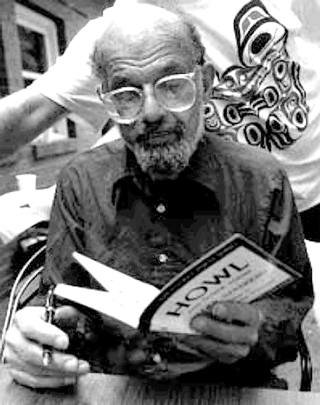
A few days ago friend of mine passed along from the April 9 New York Times Book section a review of The Poem That Changed America: "Howl" Fifty Years Later, a book of reminiscences edited by Jason Shinder.
Here for me is the most memorable passage of that review, particularly the Luc Sante quote starting two paragraphs down (I include the first two paragraphs because they provide some interesting context; the whole review can be found here):
Ginsberg wrote "Howl" in San Francisco and Berkeley; he read the long first section in public for the first time in San Francisco in 1955, and the whole of the poem for the first time in Berkeley the next year. (A CD of that performance is included in this book.) All sorts of divisions, exclusions, restrictive manners and deferences that were second nature in the East were missing in the Bay Area. If the primary terrain of the poem is New York City, the freedom one could find in California in the 50's is crucial to the air that blows through the dank rooms of "Howl," blowing all the way back to New York --but you wouldn't know it from the Eastern writers Shinder has brought together, as if such Bay Area poets and critics as Ishmael Reed,Robert Hass, Rebecca Solnit, Joshua Clover or Richard Candida Smith would have less to say about where "Howl" came from and where it went than Jane Kramer and Eileen Myles, who have plenty to say. The America that gets changed in "The Poem That Changed America" is a Steinberg map, with San Francisco as far away as Tangier. "No one," Marjorie Perloff says off-handedly, but too revealingly, "New Yorker or foreigner. . . . "
You can forget that when Luc Sante begins to tell his tale from 437 East12th Street, which is, as it happens, the same New York City building where Ginsberg lived... Sante changes the discussion as if throwing open a door: "Was 'Howl' the last poem to hit the world with the impact of news and grip it with the tenacity of a pop song?" The language is burning, the ideas are jumping and, finally, you are brought into the adventure of the poem, Ginsberg and his fellows turning New York City into their own frontier, then heading west, through Kansas, into Colorado, to the coast, then back again, discovering, you can feel, more of America in the decade before Ginsberg wrote the poem in 1955 than de Soto, Daniel Boone or even Lewis and Clark did in the centuries before them.
"Reading 'Howl' aloud or reciting it," Sante writes, "you could feel the poem giving you supernatural powers, the ability to punch through brick walls and walk across cities from rooftop to rooftop" faster than a speeding bullet, more powerful than a locomotive, able to leap tall buildings in a single bound, as George Reeves was doing on TV as Ginsberg wrote, just like Scotty Moore's second guitar break in Elvis Presley's "Hound Dog," on Ginsberg's hydrogen jukebox the year that "Howl" first made it into print. Why not? Sante lived for 11 years in Ginsberg's building. He was 36 when he moved out, and when he looks back to that moment, the self-regard of adolescent illumination, so common elsewhere in the pages Sante shares, is replaced by something that doesn't melt at the touch.
"'Howl' probably meant more to me then than ever before," he says, "because finally I could reconcile it with my own experience. 'Poverty' and 'tatters' and 'hollow-eyed' and 'high' were more than poetic figures by then. I could compile my own list of the best minds of my generation destroyed by madness. The decade during which I lived two flights down from Allen was particularly notable for its body count in suicides and overdoses, and those cadavers really had contained some of the best minds I knew. . . . If 'Howl' is a catalog of flameouts and collapses, it is ecstatic in its lamentation. And that is the basic measure of its strength: it is a list of . . . leprous epiphanies as redoubtable as Homer's catalog of ships, but rather than stopping at that, it seizes the opportunity to realize all the botched dreams it enumerates. It envisions every broken vision, supplies the skeleton key that reveals the genius of every torrent of babble, reconstitutes every page of scribble that looks like gibberish the next morning."
Friday, December 02, 2005
REFLECTIONS ON CHARLES OLSON'S PROJECTIVE VERSE
An excerpt from my reply to the letter in the previous post (this was dated June 7, 2004):
Hi Allen,
The best American anthology I have is the old 1960 Grove Press THE NEW AMERICAN POETRY edited by Donald M. Allen. Have been reading it lately -- Olson, Duncan, Ginsburg, etc. Love those statements on poetics. Has there been any real groundbreaker in that area since Olson's PROJECTIVE VERSE? (i.e. linelengths = breathlengths, the page as field...) It seems to me that pretty well all the formal possibilities within the static typewriter/typeface world of Olson's day (and pretty much our day) were outlined there. As we become digitalized, of course, we have juxtapositional possibilities of words and image or even wallpaper background that you could only dream of as you evolved your scissors-and-tape TV (text-visual) series a decade or two ago. Not to forget accompanying soundbites, as poetry enters the domain of multimedia. Even within the restrictive realm of print, variety of fonts and colours available to us -- consider these EXPRESSIVE POSSIBILITIES -- would have been unimaginable in Olson's day. Master a program like Flash and you can have those words going any direction you want, spiralling around, etc. All these are ways we can expand, slickly and seamlessly, on Olson's notions.
I've since acquired the Strand anthology Allen talks about below -- ordered it used from a Virginia bookstore through Amazon.ca for all of $3 (well, with shipping, $7 Canadian.)
Funny, without knowing it at the time, Allen and I were talking about what could be seen as the two key anthologies of post-war American poetry. (If there were others that may be considered key, I just don't know of them.) Between these two, the eleven poets they have in common -- John Ashbery, Gregory Corso, Robert Creeley, Edward Field, Allen Ginsburg, Le Roi Jones, Kenneth Kotch, Denise Levertov, Frank O'Hara, Charles Olson, Gary Snyder -- would suggest a considerable overlap, but both are big anthologies: the Strand anthology comprises 92 poets, and the Allen anthology 44. And indeed, the contrast in tone and argument couldn't be greater. The Strand anthology includes chiefly lyric poets, a lot of them celebrated professor poets that published with big "mainstream" presses and that Ron Silliman lumps into the SoQ (for those who don't know, School of Quietude), including AR Ammons, John Berryman, Robert Bly, Elizabeth Bishop, Donald Hall, Donald Justice, Anthony Hecht, Robert Lowell, Adrianne Rich, Sylvia Plath, Anne Sexton, James Tate, Richard Wilber, and Mark Strand himself. The Allen anthology includes a number of wilder shrubs like Edward Dorn, Robert Duncan, Lawrence Ferlinghetti, Jack Kerouac, Jack Spicer. The Allen anthology is a conceptually bolder and more powerful anthology, delineating for the first time groupings or "milieus" that -- however arbitrary and, as Allen himself put it, "for the most part more historical than actual" -- have remained sharply etched in our mental geography: the Black Mountain group, the San Francisco Renaissance, the Beat Generation, the New York Poets. With its essays on poetics -- including that benchmark essay by Olson -- it is definitely a precursor of Lang Po. The Strand anthology is a pretty typical good-poems -written-by-poets-in-alphabetical-order selection. Globally more inclusive than the Allen anthology, it draws a far diffuser picture. Even the poems selected in the Strand anthology of poets also in the Allen are, are formally speaking, the more conservative poems, or at least look more conservative within the constraints of the shorter selection (i.e. 1-3 poems for most poets) and smaller page size: these poets just don't stand out alongside the Hugos and Wilbers as they could. If anything would argue for the validity of the distinction Ron makes between the SoQ and Avant/post-avant, it would be these two anthologies -- however much he rankles by his obsessive harping on it (and however much I disagree with the way he flings that derogatory term - SoQ - around.)
-- a little post script: funny how much we can overlook in the heat of writing, i.e. when I wrote on that hot June day that "pretty well all the formal possibilities... within the typeface world" were outlined by Olson's essay. What about Concrete poetry? What about -- taking a step "backwards" a moment -- poetic forms or the so-called New Formalism? Actually, what I was referring to was a certain scope of free verse possibility that Olson had opened up for for me over the previous few years...
Monday, May 30, 2005
SYNECDOCHE & VICTORIA CHANG
As I was reading through Victoria Chang's Circle, a half-forgotten term from my U of T English Literature years -- my god! it's twenty-five years ago -- kept nudging its way persistently into consciousness: Synecdoche. My allergic reaction to the overly systematic use of terms like synecdoche, repetend, hypallage -- all part and parcel of the jargon-filled structuralist (it wasn't yet post-s.) criticism so much the academic rage in those days -- was one of a number of reasons I decided not to persue a post-graduate degree in English literature. Now, for all I care, synecdoche and its little brother, metonymy, could be wingers on the Czech Republic hockey team. (I can just hear it: Synecdoche, he passes the puck to Metonymy, back to Synecdoche, he shoots, he SCORES!) But here I kept thinking as I read Victoria Chang's poetry: "synecdoche".... "good synecdoche"... hmm.
Question : how the can one critically apply this stuff every day, have it uppermost in mind, and still write passionate, groundbreaking poetry?
Nope. Still not obvious to me. After all these years.
Answer that one for me if you can...
How weird, I thought.
Here's a simple example, from a simple poem (well, not so simple!) that I very much enjoy. I copied it from her website.
MORNING PORRIDGE
Before the pork buns steamed
in the pot, moisture in their
white folds, before the dried tofu
was trimmed into thin strips,
my father raked long-grain rice
out of the mesh bag, poured a bowl
of porridge, spread dried pork
shreds and salted peanuts into
a heap on top. Each morning
my grandmother listened for steam
rising up the stairs. She reclined
on her bed with the blue hydrangea
pattern I wanted. I handed her
the tray, glanced at the expanding
brown mass on her face. Day
after day, my father told me not to
wear white in my hair, not to leave
chopsticks vertical in a bowl of rice.
I did it anyway. One by one, the raisins
I stole from the box on her bedside table.
Don't you love that image of the vertical chopsticks in a bowl of rice? They stick persistantly into memory -- as I made dinner this evening (and it wasn't even rice), I thought of them. As I went to bed last night (no, I wasn't thinking about sex...), I thought of them. That they would be interpreted as bad, rude, whatever, and that she would be told not to leave them that way, but that she persisted in doing so anyway... isn't that emblematic of venerable Chinese custom, of restriction, of her nascent rebellion? And what of those little raisins she keeps stealing, "one by one"? The atmosphere -- her father's role is so deftly described, her grandmother, the expectations, the restraint, the self-regard.... The only thing that gives me pause (in a doubtful way) is the "expanding brown mass on her face". What is that? A smile? A cancer of some kind? I suppose the porridge...
But those chopsticks. Those raisins. Morning porridge -- morning being the beginning of life, + the pabulum we are all fed with... so emblematic! Yet so limpid, so simple...
Synecdoche. Synecdoche...
Because I am rusty on my rhetorical terminology I actually looked up synecdoche in my yellowing (and yes, dust-covered) Holman's Handbook to Literature, to see if I was remembering right. I am sure that many of you are also rusty -- or perhaps virgins to the intellectual rape that is hard-core structuralist criticism (please allow me the luxury of hard-won prejudices) -- so here, at the risk of being charged with a major offence, it is:
Synechdoche: A form of METAPHOR which in mentioning a part signifies the whole or the whole signifies the part. In order to be clear, a good synecdoche must be based on an important part of the whole and not a minor part and, usually, the part selected to stand for the whole must be the part most directly associated with the subject under discussion. Thus under the first restriction we say motor for automobile (rather than tire), and under the second we speak of infantry on the march as foot rather than as hands just as we use hands rather than foot for men who are at work at manual labor.
Question : how the can one critically apply this stuff every day, have it uppermost in mind, and still write passionate, groundbreaking poetry?
Nope. Still not obvious to me. After all these years.
Answer that one for me if you can...
Saturday, May 28, 2005
A PLUG FOR CIRCLE
Victoria Chang's Circle is one book I just had to order as soon as it came out. I just had to get to know the poetry of/within/behind that extraordinary poet blogger so many of us enjoyed and admired.
I finally got it last week, and finished a first read-through yesterday. (Seems it was delayed... so was another book in the same order, Janet Frame's Angel at My Table, which still hasn't arrived at this table...)
Anyway, it's nice to report that this is one book I'm really glad I did order. Every poem was engaging -- the standout poems, the OK poems, even the poems I felt could have been better realized. Each offered rewards. V Chang definitely offers significant things to learn from a poem-making point of view.
Certain poets make one feel the force of their mastery of one or two elements or strategems common to much good poetry, but which are particularly salient in theirs. Robyn Sarah, as I was saying a few weeks back, makes one feel the force of her concision, of her precise control of conversational language;Victoria Chang makes one feel the mastery of another element: the laying out intelligent clues.
The strongest poems in the collection -- excellent poems by any standard -- were, for me, Yang Gui Fe, Eva Braun at Bershtesgarden, Kitchen Aid Epicurean Stand Mixer, and Lantern Festival. In these a whole life or lives seemed to hang on an image or line, and in almost any given poem, a sequence of deftly placed lines or images outline a deliberate "story" or subtext.
If there are weaker poems in the collection, it seems to me that the clues provided are meagre, arbitary; they don't connect with a sufficiently strong necessity to satisfy me. "The Laws of the Garden" is one; "The Goal" and "Majority Rules" are two others. However, the poem that first appeared in Slate, Holiday Parties, struck me in an annoying way as one of these, but a careful re-reading reveals it to be a remarkable depiction of the social pressures faced by a young woman coming of age in a Chinese American family in the incongruous context of socially-disconnected North America. So at this point word is out on a number of these "insufficient" poems; for me, perhaps, all they deserve is a careful re-reading.
Anyway, I'll leave this as a sketch of a review -- a review in process, if you will, if I ever follow through. Clearly, though, Circle is well worth reading, and re-reading... & Victoria Chang a talented poet worth watching...
Thursday, March 31, 2005
ROBERT CREELEY R.I.P.
It is hard going to the door
cut so small in the wall where
the vision which echoes loneliness
brings a scent of wild flowers in a wood.
-- From "The Door"
Friday, February 25, 2005
READING ROETHKE
Here in Montreal, English is of course a minority language, and English books - particularly poetry books -- are not all that readily available. If you don't have a library card with one of the two English language universities - Concordia or McGill (and if you're not student or faculty, that can run you about $140 a year, at McGill at least), you're left with a piss-poor public library system, and a very limited assortment of bookstores. So of course I find myself ordering a lot more books that when I lived in Toronto. Balance that against the high rents in Toronto, though, and I'm still ahead of the game, financially at least.
Among the many books I ordered from Amazon last December, the one that I've been reading a lot lately has been Theodore Roethke's Collected Poems. In fact I'm enjoying it so much that over the next few weeks I intend to read it from cover to cover - perhaps the first Collected I've read that way in a long time, since perhaps T.S. Eliot's, which I read shortly after graduating from university (over 20 years ago now…). Like Eliot's, Roethke's Collected is not particularly long, running some two hundred and sixty pages. It reads more like a selected. Minor poems, major linked works, but not a weak poem to be found, so far at least. (At this point, I've almost finished the second of seven collections in the book, The Lost Son and Other Poems, first published in 1948.)
What is remarkable about Roethke is that he constructs a far-reaching and resonant dialogue from a limited - obsessively limited -- set of themes and images, practically all pastoral. I find that kind of singularity amazing in an age when we are bombarded by so many different influences from so many different directions. In times of hyper-abundance, such narrowness of focus could almost be taken as dishonest. Where Roethke is honest, where he takes risks, is in his fidelity to his subject matter (I'm sure I'm being tautological here, but being true to ones subject matter always entails great risk), his sensitivity, his vulnerability, his expression of his very real throes of manic-depressive illness, his adventurous thrust into a world of wholly subjective language. The pastoral provided a refuge and mooring place -- the beauty and archetypal qualities of plants, winds, soil, greenhouses, as well as the structured rhythms and rhyme schemes which no matter how committed he was to free verse he always returned to. Whatever Silliman may say (I honestly don't know what Silliman thinks of Roethke), no Poetry of Quietude this. Too much edginess and anxiety here; too much flight into the unknown.
In his first book, Open House (1941) Roethke establishes himself on very solid if conservative ground. Aside from a few starchy, highly compressed constructions where he tries to sum up Reality in a few words (I'm thinking of "The Adament", in particular, and a couple of others), these short poems - and those that begin his second collection -- are among his most successful and highly anthologized. I'm thinking of the title poem, "Cuttings 1 & 2", "My Papa's Waltz", & others. (For a link containing a Roethke bio and many of these, click here.)
With the longer poems that end his second collection, he departs in a forcefully subjective direction - prime referents practically being the words themselves, the language becomes suffused with subjectivity. Roethke shatters Ruskin's strictures against pathetic fallacy with abounding personifications that are never pathetic in any pitiful sense of the word, but constitute ecstatic (if arguably disturbed) mystical communions with nature.
The salt laughed and the stones;
The ferns had their ways, and the pulsing lizards,
And the new plants, still awkward in their soil,
The lovely diminutives.
I could watch! I could watch!
I saw the separateness of all things!
My heart lifted up with the great grasses;
The weeds believed me, and the nesting birds.
There were clouds making a rout of shapes crossing a
windbreak of cedars,
And a bee shaking drops from a rain-soaked honeysuckle.
The worms were delighted as wrens.
And I walked, I walked through the light air;
I moved with the morning.
-- "A Field of Light"
Any poet worth his salt will write the odd schizophrenic poem or three - poems where the images and referents are so personal, the rhythms and devices so idiosyncratic that they defy interpretation by any but the author himself (and may even be somewhat indecipherable to him... or her).
At times Roethke risks skating on his own private pond.
My meat eats me. Who waits at the gate?
Mother of quartz, your words writhe into my ear.
Renew the light, lewd whisper…
The wasp waits.
The edge cannot eat the center.
The grape glistens.
The path tells little to the serpent.
The eye comes out of the wave.
The journey from the flesh is longest.
A rose sways least.
The redeemer comes a dark way.
-- "The Shape of Fire"
While on certain levels I feel that poems like "The Shape of the Fire" may not be as
"successful" as his earlier, more accessible work, the language is tremendously evocative, the rhythms lovely, and at least impressionistically it's pretty clear what Roethke's up to. Reading and rereading these poems even for this blog, I find clarity is gained… the prevailing mystery
remains an essential part of the pleasure.
One of the great pleasures of reading a collected is coming across fine "minor" poems that don't make it into the anthologies, and seeing how they relate in the development of the poets internal dialectic and contribute to his oeuvre as a whole. Here, though, are a couple of superb ones
from the earlier period, obviously linked in theme - not minor at all to my view -- but that
I haven't yet come across in any anthology.
THE BIG WIND
Where were the greenhouses going,
Lunging into the lashing
Wind driving water
So far down the river
All the faucets stopped? -
So we drained the manure-machine
For the steam plant,
Pumping the stale mixture
Into the rusty boilers,
Watching the pressure gauge
Waver over to red,
As the seams hissed
And the live steam
Drove to the far
End of the rose-house,
Where the worst wind was,
Creaking the cypress window-frames,
Cracking so much thin glass
We stayed all night,
Stuffing the holes with burlap;
But she rode it out,
That old rose-house,
She hove into the teeth of it,
The core and pith of that ugly storm,
Plowing with her stiff prow,
Bucking into the wind-waves
That broke over the hole of her,
Flailing her sides with spray,
Flinging long strings of wet across the rooftop,
Finally veering, wearing themselves out, merely
Whistling thinly under the wind-vents;
She sailed until the calm morning,
Carrying her full cargo of roses.
The greenhouse becomes an ark, a womb, a wild horse to be broken in, transport of
romance & mystical symbol… all at once! Fantastic!
CHILD ON TOP OF A GREENHOUSE
The wind billowing out of the seat of my britches,
My feet cracking splinters of glass and dried putty,
The half-grown chrysanthemums staring up like accusers,
Up through the streaked glass, flashing with sunlight,
A few white clouds all rushing eastward,
A line of elms plunging and tossing like horses,
And everyone, everyone pointing up and shouting!
Regardless of what goes on, it's still gotta be a wonderful world that contains such poems…
Among the many books I ordered from Amazon last December, the one that I've been reading a lot lately has been Theodore Roethke's Collected Poems. In fact I'm enjoying it so much that over the next few weeks I intend to read it from cover to cover - perhaps the first Collected I've read that way in a long time, since perhaps T.S. Eliot's, which I read shortly after graduating from university (over 20 years ago now…). Like Eliot's, Roethke's Collected is not particularly long, running some two hundred and sixty pages. It reads more like a selected. Minor poems, major linked works, but not a weak poem to be found, so far at least. (At this point, I've almost finished the second of seven collections in the book, The Lost Son and Other Poems, first published in 1948.)
What is remarkable about Roethke is that he constructs a far-reaching and resonant dialogue from a limited - obsessively limited -- set of themes and images, practically all pastoral. I find that kind of singularity amazing in an age when we are bombarded by so many different influences from so many different directions. In times of hyper-abundance, such narrowness of focus could almost be taken as dishonest. Where Roethke is honest, where he takes risks, is in his fidelity to his subject matter (I'm sure I'm being tautological here, but being true to ones subject matter always entails great risk), his sensitivity, his vulnerability, his expression of his very real throes of manic-depressive illness, his adventurous thrust into a world of wholly subjective language. The pastoral provided a refuge and mooring place -- the beauty and archetypal qualities of plants, winds, soil, greenhouses, as well as the structured rhythms and rhyme schemes which no matter how committed he was to free verse he always returned to. Whatever Silliman may say (I honestly don't know what Silliman thinks of Roethke), no Poetry of Quietude this. Too much edginess and anxiety here; too much flight into the unknown.
In his first book, Open House (1941) Roethke establishes himself on very solid if conservative ground. Aside from a few starchy, highly compressed constructions where he tries to sum up Reality in a few words (I'm thinking of "The Adament", in particular, and a couple of others), these short poems - and those that begin his second collection -- are among his most successful and highly anthologized. I'm thinking of the title poem, "Cuttings 1 & 2", "My Papa's Waltz", & others. (For a link containing a Roethke bio and many of these, click here.)
With the longer poems that end his second collection, he departs in a forcefully subjective direction - prime referents practically being the words themselves, the language becomes suffused with subjectivity. Roethke shatters Ruskin's strictures against pathetic fallacy with abounding personifications that are never pathetic in any pitiful sense of the word, but constitute ecstatic (if arguably disturbed) mystical communions with nature.
The salt laughed and the stones;
The ferns had their ways, and the pulsing lizards,
And the new plants, still awkward in their soil,
The lovely diminutives.
I could watch! I could watch!
I saw the separateness of all things!
My heart lifted up with the great grasses;
The weeds believed me, and the nesting birds.
There were clouds making a rout of shapes crossing a
windbreak of cedars,
And a bee shaking drops from a rain-soaked honeysuckle.
The worms were delighted as wrens.
And I walked, I walked through the light air;
I moved with the morning.
-- "A Field of Light"
Any poet worth his salt will write the odd schizophrenic poem or three - poems where the images and referents are so personal, the rhythms and devices so idiosyncratic that they defy interpretation by any but the author himself (and may even be somewhat indecipherable to him... or her).
At times Roethke risks skating on his own private pond.
My meat eats me. Who waits at the gate?
Mother of quartz, your words writhe into my ear.
Renew the light, lewd whisper…
The wasp waits.
The edge cannot eat the center.
The grape glistens.
The path tells little to the serpent.
The eye comes out of the wave.
The journey from the flesh is longest.
A rose sways least.
The redeemer comes a dark way.
-- "The Shape of Fire"
While on certain levels I feel that poems like "The Shape of the Fire" may not be as
"successful" as his earlier, more accessible work, the language is tremendously evocative, the rhythms lovely, and at least impressionistically it's pretty clear what Roethke's up to. Reading and rereading these poems even for this blog, I find clarity is gained… the prevailing mystery
remains an essential part of the pleasure.
One of the great pleasures of reading a collected is coming across fine "minor" poems that don't make it into the anthologies, and seeing how they relate in the development of the poets internal dialectic and contribute to his oeuvre as a whole. Here, though, are a couple of superb ones
from the earlier period, obviously linked in theme - not minor at all to my view -- but that
I haven't yet come across in any anthology.
THE BIG WIND
Where were the greenhouses going,
Lunging into the lashing
Wind driving water
So far down the river
All the faucets stopped? -
So we drained the manure-machine
For the steam plant,
Pumping the stale mixture
Into the rusty boilers,
Watching the pressure gauge
Waver over to red,
As the seams hissed
And the live steam
Drove to the far
End of the rose-house,
Where the worst wind was,
Creaking the cypress window-frames,
Cracking so much thin glass
We stayed all night,
Stuffing the holes with burlap;
But she rode it out,
That old rose-house,
She hove into the teeth of it,
The core and pith of that ugly storm,
Plowing with her stiff prow,
Bucking into the wind-waves
That broke over the hole of her,
Flailing her sides with spray,
Flinging long strings of wet across the rooftop,
Finally veering, wearing themselves out, merely
Whistling thinly under the wind-vents;
She sailed until the calm morning,
Carrying her full cargo of roses.
The greenhouse becomes an ark, a womb, a wild horse to be broken in, transport of
romance & mystical symbol… all at once! Fantastic!
CHILD ON TOP OF A GREENHOUSE
The wind billowing out of the seat of my britches,
My feet cracking splinters of glass and dried putty,
The half-grown chrysanthemums staring up like accusers,
Up through the streaked glass, flashing with sunlight,
A few white clouds all rushing eastward,
A line of elms plunging and tossing like horses,
And everyone, everyone pointing up and shouting!
Regardless of what goes on, it's still gotta be a wonderful world that contains such poems…
Thursday, December 02, 2004
SYMPATHETIC CONTRACT
John Ciardi in his anthology/critique/contemporary apology for poetry How Does a Poem Mean, describes a the sympathetic contract, the necessary bond of sympathy that must take place between poet and reader if a poem is to succeed:
"Every poem makes some demand upon the reader's sympathies. In addressing his subject, the poet takes an attitude toward it and adopts a tone he believes to be appropriate. His sense of what is appropriate, either in tone or in attitude, is of course a question of values. As such, it is obviously basic to the effect of the poem upon the reader. The reader may be right or wrong in disagreeing with the poet's values, but once such disagreement has occurred, that poem has failed for that reader. It is a question, as Robert Frost once put it, of "the way the poet takes himself and the way the poet takes his subject."
That demand upon the reader's sympathies may be made implicitly or explicitly, but there can be no poem without some sort of sympathetic contract between poet and reader."
After continuing in this vein with several pages of quotation and discussion, he challenges the reader to determine for him/herself how some 24 love poems, ranging from renaissance (Donne, Marvell, Lovelace, Herrick, Thomas Randolph) to restoration (John Dryden) to romantic + their contemporaries (Shelley, Byron, Thomas Moore, Leigh Hunt) to modern (Roethke, Nikki Giovanni, George Garrett, Diane Wakoski, Gary Snyder, Charles Bukowski, Edna St-Vincent Millay), more or less randomly juxtaposed, "ring true" … whether their tone and attitude are exactly what they profess to be. It's a hell of an interesting reading experience… one reason why, for those who haven't had the chance to peruse this book, I strongly recommend doing so. (How lucky for me the day I picked my copy off the shelves of a second hand bookstore here in Montreal…) In this selection, Shelley (in The Indian Serenade) fares pretty badly, as perhaps he was meant to with lines like
Oh, lift me from the grass!
I die! I faint! I fail!
Donne (The Good-Morrow, Song) is so focussed on the rigours of his wit that I hope for his sake he had at least one good lay --
Dryden (Ah, How Sweet It Is to Love!), hopelessly dry, all talk talk talk, I think he badly needed good a roll in the hay --
Snyder (After Work) had obviously rolled, but could have benefited from a good four-poster bed with a canopy--
Theodore Roethke (I knew a woman) - he's a marvellous fellow, I wonder though: did he really know that woman?
etc.
Richard Lovelace's poem To Amarantha, that She Would Dishevel Her Hair, conventional as it is with "Amarantha, sweet and fair/Ah braid no more that shining hair!" wins me over with a spectacular ending:
Do not then wind up that light
In ribbands, and o'ercloud in night,
Like the Sun in's early ray;
But shake your head, and scatter day!
Amarantha must have been a catch. But so, too, must have Richard.
Seems I'm focussing a lot on lays here.... My actual feelings are too complex to set down quickly , so I resort to tongue in cheek, cheek to cheek, etc.… as far as sincerity goes, however, two poems struck me as sincere to depths of their words. And these are actually, in a way, dirges:
For Jane
225 days under grass
and you know more than I.
they have long taken your blood,
you are a dry stick in a basket.
is this how it works?
in this room
the hours of love
still make shadows.
when you left
you took almost
everything.
I kneel in the nights
before tigers
that will not let me be.
what you were
will not happen again.
the tigers have found me
and I do not care.
That's by Charles Bukowski. Here, by the way, is another one by him that I very much liked:
Style
Style is the answer to everything -
a fresh way to approach a dull or
a dangerous thing.
To do a dull thing with style
is preferable to doing a dangerous thing
without it.
Joan of Arc had style.
John the Baptist.
Christ
Socrates
Caesar,
García Lorca.
Style is a difference,
a way of doing,
a way of being done.
6 herons standing quietly in a pool of water
or you, walking out of the bathroom naked
without seeing
me.
The one that affected me most deeply, however, was the last selection in the group, perhaps placed by John Ciardi as a kind of last word on the subject… as I'm getting tired (it's past 2 in the morning as I write this) I'll leave it to speak for itself…
WHAT LIPS MY LIPS HAVE KISSED
Edna St-Vincent Millay
What lips my lips have kissed, and where, and why,
I have forgotten, and what arms have lain
Under my head till morning; but the rain
Is full of ghosts tonight, that tap and sigh
Upon the glass and listen for reply,
And in my heart there stirs a quiet pain
For unremembered lads that not again
Will turn to me at midnight with a cry.
Thus in winter stands the lonely tree,
Nor knows what birds have vanished one by one,
Yet knows its boughs more silent than before:
I cannot say what loves have come and gone,
I only know that summer sang in me
A little while, that in me sings no more.
"Every poem makes some demand upon the reader's sympathies. In addressing his subject, the poet takes an attitude toward it and adopts a tone he believes to be appropriate. His sense of what is appropriate, either in tone or in attitude, is of course a question of values. As such, it is obviously basic to the effect of the poem upon the reader. The reader may be right or wrong in disagreeing with the poet's values, but once such disagreement has occurred, that poem has failed for that reader. It is a question, as Robert Frost once put it, of "the way the poet takes himself and the way the poet takes his subject."
That demand upon the reader's sympathies may be made implicitly or explicitly, but there can be no poem without some sort of sympathetic contract between poet and reader."
After continuing in this vein with several pages of quotation and discussion, he challenges the reader to determine for him/herself how some 24 love poems, ranging from renaissance (Donne, Marvell, Lovelace, Herrick, Thomas Randolph) to restoration (John Dryden) to romantic + their contemporaries (Shelley, Byron, Thomas Moore, Leigh Hunt) to modern (Roethke, Nikki Giovanni, George Garrett, Diane Wakoski, Gary Snyder, Charles Bukowski, Edna St-Vincent Millay), more or less randomly juxtaposed, "ring true" … whether their tone and attitude are exactly what they profess to be. It's a hell of an interesting reading experience… one reason why, for those who haven't had the chance to peruse this book, I strongly recommend doing so. (How lucky for me the day I picked my copy off the shelves of a second hand bookstore here in Montreal…) In this selection, Shelley (in The Indian Serenade) fares pretty badly, as perhaps he was meant to with lines like
Oh, lift me from the grass!
I die! I faint! I fail!
Donne (The Good-Morrow, Song) is so focussed on the rigours of his wit that I hope for his sake he had at least one good lay --
Dryden (Ah, How Sweet It Is to Love!), hopelessly dry, all talk talk talk, I think he badly needed good a roll in the hay --
Snyder (After Work) had obviously rolled, but could have benefited from a good four-poster bed with a canopy--
Theodore Roethke (I knew a woman) - he's a marvellous fellow, I wonder though: did he really know that woman?
etc.
Richard Lovelace's poem To Amarantha, that She Would Dishevel Her Hair, conventional as it is with "Amarantha, sweet and fair/Ah braid no more that shining hair!" wins me over with a spectacular ending:
Do not then wind up that light
In ribbands, and o'ercloud in night,
Like the Sun in's early ray;
But shake your head, and scatter day!
Amarantha must have been a catch. But so, too, must have Richard.
Seems I'm focussing a lot on lays here.... My actual feelings are too complex to set down quickly , so I resort to tongue in cheek, cheek to cheek, etc.… as far as sincerity goes, however, two poems struck me as sincere to depths of their words. And these are actually, in a way, dirges:
For Jane
225 days under grass
and you know more than I.
they have long taken your blood,
you are a dry stick in a basket.
is this how it works?
in this room
the hours of love
still make shadows.
when you left
you took almost
everything.
I kneel in the nights
before tigers
that will not let me be.
what you were
will not happen again.
the tigers have found me
and I do not care.
That's by Charles Bukowski. Here, by the way, is another one by him that I very much liked:
Style
Style is the answer to everything -
a fresh way to approach a dull or
a dangerous thing.
To do a dull thing with style
is preferable to doing a dangerous thing
without it.
Joan of Arc had style.
John the Baptist.
Christ
Socrates
Caesar,
García Lorca.
Style is a difference,
a way of doing,
a way of being done.
6 herons standing quietly in a pool of water
or you, walking out of the bathroom naked
without seeing
me.
The one that affected me most deeply, however, was the last selection in the group, perhaps placed by John Ciardi as a kind of last word on the subject… as I'm getting tired (it's past 2 in the morning as I write this) I'll leave it to speak for itself…
WHAT LIPS MY LIPS HAVE KISSED
Edna St-Vincent Millay
What lips my lips have kissed, and where, and why,
I have forgotten, and what arms have lain
Under my head till morning; but the rain
Is full of ghosts tonight, that tap and sigh
Upon the glass and listen for reply,
And in my heart there stirs a quiet pain
For unremembered lads that not again
Will turn to me at midnight with a cry.
Thus in winter stands the lonely tree,
Nor knows what birds have vanished one by one,
Yet knows its boughs more silent than before:
I cannot say what loves have come and gone,
I only know that summer sang in me
A little while, that in me sings no more.
Sunday, November 21, 2004
PAPA WALT
What I'm saying here has been remarked plenty of times before, but maybe because some recent reading has smacked it once again into my face, it seems to bear repeating: if there's anything that is truly distinctive about American poetry as compared to that of other nations, if there is anything that truly distinguishes it, it can be summed up in one word: Whitman. (If you feel you've heard and read just about enough about Papa Walt, please feel free to click on to something else…) Sure, there are other currents- even at his time Dickinson and Poe provided very different poetics - but these seem like little eddies compared to the grand stream that followed Whitman's wake ("wake", by the way, in any sense you like it). Think of the poets who bear his mark, that expanded line, that relaxed diction, that joyful (even if anguished) cataloguing of everything: Pound ("Let there be commerce between us" - A Pact), Hart Crane (well, quite different in language sensibility, but yes--), Sandburg, the Beats (I think particularly of Ginsburg), Frank O'Hara, Ashbery, A.R. Ammons, Olson, Duncan, the langpo people like Bernstein, Hejinian, Silliman… am I missing anybody important?
John Ciardi had some perceptive things to say, in the 1987 edition of How Does a Poem Mean, which I've been reading with great delight these last few weeks. After citing Song of Myself, #26, he writes,
Whitman fathered a large pretence that his catalogues were all inclusive, that every sort of detail was equally welcome to his mind. Obviously, however, certain kinds of images were more welcome to his sensibilities than were others. Whitman tended to welcome without reserve, all images of industrial expansion, of fruitful nature, of the brotherhood of man, of astronomy, of the bustle of urban life, and of physical strength, for example, but one will not find anywhere in his catalogues such satanic images as one may find in Poe or in Baudelaire. One only has to turn to "Prufrock" or to "Dirge" (Kenneth Fearing) to see two categories of properties that would never occur in Whitman, despite his pretence to all-inclusiveness.
There is, that is to say, some principle of selection at work. One can see certain kinds of images that occurred readily to Whitman's mind and were welcomed into his poems. And one can locate other sorts of images that not only were pushed away from the poems, but that probably never occurred to the poet's mind. (p. 245)
Only America could have fathered Whitman (and it's funny how the word father keeps coming up in reference to Whitman… Pound again: "I come to you as a grown child/Who has had a pig-headed father"), and only at the time it did. Now as America sullies itself, the world, and indeed the planet, poets who follow his lead have been forced to admit images into their oeuvre that Whitman was able to happily screen out. The challenge for those poets is to catalogue everything and still maintain that feisty affirmativeness - in other words, to throw away the pretence, and still celebrate - or at least not throw themselves off a boat or bridge as Hart Crane or Berryman did. A tall order.
Of course, we Canadians have no Whitman, nor anyone who occupies such a central place in our poetry. What I'm doing here is what most Canadians do: live as far south as our citizenship permits, and observe from the sidelines. That 49th parallel cuts us out of that enterprising American spirit as conclusively as any Berlin Wall. What I observe is that the out-and-out materialism/imperialism of America, which created Whitman, now produces a series of hollow political parodies, the latest and most egregious being George W. Bush. Culturally speaking, Bush is to Whitman what Hitler was to Beethoven. And what I do as a writer is what many of the powerless do in America: absorb influences from everywhere I can, and out of my limitations, speak anguish, speak joy, speak out of a kind of loneliness.
John Ciardi had some perceptive things to say, in the 1987 edition of How Does a Poem Mean, which I've been reading with great delight these last few weeks. After citing Song of Myself, #26, he writes,
Whitman fathered a large pretence that his catalogues were all inclusive, that every sort of detail was equally welcome to his mind. Obviously, however, certain kinds of images were more welcome to his sensibilities than were others. Whitman tended to welcome without reserve, all images of industrial expansion, of fruitful nature, of the brotherhood of man, of astronomy, of the bustle of urban life, and of physical strength, for example, but one will not find anywhere in his catalogues such satanic images as one may find in Poe or in Baudelaire. One only has to turn to "Prufrock" or to "Dirge" (Kenneth Fearing) to see two categories of properties that would never occur in Whitman, despite his pretence to all-inclusiveness.
There is, that is to say, some principle of selection at work. One can see certain kinds of images that occurred readily to Whitman's mind and were welcomed into his poems. And one can locate other sorts of images that not only were pushed away from the poems, but that probably never occurred to the poet's mind. (p. 245)
Only America could have fathered Whitman (and it's funny how the word father keeps coming up in reference to Whitman… Pound again: "I come to you as a grown child/Who has had a pig-headed father"), and only at the time it did. Now as America sullies itself, the world, and indeed the planet, poets who follow his lead have been forced to admit images into their oeuvre that Whitman was able to happily screen out. The challenge for those poets is to catalogue everything and still maintain that feisty affirmativeness - in other words, to throw away the pretence, and still celebrate - or at least not throw themselves off a boat or bridge as Hart Crane or Berryman did. A tall order.
Of course, we Canadians have no Whitman, nor anyone who occupies such a central place in our poetry. What I'm doing here is what most Canadians do: live as far south as our citizenship permits, and observe from the sidelines. That 49th parallel cuts us out of that enterprising American spirit as conclusively as any Berlin Wall. What I observe is that the out-and-out materialism/imperialism of America, which created Whitman, now produces a series of hollow political parodies, the latest and most egregious being George W. Bush. Culturally speaking, Bush is to Whitman what Hitler was to Beethoven. And what I do as a writer is what many of the powerless do in America: absorb influences from everywhere I can, and out of my limitations, speak anguish, speak joy, speak out of a kind of loneliness.
Saturday, November 13, 2004
MARK STRAND
Today Mark Strand came to Montreal to read at Concordia University, as part of the Writers Read series. A tall hale 70-year old, centred, whimsical, bright, it was easy to see the young man in the old man. There were some hundred and fifty-odd in the hall, rather remarkable in this rather small Anglophone town in a Francophone city. I enjoyed his strange, spare - and rare -- poems. His reading style was not especially dramatic, but suitable to the understated humour of his work. He read mostly newer stuff, including some very recent, unpublished work. During the question period afterwards he was charmingly modest, wry. Standard questions: Who influenced you, and do you think you will be an influence on younger writers? For influences on himself, he mentioned Ashbury, but other seminal or influences he couldn't really remember. Some poets in the generation before his - like James Merrill - he found simply so skilful with language as to be inimitable. People like Merrill were so skilful that they "priced themselves out of the market" as far as imitators were concerned. As for the second part of the question, he said some of his early poetry got some attention and even inspired imitators, and some of his imitators wrote his own verse better than he did, especially as his own style changed with subsequent books…but who would want to imitate his weird stuff today? Sharon Olds does something different than he would want to do, but does it well, and is much more imitable than he was, and he would say was a much greater influence than he would ever be… When did you realize you would be a poet? someone asked. He said he has never really realized it. People said his work was great and that encouraged him, as you tend to believe whatever people tell you - but within himself, there was always a doubt. He has met people who are so sure of themselves he has felt genetically short-changed. Now though he feels that a self-doubt is healthy. There is a hope that he will be a seen as a poet, but he always has had this doubt.
Here's a favourite poem of mine from his earlier years. It's been much anthologized:
Eating Poetry
Ink runs from the corners of my mouth.
There is no happiness like mine.
I have been eating poetry.
The librarian does not believe what she sees.
Her eyes are sad
and she walks with her hands in her dress.
The poems are gone.
The light is dim.
The dogs are on the basement stairs and coming up.
Their eyeballs roll,
their blond legs burn like brush.
The poor librarian begins to stamp her feet and weep.
She does not understand.
When I get on my knees and lick her hand,
she screams.
I am a new man.
I snarl at her and bark.
I romp with joy in the bookish dark.
For more work by Strand, click here.
Here's a favourite poem of mine from his earlier years. It's been much anthologized:
Eating Poetry
Ink runs from the corners of my mouth.
There is no happiness like mine.
I have been eating poetry.
The librarian does not believe what she sees.
Her eyes are sad
and she walks with her hands in her dress.
The poems are gone.
The light is dim.
The dogs are on the basement stairs and coming up.
Their eyeballs roll,
their blond legs burn like brush.
The poor librarian begins to stamp her feet and weep.
She does not understand.
When I get on my knees and lick her hand,
she screams.
I am a new man.
I snarl at her and bark.
I romp with joy in the bookish dark.
For more work by Strand, click here.
Subscribe to:
Posts (Atom)