Showing posts with label Ginsberg. Show all posts

Friday, February 01, 2008

So much for the hype...

Tonight I was strongly considering heading down to the Sala Rossa to see spoken word pioneer John Giorno perform. Montreal's Hour gave him its supreme hype -- last week's cover and a full page spread -- proclaiming him a "literary icon" with a "star-studded legendary life", "internationally acclaimed", "one of the last living sons of the Beat Generation."

This kind of attention, of course, is rare for a poet.

And yes, from the interview and photos you can tell Giorno's a charismatic dude with interesting stories to tell, and at 72, he's unlikely to swing through these parts again.

But a telling thing is, not a line of his poetry was quoted in the article.

And because of tonight's weather -- a particularly nasty combination of blowing snow and sleet -- I balked further about hoofing 2 km. down the road and shelling out $12 to see him. Is this guy really worth it? (You see, like so many "legends", I had never actually heard of him until he pulled into town.)

So I decided to look him up on the net. And sure enough, his poetry is crap. You need only to read this to see how he strings together dead metaphors, hackneyed slogans and cliches. For a guy who hung with the likes of Ginsberg, Kerouac, and Burroughs, he didn't learn a lot -- about the art of writing, at least.

His Youtube performance is considerably more compelling, but like much of what goes under the rubric spoken word, it rings hollow because it consists of bad writing grandstanded into something, well, pseudo-compelling.

To his credit, Giorno founded Giorno Poetry Systems, releasing over 40 LP's of Allen Ginsberg, William Burroughs, Ted Berrigan, Frank O'Hara, Aram Saroyan, and others. In 1968 he also created Dial-A-Poem, a wildly successful poetry promotion and an interesting concept even today. Besides being the subject of a couple of Andy Warhol's more controversial films, Giorno's greatest legacy may be as an energetic enabler and presenter of other writers.

Whatever Giorno is himself as a writer, there's got to be lot of genuine love behind that kind of effort. Besides, of course, the requisite dose of ego.

In the meantime, I'm going to thumb my nose at the weather, lie back and read Sylvia Plath's The Belljar. Now, that woman's prose absolutely crackles. (Her poetry, of course, deserves all the superlatives it's been given.) I'm also going to dip into Charles Simic's Selected and Bob Hicok's This Clumsy Living, which arrived today in the mail.

Sunday, April 30, 2006

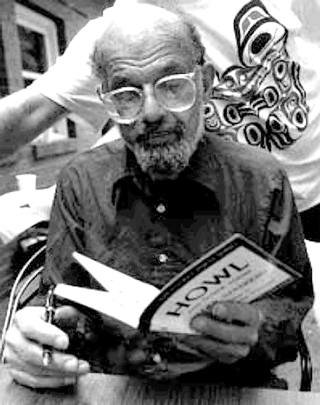
Howl to you too, babe


A few days ago friend of mine passed along from the April 9 New York Times Book section a review of The Poem That Changed America: "Howl" Fifty Years Later, a book of reminiscences edited by Jason Shinder.

Here for me is the most memorable passage of that review, particularly the Luc Sante quote starting two paragraphs down (I include the first two paragraphs because they provide some interesting context; the whole review can be found here):

Ginsberg wrote "Howl" in San Francisco and Berkeley; he read the long first section in public for the first time in San Francisco in 1955, and the whole of the poem for the first time in Berkeley the next year. (A CD of that performance is included in this book.) All sorts of divisions, exclusions, restrictive manners and deferences that were second nature in the East were missing in the Bay Area. If the primary terrain of the poem is New York City, the freedom one could find in California in the 50's is crucial to the air that blows through the dank rooms of "Howl," blowing all the way back to New York --but you wouldn't know it from the Eastern writers Shinder has brought together, as if such Bay Area poets and critics as Ishmael Reed,Robert Hass, Rebecca Solnit, Joshua Clover or Richard Candida Smith would have less to say about where "Howl" came from and where it went than Jane Kramer and Eileen Myles, who have plenty to say. The America that gets changed in "The Poem That Changed America" is a Steinberg map, with San Francisco as far away as Tangier. "No one," Marjorie Perloff says off-handedly, but too revealingly, "New Yorker or foreigner. . . . "

You can forget that when Luc Sante begins to tell his tale from 437 East12th Street, which is, as it happens, the same New York City building where Ginsberg lived... Sante changes the discussion as if throwing open a door: "Was 'Howl' the last poem to hit the world with the impact of news and grip it with the tenacity of a pop song?" The language is burning, the ideas are jumping and, finally, you are brought into the adventure of the poem, Ginsberg and his fellows turning New York City into their own frontier, then heading west, through Kansas, into Colorado, to the coast, then back again, discovering, you can feel, more of America in the decade before Ginsberg wrote the poem in 1955 than de Soto, Daniel Boone or even Lewis and Clark did in the centuries before them.


"Reading 'Howl' aloud or reciting it," Sante writes, "you could feel the poem giving you supernatural powers, the ability to punch through brick walls and walk across cities from rooftop to rooftop" faster than a speeding bullet, more powerful than a locomotive, able to leap tall buildings in a single bound, as George Reeves was doing on TV as Ginsberg wrote, just like Scotty Moore's second guitar break in Elvis Presley's "Hound Dog," on Ginsberg's hydrogen jukebox the year that "Howl" first made it into print. Why not? Sante lived for 11 years in Ginsberg's building. He was 36 when he moved out, and when he looks back to that moment, the self-regard of adolescent illumination, so common elsewhere in the pages Sante shares, is replaced by something that doesn't melt at the touch.


"'Howl' probably meant more to me then than ever before," he says, "because finally I could reconcile it with my own experience. 'Poverty' and 'tatters' and 'hollow-eyed' and 'high' were more than poetic figures by then. I could compile my own list of the best minds of my generation destroyed by madness. The decade during which I lived two flights down from Allen was particularly notable for its body count in suicides and overdoses, and those cadavers really had contained some of the best minds I knew. . . . If 'Howl' is a catalog of flameouts and collapses, it is ecstatic in its lamentation. And that is the basic measure of its strength: it is a list of . . . leprous
epiphanies as redoubtable as Homer's catalog of ships, but rather than stopping at that, it seizes the opportunity to realize all the botched dreams it enumerates. It envisions every broken vision, supplies the skeleton key that reveals the genius of every torrent of babble, reconstitutes every page of scribble that looks like gibberish the next morning."

Friday, December 17, 2004

FORM & SUBSTANCE; PRINT & VOICE

Mike Snider has written an insightful series of blogs over the last week or so on enjambment in accentual-syllabic poetry. Highly recommend it, for those who are interested in poetic form.

Mike Snider's blog directed me to a fabulous poetry resource, the Factory School Digital Archive.
Recordings of readings by the all sorts of well-known poets are freely available here -- from Ammons to Plath to Yeats to William Carlos Williams. Snider was pointing out how when WCW reads, he ignores his exquisite line breaks and pauses only when punctuation demands it. The oral presentation of the poem doesn't necessarily have to conform to the visual version. They are different media, page & voice. Listening to Ginsberg reading Supermarket in California, I was surprised by how weary & woebegone his voice & reading seemed. I expected a more exuberant interpretation, especially with all those exclamation marks in the poem(... I went into the neon fruit supermarket, dreaming of your enumerations! What peaches and what penumbras! Whole families shopping at night! Aisles full of husbands! Wives in the avocados, babies in the tomatoes! etc.) But it was effective nevertheless... there is a plaintive undersong there, which his reading brings to the fore, with "What thoughts I have of you, Walt Whitman", "In my hungry fatigue, and shopping for images", the "solitary streets", and "Ah, dear father, graybeard, lonely old courage-teacher, what America did you have when Charon quit poling his ferry..." Print is of course black and white: in an aural/oral poem, it is a series of instructions for interpretation, like a musical score. (On the page Ginsburg can't indicate how strong those exclamation points are!...!...!) Voice is many shades of grey, or rather sound colour... nuances of pause, volume, raspiness, clarity, rapidity of delivery, feeling of the moment... varied taste of words & silences, transmuted into speech...