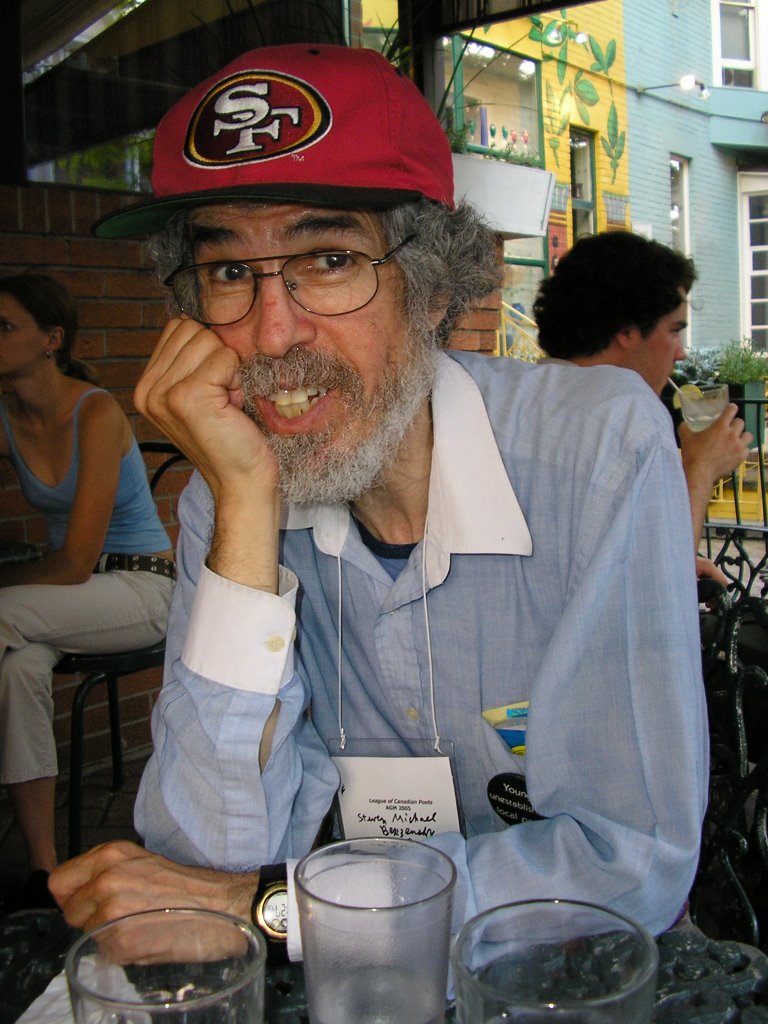
Getting back to Edmonton -- I had a good time at
Canadian League of Poets' AGM, meeting friendly and intelligent poets, launching Undressing the Night at the city hall, attending seminars, participating in council meetings where I learned of the travails -- in all their Byzantine intricacies -- of running an arts service organization in these funding-tight times.
The most memorable seminar I attended was one on form poetry. It is significant that at least two-thirds of the poets present -- and there were about 75 or 80 in all, by my guestimate -- attended this seminar, rather than one scheduled at the same time on the Poem Made Visual, about video poems, concrete poems, etc. Panelists included Kate Braid, one of the editors of
In Fine Form: The Canadian Book of Form Poetry; poet Ted Blodgett, who writes consistently in form, and Steven Michael Berzensky (aka Mick Burrs), who has written dozens of what he calls "liberated sonnets". All of them commented on the paradox of how constraints generate creativity, how student work so often shines within the strictest frameworks, how accomplished poets enter unknown regions under the mysterious momentum generated by these schemata. Kate started compiling
In Fine Form when, asked to teach a course on writing poetry in form, she couldn't find an an anthology with Canadian content. She and Sandy Shreve came up with the idea of creating one of their own. They imagined they might compile a small book to show off high calibre Canadian work -- but surprised themselves to find, upon scouring the Canadian poetry section of the Vancouver Public Library, 1400-plus poems dating from the 1800s to the present worthy of setting aside for possible inclusion. A limited call for submissions lead to 1,000 more of what they considered to be high-quality form poems. Then the difficulty would be, as all editors find, selecting a manageable number from this astonishing superabundance.
Clearly a strong interest in form poetry is abiding, and probably resurgent after nearly a century of free verse predominance. (Actually, poetry in strict form -- rhymes, repetitions, incantations -- has been around since the dawn of humanity, and still is in the popular mind what largely constitutes "poetry"; it is free verse that is the upstart.) What these panelists found was that among Canadian poets, there has not been been such strong contention vis-a-vis form vs. free verse as in the US; many Canadian free-forms people, including some of our most flamboyant personalities (Irving Layton, Milton Acorn and BP Nichol come to mind), delve frequently into fixed form with more than creditable results; fixed form is largely viewed as simply another way to create poetry. In the States, polarized camps have come quite literally to demonize each other -- the "Post Avant" vs. the SoQ (to borrow Silliman's terminology), the Language poets vs. the New Formalists.
In Fine Form is well worth buying, by the way. I also have
The Making of a Poem: A Norton Anthology of Poetic Forms, edited by Mark Stand and Eavan Boland -- a volume in which, despite Norton's compendious reputation, comparatively few of hundreds of possible forms are covered: just the Villanelle, the Sestina, the Pantoum, the Sonnet, the Ballad, Blank Verse, the Heroic Couplet, and the Stanza along with what they call Shaping Forms, viz. the Elegy, The Pastoral, and the Ode. An additional chapter brings together examples of so-called "Open Forms" without much explanation. In
In Fine Form, not only are these categories explained and amply exemplified but also Blues, the Couplet, the Epigram, the Fugue (a term the editors came up with after Robyn Sarah's poem "Fugue"), the Madrigal, the Glosa, Haiku and other Japanese forms, the Incantation, Palindrome, the Rondeau family, Syllabics, Triolet, plus definitions and examples of other forms or modes such as Acrostic, Anglo Saxon, Limerick, Lipogram and Visual. (Funny: they didn't include the Liposuction or the Implant.) The Norton Anthology brings together the most stellar examplars in the language: it's pretty hard to beat Dylan Thomas's Do Not Go Gentle, Elizabeth Bishop's One Art, and Theodore Roethke's The Waking as far as villanelles are concerned. For a poet, though, these can be downright intimidating acts to follow. The Canadian anthology is a more varied and approachable: the quality ranges from excellent (some of these selections give those in the
Norton a good run for their money) to, well, serviceable. Much of the work by is comparative unknowns; a fair number of the poems by living, breathing peers in the CanPo scene. Thus as a living, breathing, unknown myself, I feel,
hey, I can do that too and writing in form becomes a wholly natural, accessible option.