Showing posts with label Poetry Resources. Show all posts

Tuesday, August 11, 2009

Poetry Quebec (PQ)


It's high time I announced Poetry Quebec (PQ), the only online magazine dedicated exclusively to English language poetry in Quebec. The premiere issue -- launched on June 24, St-Jean Baptiste's day -- features the late Louis Dudek: a selection of his poetry, essays, and an interview. The coming issue, the editors tell me, will be dedicated to the memory of Sonja Skarstedt, who, as this blog noted, recently passed away. In an issue after that, I'll be featured; at least, I've been invited to do an interview. This is my first booking of an online "tour" I have yet to organize. The review also features a listing of English poetry events in the province -- a valuable thing, if they can manage to keep it up.

Wednesday, April 16, 2008

POETRY PLEASE (BBC)

A note from a friend a few weeks ago about BBC's Poetry Please, an exceptional online resource. A little context here might serve: I was having trouble downloading podcasts. Excuse the weird lineation that comes of copying and pasting from an e-mail.
Brian,

Some sites will provide their own player so you can hear their
programs online without having anything installed on your end..

One such site which works well, and the work is of caliber is BBC's
program POETRY PLEASE.

It provides it's own player that you can use on-line to hear past
programs from the previous week...so check this out and enjoy.

The readings are fabulous and some of the poems terrific classics too.

Enjoy.

http://www.bbc.co.uk/radio4/arts/poetryplease_potwpiano.shtml

Try it, try it, try it...it's actually a request line where people
from England request certain poetry to be read. What a simple and
effective idea...a bit better that dial a poem sponsored by the
National broadcaster that is funded by government coffers.

Try this out, it's surprisingly simple and effective radio....some of
the poems are read by the poets themselves like Ted Hughes, Philip
Larkin and that's where the fun is too.

Raphael

PS I just listened to this one and some of the poems are fabulous and
one of the them by a guy born in 1871....who knew he'd web broadcast
on BBC?? So, posterity be damned.

Speak to you tomorrow.
Well, I never took advantage of it ... too busy! (Or distracted.) But another option for a random poetry fix.

Thursday, August 09, 2007

Writers' Centres

Tired of all the distractions of writing at home? If you live in Edmonton, you can go to the Writers' Centre. A great idea I would like to see replicated closer (i.e. a lot closer) to chez moi.

------

Apparently, there is one somewhat closer to home -- the Toronto Writers' Centre. It's quite impressive: check out the promotional video. This one, though, might be called the Toronto Writers'-With-Money Centre, as the full memberships fees are $175 + GST per month. To pay that plus a Toronto rent, you (or a generous benefactor) have to be doing well indeed. (The Edmonton Centre is in a public library, and is free.) However, there are daily rates for associate members (about $15 a day) and similar rates for out-of-province visitors, so I might take advantage of it when I visit TO (I have parents/friends there... it is my former hometown.) Thanks to Pearl for that information.

Tuesday, August 07, 2007

Pressed & dried

Two copies of Saranac Review arrived today, with my poem somewhere in the midst of its 170-odd pages and 50-odd contributors. Initially it was a kind of a bitter-sweet feeling, finding oneself in the midst of such a huge lineup after such a long wait (nearly a year, in toto). It is, though, a glossy, lovely review... and it's a pleasure to see one's words in old-fashioned print. Other Canadian contributers I know: Barry Dempster, Brian Bartlett, Tom Wayman, + Louise Warren, a Quebecoise translated into English, whom I should know. The rest Americans I don't know, some with impressive credentials. I read a couple of poems with interesting imaginative leaps. Good company, in other words. I look forward to looking at their work over the next few days.

Today (now yesterday) I spent 4 hours or so cleaning house -- it was that rainy day we were waiting for after so many sunny days and scorchers. Then I spent about 6 or 7 hours going through online lists of Canadian poetry book publishers at the Canadian League of Poets website and at CV2's site, reading & copying their submission guidelines, paying special attention to whether they want whole manuscripts, samples, etc., looking at their author lists etc. and sorting them into an A-list, B-list, C-list and D-list according to prestige/desirability, + an additional category, Chapbooks & Alt. Formats. I actually got the whole job done: it's possible to cover this whole country in one long sitting. There are about 35 book presses in all -- just under one for every million of us, think of that! -- 20 of which got onto my A and B lists. For a break, I played some interesting 8-bar blues riffs I learned off the net. Right now, my back and neck are sore.

Sunday, September 10, 2006

Dutrope; Me; Li-Young Lee

Thanks to C. Dale Young (who learned about it from another blogger), I've discovered Duotrope, extraordinary site listing lit mags, response times, etc. As CDY was saying, it's more searchable that Jeff Baher's compilation. It's also more international (it has quite a few Canadian magazines), links to websites, etc. I think I'll put it on top of my magazines list.

~~~~~~~~~~~

I've lined up a gig at Noches de Poesia, which has fast become Montreal's premier multicultural poetry venue, and one Montreal's premier poetry venues period. (Well, there are only about three or four of them.) I'll be reading along with four others (as well as performing some music) on Wed., Nov. 1 starting at 6:30. Further details here.

~~~~~~~~~~

This weekend I read through Li-Young Lee's Rose, which I recently received in the mail along with a batch of other books. I love this poet's emotional warmth and depth, his disarming ease and innocence of expression. Poignant works about childhood and father -- a kind of looming (yet disturbing) hero-figure -- blend into beautiful poems about his own fatherhood, woven together by such elemental motifs as hair, blossoms, fruit -- and despite what that descrption may suggest, nary a word trite or precious (tho he he does verge at a couple of points. Good for him, I say.)

The reason I ordered Rose is that about a year ago in The Sun I came across some damned good poems from that book. Here's one of them. (And here's an exerpt of the interview with Lee in that same issue -- and I see now that Ilya Kaminsky is one of the interviewers. Interesting.)

Of course, it's often best to read first books first: that's where so many poets quite definitively define themselves, and from what I had read of Lee, I wanted to see that. Now I'm inclined to order his latest, perhaps, and work backwards.

P.S. I see also now that there's an interview with Li-Young Lee in the current issue of Rock Salt Plum Review. Very interesting. I'll have to read it when I have a free moment. My essay is also there, but funny, it didn't leap out at me that Lee was featured in the same issue perhaps because I hadn't read much of him yet.

Wednesday, June 14, 2006

Poetry Fans

There are real poetry fans out there... not just poem-writers who read what they can get their hands on to feed their craft (although one could argue just as persuasively these are the real aficionados), but non-writers who love poetry, cheer it on, just can't get enough of it (or at least, of the poetry they cheer on, can't get enough of). Rather like music fans... This one, with some friends, edits a site called Famous Poets and Poems and the other day she sent me this letter. I asked her permission to put it here (and indeed, she confirmed she doesn't write poetry). To me it's so refreshing to get a letter from someone who calls themselves a poetry fan!

Hello, Brian!

I'm Diana Collins, I'm a poetry fan.

I've visited your blog and I liked it very much.

I would like to thank you for your blog and for the time you spent creating it.

It's wonderful that there are such blogs, where people can learn something new and useful about poetry. It would be great to have such blogs as many as possible!

Wish you good luck and success in your occupation!

Hats off,

Diana Collins
www.famouspoetsandpoems.com

Anyway, Famous Poetry and Poems is an impressive compilation, rather like the older and less graphically fancy Poetry Connection. It has hundreds of poems, a featured poet of the month, quotes of poets, etc. It will be on my blogroll, under Other Poetry and Writer sites.

Thursday, April 06, 2006

National Poetry Month

I just learned through Amanda Auchter's blog that one of the ways the American Academy of Poets celebrates National Poetry Month is by posting a daily poem on their site as well as emailing it to interested subscribers (even uninterested ones). These are recently published poems by, of course, Americans. To see the poems published so far and to subscribe yourself, see here.


Up here April is also our National Poetry Month. (Is that what makes it the cruellest month? Joking aside...) It would be great if our League of Canadian Poets could get it together to do the same thing... an obvious and simple and probably not too expensive way to raise poetry awareness. Will suggest it to the "powers that be"...

Wednesday, February 22, 2006

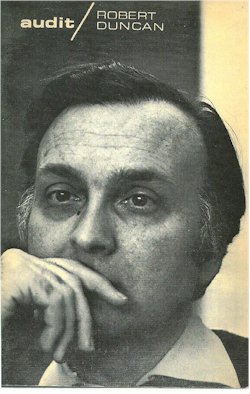
Robert Duncan: Warp & Woof

Last weekend, besides seeing Marie Chouinard Dance Company go through its paces at La Place des Arts in Montreal (see post below), I also attended a lecture by Robert Duncan at Naropa College in Boulder, Colerado. It was pleasant being part of the audience, people around me caughing and shuffling their feet, rising to ask barely audible questions, or laughing at his jokes (sometimes I chuckled too). A fair number of these people are probably dead, as is, of course, the lecturer. Occasionally cars purred by that have long since been to the junkyard, and I think I heard a plane, possibly heading to Denver -- the windows were open, so it must have been some time in early Fall or late Spring. Attending a lecture of 25 or 30 years ago is one of those things, of course, you can easily do nowadays via a medium that Duncan, eminent spiritualist though he was, could never have possibly imagined. Like the University student I haven't been for decades, I kept assiduous notes -- this time, not on a notepad but on a computer screen.

Duncan was a fascinating and entertaining lecturer, whose nervous stuttering staccato could barely keep up with rapid-fire associations in his head. Frequently, almost willy-nilly, he went on tangents, but the theme and direction were nearly always clear. Today I touched up my notes, added paraphrases here and there to make them at least somewhat intelligible. Since the lecture, entitled Warp & Woof, Part 1 (I was unable to find Part 2) is more than an hour and a half long, I thought you dear readers might benefit by scanning this synopsis of most of his main ideas, as well as a number of thought-provoking curiosities that came out along the way:

Imagine a warp and woof, as of a fabric -- imagine it going throughout the universe
The warp & woof of the "true" and fabricated universe
The word poetry: Greek word for making something up
"Song" -- canto -- entirely other origin, aspect
Semitic community (Judeo-Christian & Moslem world) was in for quite a shock when it came in contact with this decadent Greek idea of a made-up world
Greece had doctrine of inspiration
Semitic world, on the contrary, was opposed to graven images, making things up. In that tradition, one should not "make a poem", but speak with a poem that comes from your voice, heart. Prophetic, vatic voice.
Duncan himself: a product of the Celtic and Jewish trads. + Greek idea of making up.
Sappho
Christian world: felt there was something profoundly wrong about making up things & persons. Only in Rennaissance was "making up" returned to prominence
Shakespeare (Tempest): Universe a stage. A master maker.
The germanic word for poet is maker too.
Story tellers thought of themselves as makers; talk about weaving a tale. (Goes along with weaving cloth): story you tell as you weave cloth. Minotaur; maze.

In happy Jung land: you aren’t making things up once again. Psychoanalysis: archetypes: not made up. Lady Macbeth’s archetypal standing less interesting than the made-up aspect.

Duncan suggests (jokingly) an alternative to the Oedipus complex: the Jocasta complex: mother aint’ going to leave the son alone.

An ecclesiastical work is not "a making up"; it is a vision of what is there.

Homer: Penelope: every day weaving a design of a plot; all a work

In our own Judeo-C world, word “craft” is even yet filled with apprehension: as in crafty
Craft is a cunning little animal: one you tame so it won’t bite you

Ezra Pound: all human spirit is identical, consubstantial. All times contemporaneous. We evoke a presentation.
Cocteau: Pound is the last rower on the sacred river of Arabus.
Lowest rung of heaven is hell.
Limbo is the conventional world, a world world where love is good, war is bad; the world of the mother’s day poem (platitudes)
We don’t have such a thing as imagining, without being recharged by understanding.
(Psychoanalysis: fantasy is called making things up)

We’re in a fabric of time and space. People 40 yrs. from now will not be buzzed by the same buzzes of now.

Celtic traditon of the bard – keeping alive the identity of the tribe. Now bardically, the poet must keep alive our identity in the universe.
We leave an imprint. We devise a design in a poem, but it is like a footprint out of which you extrapolate an entire dinosaur.

Conventional dictum “Write with your true voice.” Don’t come on like an immitation Robert Browning. But if you do immitate well, you are yourself anyway. Imprint.

“What do you think of this” = will you think about this for me.

No matter what I think I say, the words say other things: storehouse of impressions.
You cannot take a thing you feel and put it into language.

Say Cow – that’s my cow, but not really your cow.

One of our communities is language.

Everybody has this notion of emptiness. Language has a term: nothing. Language tells us we’re individuals. That’s not our idea. We discover ourselves in commonality.

Idea that archetype is in you, nothing like the idea that it’s in language.

You’re in the hands of the peril of the universe when you are in health. Being sick: getting with the program, as it were.

Eripides not in the web; Shakespeare is. E. limited by notion of catharsis. S. creates a world; gives eloquence to all virtues and vices in the web.

Creely poems frequently have no images. Shakespeare: no images in “To be or not to be”
What was an image? Nexus of when a person... (forgot to finish my note here)

We are not warp nor woof – we are holes (between warp & woof).

We think of Whitman as "big superdaddy poet", not as leaves of grass, one of millions, which was his view, ultimately.

A love song with language rather than notes.

Writing a sonnet – doesn’t require faith. Playing tennis with the net up (Frost). But being is a different game – hard to know when you are playing being.

Loyalty is not faith.

There’s a flow – because there’s a language and going on in our heads all the time -- continuously of poems – an artesian well of sorts – but the art of poetry is actually a structure to prevent us from being plunged into the absolutely everlasting generative field that language is. It is of high magic field, it is a form of evocation. You get inside a pentagon – because you don’t want to be swamped by the whole spiritual world. A sonnet (or any other poem) like making a little garden inside the language. In the sonnet, love and the erotic brought close together in a relation. This is the grand attraction of magic: bringing things together in a circumscribed area. In the grand web (warp & woof) of the universe : love and sex not even related much of the time. We’re back to leaves of grass. We don’t mourn the loss of one leaf. Rationality, too, is a grand magic, which makes sure all its own demons remain present while the rest are consigned to the realm of the “irrational.”

Thursday, December 29, 2005

COMMUNITY, ROBERT BLY, ETC.

The following is from an interview with Robert Bly on Bly's website -- it's a fascinating site... but then, I'm a huge admirer, esp. of his criticism and translations:

Donald Hall and I have been sending poems back and forth twice a week for forty years. At one time, we had a 48-hour rule: the other had to answer within 48 hours. My generation did a lot with letters. Galway Kinnell and Louis Simpson and Don and I and James Wright would often send five- and six-page typed letters commenting on and arguing with each others' poems. I'm amazed we had the time for that. TranstrĂśmer and I exchanged hundreds of letters. The gist of it is that no one writes alone: One needs a community.

Voila! The way in which poetry lends itself to community -- glorious get-togethers with writerly company for sharing, feedback, wine, song, etc. -- is but one thing which brought me back into its fold after a haitus of nearly a decade (during which I wrote songs, recorded an album, even tried to get a music career off the ground...something I rarely talk about on this blog.) Trouble is, these get-togethers don't always manage to coalesce (this I write after yet another fell through earlier this month...). People are so busy these days, with family obligations, house repairs, etc... it requires a degree of commitment and availability that not many of us can muster at any given stage of our lives.

Hence the usefulness of poetry boards -- in particular, Eratosphere. Discovered this one through Whimsy Speaks (Jeff Bahr). In some post of his he mentioned that of 60 poems he had gotten published, only 2 hadn’t gone through the acid test of a poetry board like this one. That in itself was remarkable piece of information. Following the link, I was truly impressed by what I saw. The discussion is at a pretty high level -- as were a number of the poems on the boards. The site appears to have had the likes of Richard Wilber and Anthony Hecht as visiting “Poet Lariats” for a day. There is an interesting division between beginning and advanced levels of metric poetry (an area I probably won't participate in much -- there seemed to be a lot of light verse there, which I rarely enjoy). I also liked some of the open discussions. Most certainly in the coming year I'll be spending more time on on-line boards such as these -- even though, of course, that means an even more inordinate amount of time with my eyes glued to a computer screen.

Back to Bly though -- one thing you can say for him, with all those books, translations, appearances, review editing, etc.: he had (and has) one serious work ethic worked out there. Serious, yet joyful, as he obviously loves what he does. He's still got quite a gig-list going, for a man just shy of 80!

If you want to hear a recent Robert Bly reading, check out this site. I enjoyed this reading a lot.

Thursday, November 17, 2005

To brush up on your poesie terms...

... try this link. Here you have writeups on the history of poetry, technical terms, periods, styles, movements, etc. with an almost inexaustible supply of links to related items. It's fun to see what you know and don't know... (believe me, there's plenty here I don't...)

Friday, June 03, 2005

Blogroll

As the old Tom Paxton song goes,

Are you going away
With no word of farewell...

Well, that's what he upped and did. Though he did announce his intentions the previous week..

Good luck this summer, Eduardo, with the manuscript. I look forward to seeing your new website in the fall.

This made me realize -- time to update my blogroll.

Since the last time, some people have moved out of the fave's list, some into it. Those who've moved in: Anne Haines (Land Mammal) is as warm and terre-a-terre as pomme de terre comfort food in a howling winter for fellow "emerging" poets, especially fellow middle-aged "emerging" poets like myself... a number of her posts (particularly on writers' groups) I've found very useful; AJPL is a bright young fella I have a lot of intellectual fun with so I find myself frequently curious to see what he's up to; Anthony Robinson has moved his blog back out of retirement and has proven to be very poignant and very engaging in his commentary, so up he goes. Emily Lloyd, always worthy, is back into the crowd of "Other Worthies" until she decides what she's doing with her blog, which should be soon, she tells us; Cris Lott (Cosmopoetica), because although I like his writing, he doesn't post frequently enough.

C Dale, you're great, your tips have been invaluable and your insights superior-- but you're on probation. Seems to me your blog has become rather too much a diary blog lately. But I still find myself dropping in on Avoid the Muse every few days...

A big addition to the blogroll: a list of on-line magazines (I'll only hyperlink some of these; I'm getting tired...). Listed alphabetically, it includes some very high-level "establishment" ones, like Slate and Blackbird (the latter strikes me as rather an online version of American Poetry Review -- everyone there is very much a "career" poet, MFA'd, Breadloafed, etc.), the conservative looking Melic Review, which looks at least at first glance like an online Poet Lore; The Page, which besides being a voluminous review has an impressive links list of other online poetry publications; then dignified/funky lit zines like How 2, Rock Salt Plum, 42 Opus, Verse, and the cute and terribly pink No Tell Motel; finally post avant hipster reviews like Shampoo, Exquisite Corpse, Jacket and Malleable Jangle (the latter two out of Australia, incidentally). Quite an assortment. This is as much as anything else to help my own exploration ... if they're at my fingertips, maybe I myself will get to know them better and eventually submit to some of them! (Having them bookmarked hasn't been enough).

Other important resources (under Other Poetry Websites): Poetry Net, a great online selection of important contemporary poets, with bios, pictures, etc; and (what an oversight not to have this until now), the Quebec Writer's Federation website.

By the way, yesterday my site meter recorded this blog's 4,000th visit since last September when I set up "digs" here. Seems things are picking up exponentially; the month of May saw exactly (yes, exactly!) 1,000 of those.

Friday, May 20, 2005

The Glorious Age of Amphigory

Phrontistry is a fun little site (actually a fun gigantic site), a compendium of unusual (mostly) polysyllabic words.

One word I came across that bears some relevance to ongoing discussions:

Amphigory am'fi-ge-ree, n (French amphigouri, of unknown origin)

A nonsense verse. Specifically, a poem designed to look and sound good, but which has no meaning upon closer reading. The term 'amphigory' could be applied to large segments of modern poetry, except that its authors probably actually believe that what they are writing is something other than a meaningless trifle.

Some of us go on to amphiglory, I suppose.

But who is the glorious logogue, pray tell, to determine once and for all that a poem is truly amphigorious?

Accuse me of conphrontistry on this one, but this calls for serious logomachy!

By the way, I'm off for the weekend with my partner to Quebec City, to walk the cobbled streets, eat in a fabulous restaurant, stay in an 18th C. auberge, take in the Musee de Beaux Arts. A la prochaine!

Sunday, April 24, 2005

Thursday, March 10, 2005

Blogroll & Another Plug for Rhubarb Is Susan

Added to my blogroll, a number of worthwhile poet blogs discovered over the last few weeks:

Maria (My Pareidolia) http://mypareidolia.blogspot.com/

Gary Norris http://dagzine.blogspot.com/

Michael Hoerman’s Pornfeld http://pornfeld.blogspot.com/

Peter Pereira http://thevirtualworld.blogspot.com/

Simon De Deo (Rhubarb is Susan) http://www.rhubarbissusan.blogspot.com/

http://lorenwebster.net/In_a_Dark_Time/

and Greg Perry http://grapez.blogspot.com/

also Penn Central Archives, a great source of recorded poetry readings.

In blogland, the poets love to chew the fat about poetry and poetics.

But it seems their eyes glaze over when they see a poem.

If a poet posts a poem, even on a blog that often gets comments, he can usually expect "no comment".

Sad commentary.

Actually, as I've admitted before, I too have been guilty of that -- eyes glazing over, leaving no comment -- the latter perhaps because I don't want to hurt people's feelings if I have a negative or indifferent reaction. But there's more to it than that. Most of us tend to be in a news-reading mode more than poetry-reading mode when we surf blogs. The inferior resolution of screens further disinclines us from the kind of focussed reading poetry demands.

The fact remains, most poems posted in blogs I've seen have a big "0" down below. My own sub-blog poetry sites -- you can see them on the side bar, to the right -- have gotten the tiniest fraction of visits that this blog gets. I'm not begging for more. This is observation based on what I see, stats and my own behaviour.

So here's a plug for Rhubarb Is Susan, a very worthwhile poetry reviewing site that is getting so little response its author posted four days ago, saying, in effect, he was considering giving it up. (It turns out he isn't ... but...)

This man gives very careful, perceptive reviews of poems in contemporary zines/magazines. Both before and after poetry theory is the reality of the poem itself. His blog -- focussing on specific poems -- suggests a direction poetry blogging may go after this heyday of poetry theorizing/shop-talking on the net is over. (Maybe it'll never be over, even should never be! Such is the delight in such talk...however...) I've decided to give him my support by commenting (at least once a week, if possible) on his reviews. Please give him a visit!

Not added to my blogroll, but fun:

A dictionary in which words are defined using limericks (courtesy of Jonathan Mayhew).

Saturday, December 18, 2004

Apropos de apropos

For essays/commentaries by people like Denise Levertov, James Wright, Richard Hugo etc. on subjects like line lengths and sentimentality in verse, bookmark this site called Essays, Issues, Poetics. Fascinating reading.

By the way, I must confess to a certain stuffiness a few days back, where I expressed annoyance at poet bloggers thrusting their drafts on the world at large. Reading Mike Snider and Tony Tost's blogs (blogrolled to the right), I quite enjoyed their draft/poem postings this week. I suppose if I am interested in the poet's process, if I'm in the mood, if the poem is apropos of some vital need of mine, I can be quite open to a blogpost poem. Clearly, this goes for all poetry: for a reader to be open to it, the poem has to be apropos of a vital need...

Friday, December 17, 2004

FORM & SUBSTANCE; PRINT & VOICE

Mike Snider has written an insightful series of blogs over the last week or so on enjambment in accentual-syllabic poetry. Highly recommend it, for those who are interested in poetic form.

Mike Snider's blog directed me to a fabulous poetry resource, the Factory School Digital Archive.
Recordings of readings by the all sorts of well-known poets are freely available here -- from Ammons to Plath to Yeats to William Carlos Williams. Snider was pointing out how when WCW reads, he ignores his exquisite line breaks and pauses only when punctuation demands it. The oral presentation of the poem doesn't necessarily have to conform to the visual version. They are different media, page & voice. Listening to Ginsberg reading Supermarket in California, I was surprised by how weary & woebegone his voice & reading seemed. I expected a more exuberant interpretation, especially with all those exclamation marks in the poem(... I went into the neon fruit supermarket, dreaming of your enumerations! What peaches and what penumbras! Whole families shopping at night! Aisles full of husbands! Wives in the avocados, babies in the tomatoes! etc.) But it was effective nevertheless... there is a plaintive undersong there, which his reading brings to the fore, with "What thoughts I have of you, Walt Whitman", "In my hungry fatigue, and shopping for images", the "solitary streets", and "Ah, dear father, graybeard, lonely old courage-teacher, what America did you have when Charon quit poling his ferry..." Print is of course black and white: in an aural/oral poem, it is a series of instructions for interpretation, like a musical score. (On the page Ginsburg can't indicate how strong those exclamation points are!...!...!) Voice is many shades of grey, or rather sound colour... nuances of pause, volume, raspiness, clarity, rapidity of delivery, feeling of the moment... varied taste of words & silences, transmuted into speech...