An interesting article on creative titling is to be found here. Well worth reading.
Rachel's contention about the "lack of academic interest in this dimension of literature" notwithstanding, I see the Dictionary of Poetic Terms (I can't believe how much I'm touting this book) has a lengthy mini essay on title strategies -- layered title, pun title, subject as title, character as title, self-negating title, titles that use outside references, etc. Indeed I think the authors could have taken a page from their own book (yes, quite literally) and come up with a snappier title for it, more reflective of the nifty contents to be found therein.
Tuesday, October 31, 2006

Sunday, October 29, 2006
The Unstated Cliché
The following is from a lengthy mini-essay on effective uses of cliché, in the Dictionary of Poetic Terms:
The Unstated Cliché
Sometimes a poem will have a cliché as its unstated theme. In the following poem by Thomas James, there lurks in the background the aphorism “Silence is Golden”, but the way in which James expresses this clichéd statement is utterly new and beautiful.
LETTER TO A MUTE
If I could reach you now, in any way
At all, I would say this to you:
This afternoon I walked into a thicket
Of gold flowers that had no idea
What they were after. They couldn’t hear a thing.
I walked among a million, small, deaf ears
Breaking their gold into the afternoon.
I think they were like you, golden, golden,
Unable to express a single thing.
I walked among them, thinking of you,
Thinking of what it would be like
To be completely solitary. Once I was alone like that.
All the field was humming, brimming
With some brazen kind of song, and I
Thought that somehow I could disappear
Into the empty hall of your right ear.
Wandering through the slender bones of you.
But I know that I could never let you know
That it is late summer here, that I
Can hear the crickets every evening
Hollowing out the darkness at my window
That you have vanished into a dark tunnel
Where I have tried to reach you with my mouth
Till my mouth ran gold, spilling over everything.
Tonight I looked into your face, tenderly,
Tenderly, but I could never find you there.
I could only touch your quiet lips.
If I could stick my pen into your tongue,
Making it run with gold, making
It speak entirely to me, letting the truth
Slide out of it, I could not be alone.
I wouldn’t even touch you, for I know
How you are locked away from me forever.
Tonight I go out looking for you everywhere
As the moon slips out, a slender petal
Offering all its gold to me for nothing.
The Unstated Cliché
Sometimes a poem will have a cliché as its unstated theme. In the following poem by Thomas James, there lurks in the background the aphorism “Silence is Golden”, but the way in which James expresses this clichéd statement is utterly new and beautiful.
LETTER TO A MUTE
If I could reach you now, in any way
At all, I would say this to you:
This afternoon I walked into a thicket
Of gold flowers that had no idea
What they were after. They couldn’t hear a thing.
I walked among a million, small, deaf ears
Breaking their gold into the afternoon.
I think they were like you, golden, golden,
Unable to express a single thing.
I walked among them, thinking of you,
Thinking of what it would be like
To be completely solitary. Once I was alone like that.
All the field was humming, brimming
With some brazen kind of song, and I
Thought that somehow I could disappear
Into the empty hall of your right ear.
Wandering through the slender bones of you.
But I know that I could never let you know
That it is late summer here, that I
Can hear the crickets every evening
Hollowing out the darkness at my window
That you have vanished into a dark tunnel
Where I have tried to reach you with my mouth
Till my mouth ran gold, spilling over everything.
Tonight I looked into your face, tenderly,
Tenderly, but I could never find you there.
I could only touch your quiet lips.
If I could stick my pen into your tongue,
Making it run with gold, making
It speak entirely to me, letting the truth
Slide out of it, I could not be alone.
I wouldn’t even touch you, for I know
How you are locked away from me forever.
Tonight I go out looking for you everywhere
As the moon slips out, a slender petal
Offering all its gold to me for nothing.
Saturday, October 28, 2006
Friday, October 27, 2006
Anticipatory line endings
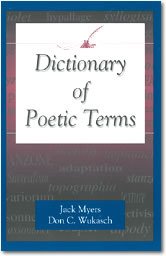 During the last few weeks I've been reading -- on an almost daily basis -- the Dictionary of Poetic Terms by Jack Myers and Don. C. Wukash, which I ordered direct from U. of North Texas Press back in September. I'm really enjoying it, and yes, I've decided to read it straight through from A to Z, with little side trips up into higher ranges of the alphabet to follow up cross-references that pique my curiosity. Right now I'm in the middle of letter C. I suppose at the rate I'm going I'll be finished by mid-March. Then I will know everything there is to know about poetry, and stop writing then and there. (Right?)
The entries are well-written and as broad in scope as you can imagine -- on history, poetics, devices, etc. featuring citations from the ancients to contemporary poets quite young. At times whole poems are cited, most of them superb and a number by poets I've never had the pleasure to read before. Included are excellent mini-essays on things like Fractured Narrative, Free Verse, Clichés, Cinematic Techniques (this would interest Charles), Juxtaposition, Meter, etc.
Here is a useful entry I found under the letter A:
anticipatory line ending (see LINE ENDING), a type of ENJAMBMENT in which the information is purposely delayed in order to heighten the reader's expectations. The a.l.e. can be formed by any part of speech when a sentence, phrase, or syntactical unit is cut off from completion. "He went into/the store of/his/desires." The device can be overused, become annoying, or appear illogical if it occurs too soon or too consistently in a poem.Funny, it was the effective use of a.l.e. that I was admiring in a review of Barbara Pelman's poetry a little over a year ago, but in a rather round-about way, because I was frankly unaware that a term had been coined for the device. I wonder though how many other poets and even academics are unaware of that term? (The review ended up being published -- in refined form -- in the Pacific Rim Review of Books, so obviously it didn't suffer too much from my ignorance.)
A, by the way, was heavy going at times. with all kinds of arcane -- and highly forgettable -- rhetorical and otherwise technical terms to wade through: antimetabole, antiphrasis, antirhesis, antisagoge, autonomasia, aphaeresis, apocarteresis, apomnemonysis, apophasis, etc. (Enough to give one apoplexy, in other words.) What it did prove to me is that whatever attitude or emotion a poet may express, the rhetoricians have identified and found some label for it, a ready tool to brand, delimit, and dissect.
All this to a practitioner of the art can be rather disconcerting.
I'm told that the experts of Japanese martial arts over the centuries compiled terms for more than 60 different kinds of kicks below the knee. Of what use could all that knowlege have been to a working samouri warrior? Ultimately, like oriental kicking terms, the rhetorical terms are, as I said, highly forgettable, best looked at and for the most part forgotten. Of what use were they to the likes of Shakespeare, Shelley, Plath, and Thomas, who without knowing them provided the most shining examples?
Monday, October 23, 2006
Good for several chuckles...
Colson Whitehead, author of John Henry Days and Apex Hides the Hurt, wrote this for New York Times back in April 06, and read from it at Harbourfront on Saturday.
Proposal for an Alternative Use of the Empire State Building, on the Occasion of Its 75th Anniversary
Personally, I think it's great that they store all the fiction writers in there. Sure, the vistas feed the imagination on good days and suicidal ideation on bad days, but what appeals most is the community. We work so much in isolation after all.
Everybody is so plain-spoken and honest on the realist floor, it's very refreshing, although when you finish a conversation you're not sure if they were really saying anything. Still, that's much more pleasant than chatting with the allegorists, who start nattering on about sentient cows and the inevitable recursiveness of human experience when you ask a simple question like "Do you know what time it is?" or "Do these pants make my ass look big?"
People complain about getting lost on the experimental floor, but I think it's pretty easy to navigate - the walls have signs that say "This is a wall," the floor has a sign that says "This is a floor," and in case you miss the signs the first time, they are repeated over and over again.
Critic-novelists stay close to ground level, so they can argue with themselves over whether to take the stairs or the elevator -- whatever they choose each day, they insist that everyone should do it that way. Hang out with the domestic fiction guys for longer than a quick drink and you'll discover they're quite paranoid, constantly accusing each other of stealing their "unique" material, but they throw great cocktail parties if you go in for that sad undercurrent thing. I know I do. John Grisham and Stephen King types have their own floors, although it's a mystery what goes on there - when their names come up, people say "If not for them..." and then trail off into an eerie silence, the kind of disturbing quiet you hear when you pass the sophomore slump floors. (Keep typing, guys!).
Floors 35-86 are the midlist stomping grounds, full of plenty of likable folks, even if they always manage to steer the conversation around to how "it's all about the work." You might want to take the express elevators. It's a long ride up to the breakout book floor, but people say it's worth the wait.
Sometimes you have to shoo away a memoirist from your desk. They wander in from time to time.
A loud alarm goes off every couple of hours or so to warn you when someone starts a new literary journal. The mad stampede you hear immediately afterwards is people looking for stamps. Building maintenance is performed by those who indicate in their author bios that they have held "real life" jobs before "settling on this writing thing." ("...worked as a longshoreman, quarryman, bouncer, boxer's cut-man, haberdasher...") After an epidemic of "snark cough" told us that delicate lungs were being irritated by airborne particles, we recruited some former construction workers from the post-9/11 anti-ironists and neo-sincerists, and they quickly removed all the snark from the ceiling insulation, well under estimate. When the furnace broke down we burned a hybrid fuel made out of MFA students and novels of linked stories. This was an abundant energy source and kept us warm until spring.
All the poets are in Madison Square Garden -- where else would they all fit? -- but we keep a few around to work the lunch room. They say the fry cook takes a mean author photo. ("Now put your hand to your face and show us how painful the words are.") Attendance used to be required at lunch, until thedubious subgenre of "cafeteria novels" surfaced, was denounced in a series of reactionary essays in the New Republic (Who can forget "Tut-tut to the Hysterical Cafeteria Novel"?), and now people just eat whenever they feel like it.
Then they go back to work.
Proposal for an Alternative Use of the Empire State Building, on the Occasion of Its 75th Anniversary
Personally, I think it's great that they store all the fiction writers in there. Sure, the vistas feed the imagination on good days and suicidal ideation on bad days, but what appeals most is the community. We work so much in isolation after all.
Everybody is so plain-spoken and honest on the realist floor, it's very refreshing, although when you finish a conversation you're not sure if they were really saying anything. Still, that's much more pleasant than chatting with the allegorists, who start nattering on about sentient cows and the inevitable recursiveness of human experience when you ask a simple question like "Do you know what time it is?" or "Do these pants make my ass look big?"
People complain about getting lost on the experimental floor, but I think it's pretty easy to navigate - the walls have signs that say "This is a wall," the floor has a sign that says "This is a floor," and in case you miss the signs the first time, they are repeated over and over again.
Critic-novelists stay close to ground level, so they can argue with themselves over whether to take the stairs or the elevator -- whatever they choose each day, they insist that everyone should do it that way. Hang out with the domestic fiction guys for longer than a quick drink and you'll discover they're quite paranoid, constantly accusing each other of stealing their "unique" material, but they throw great cocktail parties if you go in for that sad undercurrent thing. I know I do. John Grisham and Stephen King types have their own floors, although it's a mystery what goes on there - when their names come up, people say "If not for them..." and then trail off into an eerie silence, the kind of disturbing quiet you hear when you pass the sophomore slump floors. (Keep typing, guys!).
Floors 35-86 are the midlist stomping grounds, full of plenty of likable folks, even if they always manage to steer the conversation around to how "it's all about the work." You might want to take the express elevators. It's a long ride up to the breakout book floor, but people say it's worth the wait.
Sometimes you have to shoo away a memoirist from your desk. They wander in from time to time.
A loud alarm goes off every couple of hours or so to warn you when someone starts a new literary journal. The mad stampede you hear immediately afterwards is people looking for stamps. Building maintenance is performed by those who indicate in their author bios that they have held "real life" jobs before "settling on this writing thing." ("...worked as a longshoreman, quarryman, bouncer, boxer's cut-man, haberdasher...") After an epidemic of "snark cough" told us that delicate lungs were being irritated by airborne particles, we recruited some former construction workers from the post-9/11 anti-ironists and neo-sincerists, and they quickly removed all the snark from the ceiling insulation, well under estimate. When the furnace broke down we burned a hybrid fuel made out of MFA students and novels of linked stories. This was an abundant energy source and kept us warm until spring.
All the poets are in Madison Square Garden -- where else would they all fit? -- but we keep a few around to work the lunch room. They say the fry cook takes a mean author photo. ("Now put your hand to your face and show us how painful the words are.") Attendance used to be required at lunch, until thedubious subgenre of "cafeteria novels" surfaced, was denounced in a series of reactionary essays in the New Republic (Who can forget "Tut-tut to the Hysterical Cafeteria Novel"?), and now people just eat whenever they feel like it.
Then they go back to work.
Thursday, October 19, 2006
GG
An interesting article on CBC's website about the short-listed nominees for this year's Governer General's Award for Poetry. According to the article, some 170 English-language poetry books come out yearly in Canada -- this aside from self-published volumes, chapbooks, etc. And here, five good-sounding poets: Sharon Thesen and Dionne Brand are familiar names, but Anne Bachinsky, John Poss, and Ken Babstock I've never heard of.
Wednesday, October 11, 2006

Friday, October 06, 2006
ALSO OF RELEVANCE TO POETRY RECITERS, SPOKEN WORD TYPES, ACTORS, ETC...
When free time allows, I've been practicing songs old and not-so-old, trying to memorize (or re-memorize) lyrics for the weekly gig at Le Depanneur.
Memorizing songs has always been a big challenge for me. Unlike a written script -- play or poem -- where pauses and hesitations can cover up a memory gaffe and even at times enhance a performance , song lyrics have to be known stone-cold, delivered with passion in perfect time with the music, often in extremely distracting settings. The only method I've ever really known is play 'em over and over and over and over again, in my apartment, a park, wherever. Doing a professional recording will certainly serve the purpose: because recording is such a vivid experience, chances are a particular song will be engraved into memory almost unawares with all the takes and re-takes and listenings and edits. Still, I'm surprised a how often when I'm up on a stage, blinding light in my eyes, adjusting to some weird mike and strangers (and friends) walking in or across the front of the stage or even clapping along in time or god forbid out of time, lyrics I thought I knew bone-cold just fly out the window of my mind and I'm left having to fill in extra instrumental bars, straining to remember some god-damned lead-in, feeling like a total idiot. I've known all variations on the theme -- reversed stanzas, repeated stanzas, whole sections forgotten, old versions instead of new versions, stop and start again. Clearly lack of regular access to a live stage -- a common bane in a day and age where live venues have all but disappeared in most cities -- is what makes stage performances, when they come up, particularly stress-ridden things. All of which of course makes my little weekly gig extremely valuable to iron out those rough spots -- and boy do I ever appreciate that.
This week's set went quite well by the way. I got through all my pieces well enough (applause, appreciative comments, etc.) that only I most probably was aware of several gaffes and/or flubs I made (of course all but one were pieces the audience didn't know). But after practicing a new piece this morning an umteenth time and still finding memory faltering, I decided go on the net and see what was to be found about MEMORIZING LYRICS.
A site like this one is all too typical. A zillion suggestions, with the proviso "persist". To a person who prefers to create and read and think up new ideas in silence, who finds -- despite the fact that he's a songwriter -- going over a particular piece again and again an ultimately airheaded thing to do, suggestions like write out lyrics in longhand or record a song and listen repeatedly while washing dishes or driving the car mind-numbing to even contemplate. (Mind you, I have done these things. It's still mind-numbing to contemplate.)
This essay, though, by a veteran blue-grass singer of all things, struck me as truly insightful, a brilliantly polished gem from a treasure-trove of experience. Basically what she suggests is insightful contemplation of the words -- always interesting to someone involved in poetry -- to make a mental film-track of the piece, a kind of personal music video, as it were. This has several advantages. I quote the entire section because I think it's so well done:
Memorizing songs has always been a big challenge for me. Unlike a written script -- play or poem -- where pauses and hesitations can cover up a memory gaffe and even at times enhance a performance , song lyrics have to be known stone-cold, delivered with passion in perfect time with the music, often in extremely distracting settings. The only method I've ever really known is play 'em over and over and over and over again, in my apartment, a park, wherever. Doing a professional recording will certainly serve the purpose: because recording is such a vivid experience, chances are a particular song will be engraved into memory almost unawares with all the takes and re-takes and listenings and edits. Still, I'm surprised a how often when I'm up on a stage, blinding light in my eyes, adjusting to some weird mike and strangers (and friends) walking in or across the front of the stage or even clapping along in time or god forbid out of time, lyrics I thought I knew bone-cold just fly out the window of my mind and I'm left having to fill in extra instrumental bars, straining to remember some god-damned lead-in, feeling like a total idiot. I've known all variations on the theme -- reversed stanzas, repeated stanzas, whole sections forgotten, old versions instead of new versions, stop and start again. Clearly lack of regular access to a live stage -- a common bane in a day and age where live venues have all but disappeared in most cities -- is what makes stage performances, when they come up, particularly stress-ridden things. All of which of course makes my little weekly gig extremely valuable to iron out those rough spots -- and boy do I ever appreciate that.
This week's set went quite well by the way. I got through all my pieces well enough (applause, appreciative comments, etc.) that only I most probably was aware of several gaffes and/or flubs I made (of course all but one were pieces the audience didn't know). But after practicing a new piece this morning an umteenth time and still finding memory faltering, I decided go on the net and see what was to be found about MEMORIZING LYRICS.
A site like this one is all too typical. A zillion suggestions, with the proviso "persist". To a person who prefers to create and read and think up new ideas in silence, who finds -- despite the fact that he's a songwriter -- going over a particular piece again and again an ultimately airheaded thing to do, suggestions like write out lyrics in longhand or record a song and listen repeatedly while washing dishes or driving the car mind-numbing to even contemplate. (Mind you, I have done these things. It's still mind-numbing to contemplate.)
This essay, though, by a veteran blue-grass singer of all things, struck me as truly insightful, a brilliantly polished gem from a treasure-trove of experience. Basically what she suggests is insightful contemplation of the words -- always interesting to someone involved in poetry -- to make a mental film-track of the piece, a kind of personal music video, as it were. This has several advantages. I quote the entire section because I think it's so well done:
Now the lyrics. Read through the lyrics carefully verse by verse. Learn the story. Feel the sentiment, the emotion or perspective the songwriter is trying to get across. Do this until those feelings, or your own version of them become alive in you. Then look at one verse at a time. Look at each phrase in that verse and notice how the words trigger mental images. If an image doesn't come to mind immediately make up your own. Make these images very large, clear and detailed. Link them together phrase by phrase within a verse. Then it's easy to link the verses together because the story has a natural sequence (usually). Another approach, and one that I use when possible, is to associate the lyrics to personal experience, or an experience in your personal repertoire that's enough in the ballpark to borrow from. The mental pictures then become personal scenes where the immediacy of the emotion is built in and powerful. In the end you will have something similar to a mini motion picture running across the screen of your minds' eye as you interpret a song, each scene triggering the related emotions.After reading this passage, I found it easier to live the lyrics of my songs, and to engrave them in memory with just a few intense run-throughs. Living in the "filmtrack" of the song as I played it enhanced performance, enunciation, everything. I love the bit about "being in the moment and out of your own way." It's certainly the way to be when doing just about anything.
There are some wonderful advantages to this. If you teach yourself to stay with the movie, that's where your thoughts will be. You'll be in the moment and out of your own way, so to speak. Where your thoughts will not be is on a track that causes self-consciousness and distraction, and this is particularly important when you're playing for or around other folks. Secondly, and I find myself smiling as I tell you this, if it happens that you forget the lyrics you will still have the back-up mental images---which tend to cause alternative words, or even phrases to offer themselves up to you like a mechanized ticket machine. They may not rhyme, but surprisingly they often do. A made-up word that rhymes has been known to create a feeling of great private victory.
A couple more thoughts for those who have trouble remembering words. Try typing them out in great big letters. This is a visual aid that helps commit words to memory. Lastly, tune into the feeling of the words on your lips as you pronounce them. This creates a helpful physical memory.
I'd like to close by passing on a remark that's worth repeating, even though it's second hand and I'm left to paraphrasing. I believe it was Robin Williams of the infinitely talented team of Robin and Linda Williams who said something like---'there's a time when you feel bad about forgetting words and tend to worry about it. Then comes a time when you relax, ignore or make a joke about it. Then finally there's the time when by the middle of the next verse you forget that you forgot the words.'
Thursday, October 05, 2006
Relief...
Some good news: my friend has been released from the Montreal General. Seems he was suffering a severe migraine headache. He had never experienced a migraine before, and it was probably induced by the novel combination of drugs he was taking. Indeed, it was so severe he suffered memory loss: for an extended period of time he couldn't remember his name nor that of anyone else around him, nor his phone number or even how to walk out his front door, all of which was of course quite frightening. Fortunately, friends were there to help him through this crisis. According to medical staff, migraines can, in rare cases, bring about such memory failures -- something neither he nor I had ever heard of. Anyway, memory and equilibrium restored to a sufficient degree, he was released late this afternoon, although a friend is staying over at his place to make sure he's OK (he lives alone.) He was still feeling a little dizzy as he talked to me on the phone, and said he still had trouble recollecting some things. Anyway, relief, for now.
Never rains
Last night I learned that a close friend of mine suffered what seems to be a minor stroke and had to be taken by ambulance to the Montreal General Hospital. He is a long survivor of AIDS, and it seems a medication he was given for arthritis reacted badly with the cocktail of experimental drugs that have kept him alive, with variations and replacements, for the past seventeen years -- causing his heart to palpitate, his blood pressure to shoot up, and now this.
My partner, who has pretty well stabilized -- she has for all intents and purposes recovered, and seems more relaxed and grounded than ever before -- remains under observation at the Allen Memorial Hospital for probably about the next five days.
So it looks like I'll be making the rounds of hospitals this evening, and the next few days...
My partner, who has pretty well stabilized -- she has for all intents and purposes recovered, and seems more relaxed and grounded than ever before -- remains under observation at the Allen Memorial Hospital for probably about the next five days.
So it looks like I'll be making the rounds of hospitals this evening, and the next few days...
Sunday, October 01, 2006
Depanner la chanson
 By "playing the guitar", I actually meant practicing songs. Last week to divert myself (well, it had been set up already -- but I heartily welcomed the distraction) I auditioned to play at the Depanneur Cafe, an artsy bistro just a few blocks from where I live. It seems I went over well -- so I'll be playing there on Tuesdays, 2-3 pm -- at least, until further notice. (NB, as of February, 2007, it's now Mondays, 2-3 pm...)
Odd time, eh?
The prime times (Fridays/Saturday nights) are reserved for bands, cabarets, etc; live "ambience" music -- solo jazz, folk, etc. -- are at odd times like mine. Here's the schedule for the people like me.
I like the place: frequented by studenty and bohemian types, with tippy tables on old wooden floors and art by starving artists on the walls, it's a kind of cafe you can find in any major city but which always seems exceptional when found. The gig gives me the chance to practice with a sound system in front of a smattering of people -- an ideal way to try out new material, solidify performance and cut stage nerves in preparation for other gigs (if, when, who knows where) down the road. + of course gain a bit of public, sell CDs books tapes & maybe even my body!!!
Subscribe to:
Posts (Atom)