Showing posts with label Robert Duncan. Show all posts

Wednesday, March 19, 2008

Robin Blaser & Phil Hall

Saw Robin Blaser and Phil Hall read at the Atwater Library last Friday night. (One can catch this reading, along with other Atwater readings, here.) Neither poets I knew particularly well, although from my bookcase I fished out Robin Blaser's Pell Mell, which a friend gave me at about the time it came out in 1988. Blaser, friend of Jack Spicer and Robert Duncan and intimately associated with what has come to be known as San Francisco Renaissance (even after he came to Vancouver and took Canadian citizenship in the early '70s), is now 83, and clearly, probabilities are I wouldn't have a chance to see him again. So I read through 50 pages of his book to get a sense of his style and see if he was worth going to hear read. I liked what I saw, although his work took a while to grow on me. Clearly, Blaser is an academic and rather abstruse at that, but he's not in the slightest bit stuffy. Free-wheeling, whimsical, ethereal ... emphasis on vision, evocation, delight in multiple possibilities, accidental juxtapositions that tend toward hermetic. A looseness of diction I associate with the West coast. Definitely a happy writer. Here's one brief poem I liked, although it is certainly more straightforward and "concrete" than most of what he does:

My Window

of neighbours and pumpkins
and sweeties, private kisses, sky
and wonderful, superstitions
to begin the day, knocking on
wood, rhythmically, musical
breakfasts, soft, boiled,
toasted with currents, intimate
wandering of questions and belief,
the thin skin wanders the adventure
of clothes-off-clothes-on, and
Mattress Mary, across Rock Creek,
out of bounds, summers

There's stuff here about which I wonder whether it belongs: "and Mattress Mary, across Rock Creek"? Could the poem do better without it? (By the way, there are no stanza breaks -- somehow the encoding included them, and I can't get rid of them.)

Many of Blaser's poetic clusterings are gathered under abstract titles: Belief, Anecdote, Romance, The Soul, Desire. Here's The Soul, another poem I enjoyed. Curious that it also features windows and summers.

The Soul

someday, the windows the transparency
screams open and zippers

the last minute -- processions -- marriages --
meetings such rainbows or corners

raindrops--the sound of--which
winds slap or wander

solitude perfect agreement
disordered

take it this way or that way
upwards and downwards, sideways
and backwards

reminders of rivers, streets,
sidewalks, the pathways

of whatever form, reforming
a definition backward and outward
of this misnomer--

there it wings, homing, dim
or not, flashes, caught, and
then winters,

a slip of a thing, in and out,
statues and stillness, walks easily

the thigh of the things, between things, golden
and repetitious

surfaces swim, collecting
the depths and inevitable summers of
there-it-is

This poem is particularly successful because it cleverly invokes an heraldic notion of "soul"-- flashing wings, borne aloft -- as locus of being, the "there-it-is", gliding artfully among the flotsam. (On Explorer I discover the stanza breaks -- every two lines or so, are lost: best to look at this post through Firefox.)

Pell Mell is a good title for a collection of such joyful skitterings among seeming (and frequently not-so-seeming) non-sequiturs. These have been amassed with all his other poems into a larger vision called "The Holy Forest", an impressive tome published just last year. (I wasn't convinced enough to shell out for it, but I might...) On stage Blazer was warm but humble presence, if at times too soft-spoken for that microphone. A couple of times a member of the audience served us all by asking to repeat a poem that was just barely audible the first time.

Phil Hall was a good poet to pair up with Blaser, because he is also cerebral and very quirky, but if anything intenser, darker, and given to offbeat and sometimes genuinely funny wordplay. Consider these lines he read from his newly published "White Porcupine" :

self-sufficiency is the worst crime
if what I have to say seems unconnected -- wider!
there is a further from lies than truth

I begged for this fresh day
to run as I have others -- a day that is already a day
to bend out of its spelling into yada yada

the landscape is lined up around the block
to get in to see The Landscape: A Wire Circus

bare coat-hangers tossing their horse heads
triangulating closet leagues & fathoms

giving their harness-bells a shake
where has it gone she gone he gone?

no one humiliates the dead (yeah right)

Perhaps to the uninitiated these lines seem remote, but now I can't read them without remembering Hall's superb reading of them. Hall performed these lines so well -- with the edgiest of inflections and pregnant pauses -- that he had the audience quite cracking up, particularly at the word "wider!": he exclaimed it, jerking his hands apart to make it clear that was urging himself and the reader to be even more disconnected. This singular sense of "wider" is not that obvious on the page, where it could be taken as simply an additional and alternative adjective to "disconnected". (Even that exclamation point doesn't quite make the point.) I should add that Hall's high-pitched voice sharpens those points, and is pretty well perfect for what he has to deliver.

Both Blaser and Hall play with abstractions and arbitrary inclusion in a fashion that goes quite against the grain of what I was saying in the foregoing post on craft, which was, essentially, interrogate those loose ends ruthlessly, cut 'em out. Refreshing and even illuminating that these poets also succeed, in their ways, so well.

Wednesday, February 22, 2006

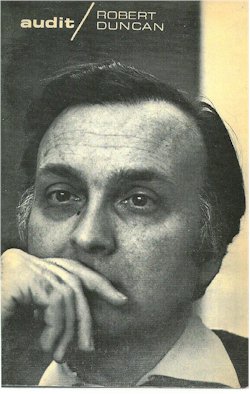
Robert Duncan: Warp & Woof

Last weekend, besides seeing Marie Chouinard Dance Company go through its paces at La Place des Arts in Montreal (see post below), I also attended a lecture by Robert Duncan at Naropa College in Boulder, Colerado. It was pleasant being part of the audience, people around me caughing and shuffling their feet, rising to ask barely audible questions, or laughing at his jokes (sometimes I chuckled too). A fair number of these people are probably dead, as is, of course, the lecturer. Occasionally cars purred by that have long since been to the junkyard, and I think I heard a plane, possibly heading to Denver -- the windows were open, so it must have been some time in early Fall or late Spring. Attending a lecture of 25 or 30 years ago is one of those things, of course, you can easily do nowadays via a medium that Duncan, eminent spiritualist though he was, could never have possibly imagined. Like the University student I haven't been for decades, I kept assiduous notes -- this time, not on a notepad but on a computer screen.

Duncan was a fascinating and entertaining lecturer, whose nervous stuttering staccato could barely keep up with rapid-fire associations in his head. Frequently, almost willy-nilly, he went on tangents, but the theme and direction were nearly always clear. Today I touched up my notes, added paraphrases here and there to make them at least somewhat intelligible. Since the lecture, entitled Warp & Woof, Part 1 (I was unable to find Part 2) is more than an hour and a half long, I thought you dear readers might benefit by scanning this synopsis of most of his main ideas, as well as a number of thought-provoking curiosities that came out along the way:

Imagine a warp and woof, as of a fabric -- imagine it going throughout the universe
The warp & woof of the "true" and fabricated universe
The word poetry: Greek word for making something up
"Song" -- canto -- entirely other origin, aspect
Semitic community (Judeo-Christian & Moslem world) was in for quite a shock when it came in contact with this decadent Greek idea of a made-up world
Greece had doctrine of inspiration
Semitic world, on the contrary, was opposed to graven images, making things up. In that tradition, one should not "make a poem", but speak with a poem that comes from your voice, heart. Prophetic, vatic voice.
Duncan himself: a product of the Celtic and Jewish trads. + Greek idea of making up.
Sappho
Christian world: felt there was something profoundly wrong about making up things & persons. Only in Rennaissance was "making up" returned to prominence
Shakespeare (Tempest): Universe a stage. A master maker.
The germanic word for poet is maker too.
Story tellers thought of themselves as makers; talk about weaving a tale. (Goes along with weaving cloth): story you tell as you weave cloth. Minotaur; maze.

In happy Jung land: you aren’t making things up once again. Psychoanalysis: archetypes: not made up. Lady Macbeth’s archetypal standing less interesting than the made-up aspect.

Duncan suggests (jokingly) an alternative to the Oedipus complex: the Jocasta complex: mother aint’ going to leave the son alone.

An ecclesiastical work is not "a making up"; it is a vision of what is there.

Homer: Penelope: every day weaving a design of a plot; all a work

In our own Judeo-C world, word “craft” is even yet filled with apprehension: as in crafty
Craft is a cunning little animal: one you tame so it won’t bite you

Ezra Pound: all human spirit is identical, consubstantial. All times contemporaneous. We evoke a presentation.
Cocteau: Pound is the last rower on the sacred river of Arabus.
Lowest rung of heaven is hell.
Limbo is the conventional world, a world world where love is good, war is bad; the world of the mother’s day poem (platitudes)

We don’t have such a thing as imagining, without being recharged by understanding.
(Psychoanalysis: fantasy is called making things up)

We’re in a fabric of time and space. People 40 yrs. from now will not be buzzed by the same buzzes of now.

Celtic traditon of the bard – keeping alive the identity of the tribe. Now bardically, the poet must keep alive our identity in the universe.
We leave an imprint. We devise a design in a poem, but it is like a footprint out of which you extrapolate an entire dinosaur.

Conventional dictum “Write with your true voice.” Don’t come on like an immitation Robert Browning. But if you do immitate well, you are yourself anyway. Imprint.

“What do you think of this” = will you think about this for me.

No matter what I think I say, the words say other things: storehouse of impressions.
You cannot take a thing you feel and put it into language.

Say Cow – that’s my cow, but not really your cow.

One of our communities is language.

Everybody has this notion of emptiness. Language has a term: nothing. Language tells us we’re individuals. That’s not our idea. We discover ourselves in commonality.

Idea that archetype is in you, nothing like the idea that it’s in language.

You’re in the hands of the peril of the universe when you are in health. Being sick: getting with the program, as it were.

Eripides not in the web; Shakespeare is. E. limited by notion of catharsis. S. creates a world; gives eloquence to all virtues and vices in the web.

Creely poems frequently have no images. Shakespeare: no images in “To be or not to be”
What was an image? Nexus of when a person... (forgot to finish my note here)

We are not warp nor woof – we are holes (between warp & woof).

We think of Whitman as "big superdaddy poet", not as leaves of grass, one of millions, which was his view, ultimately.

A love song with language rather than notes.

Writing a sonnet – doesn’t require faith. Playing tennis with the net up (Frost). But being is a different game – hard to know when you are playing being.

Loyalty is not faith.

There’s a flow – because there’s a language and going on in our heads all the time -- continuously of poems – an artesian well of sorts – but the art of poetry is actually a structure to prevent us from being plunged into the absolutely everlasting generative field that language is. It is of high magic field, it is a form of evocation. You get inside a pentagon – because you don’t want to be swamped by the whole spiritual world. A sonnet (or any other poem) like making a little garden inside the language. In the sonnet, love and the erotic brought close together in a relation. This is the grand attraction of magic: bringing things together in a circumscribed area. In the grand web (warp & woof) of the universe : love and sex not even related much of the time. We’re back to leaves of grass. We don’t mourn the loss of one leaf. Rationality, too, is a grand magic, which makes sure all its own demons remain present while the rest are consigned to the realm of the “irrational.”

Saturday, December 04, 2004

XJ Kennedy, Robert Duncan, et al.

Googling around for citations of Ciardi for the post below, I found this rather fun interview with XJ Kennedy. In it he talks about how Ciardi edited by "sympathetic contract", about trends in poetry, the ease of getting published but the difficulty of "getting noticed", etc.

Tony Tost meanwhile has sent my browser to a lecture by Robert Duncan, recorded some 30 years ago. This should provide an hour and a half's entertainment.

Things that arrived in the mail from Amazon today: Janet Frame's Faces in the Water (we couldn't find any Frame in any of the bookstores here... an Xmas gift for my girlfriend, which I've already wrapped...hardly a surprise since she saw me order it), Tony Tost's Invisible Bride, and The Making of a Poem: A Norton Anthology of Forms edited by Mark Strand and Eavan Boland. The latter looks like not only a beautiful anthology, but a remarkably unstuffy approach to closed and open forms, by poets, for poets. On order: Blizzard of One: Poems by Mark Strand; Triggering Town by Richard Hugo; Contemporary American Poets, an old anthology my friend Adze is reading, which I got for about $3; Duncan's Selected, and Introspections: American Poets on their own poems, by Robert Pack (thanks for recommending that, Charles). An order of Strand's Selected backfired, the bargain price copy I ordered not available. I'll reorder when I see the money's been refunded.

A note for Canadians ordering from US booksellers thru Amazon: the prices look like bargoons, even in Cdn. $$, but shipping costs approximately double them, on average. They don't tell you those costs until just before you finalize the order, in an obscure top right corner of your screen. The first time I ordered I didn't notice: I found out how much I was getting whacked with when I got my bill emailed to me. In most cases, though, it's worth it anyway. In others, there's no alternative. I'm keeping my fingers crossed that I don't get hit with customs charges. (The books were priced low enough... I think ... but...)