Sunday, April 30, 2006

Howl to you too, babe


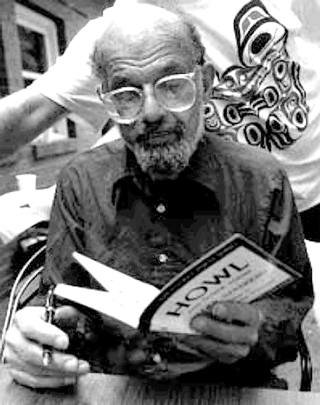
A few days ago friend of mine passed along from the April 9 New York Times Book section a review of The Poem That Changed America: "Howl" Fifty Years Later, a book of reminiscences edited by Jason Shinder.

Here for me is the most memorable passage of that review, particularly the Luc Sante quote starting two paragraphs down (I include the first two paragraphs because they provide some interesting context; the whole review can be found here):

Ginsberg wrote "Howl" in San Francisco and Berkeley; he read the long first section in public for the first time in San Francisco in 1955, and the whole of the poem for the first time in Berkeley the next year. (A CD of that performance is included in this book.) All sorts of divisions, exclusions, restrictive manners and deferences that were second nature in the East were missing in the Bay Area. If the primary terrain of the poem is New York City, the freedom one could find in California in the 50's is crucial to the air that blows through the dank rooms of "Howl," blowing all the way back to New York --but you wouldn't know it from the Eastern writers Shinder has brought together, as if such Bay Area poets and critics as Ishmael Reed,Robert Hass, Rebecca Solnit, Joshua Clover or Richard Candida Smith would have less to say about where "Howl" came from and where it went than Jane Kramer and Eileen Myles, who have plenty to say. The America that gets changed in "The Poem That Changed America" is a Steinberg map, with San Francisco as far away as Tangier. "No one," Marjorie Perloff says off-handedly, but too revealingly, "New Yorker or foreigner. . . . "

You can forget that when Luc Sante begins to tell his tale from 437 East12th Street, which is, as it happens, the same New York City building where Ginsberg lived... Sante changes the discussion as if throwing open a door: "Was 'Howl' the last poem to hit the world with the impact of news and grip it with the tenacity of a pop song?" The language is burning, the ideas are jumping and, finally, you are brought into the adventure of the poem, Ginsberg and his fellows turning New York City into their own frontier, then heading west, through Kansas, into Colorado, to the coast, then back again, discovering, you can feel, more of America in the decade before Ginsberg wrote the poem in 1955 than de Soto, Daniel Boone or even Lewis and Clark did in the centuries before them.


"Reading 'Howl' aloud or reciting it," Sante writes, "you could feel the poem giving you supernatural powers, the ability to punch through brick walls and walk across cities from rooftop to rooftop" faster than a speeding bullet, more powerful than a locomotive, able to leap tall buildings in a single bound, as George Reeves was doing on TV as Ginsberg wrote, just like Scotty Moore's second guitar break in Elvis Presley's "Hound Dog," on Ginsberg's hydrogen jukebox the year that "Howl" first made it into print. Why not? Sante lived for 11 years in Ginsberg's building. He was 36 when he moved out, and when he looks back to that moment, the self-regard of adolescent illumination, so common elsewhere in the pages Sante shares, is replaced by something that doesn't melt at the touch.


"'Howl' probably meant more to me then than ever before," he says, "because finally I could reconcile it with my own experience. 'Poverty' and 'tatters' and 'hollow-eyed' and 'high' were more than poetic figures by then. I could compile my own list of the best minds of my generation destroyed by madness. The decade during which I lived two flights down from Allen was particularly notable for its body count in suicides and overdoses, and those cadavers really had contained some of the best minds I knew. . . . If 'Howl' is a catalog of flameouts and collapses, it is ecstatic in its lamentation. And that is the basic measure of its strength: it is a list of . . . leprous
epiphanies as redoubtable as Homer's catalog of ships, but rather than stopping at that, it seizes the opportunity to realize all the botched dreams it enumerates. It envisions every broken vision, supplies the skeleton key that reveals the genius of every torrent of babble, reconstitutes every page of scribble that looks like gibberish the next morning."

Thursday, April 27, 2006

RIP Pasha 1996-2006


…but all at once

as if awakened, he turns his face to yours;
and with a shock, you see yourself, tiny,
inside the golden amber of his eyeballs
suspended, like a prehistoric fly.

-- adapted from “Black Cat” by Rainer Maria Rilke

Rilke in this poem captures all the relentlessness and "otherness" of cats, but this fellow -- my partner's cat -- was also a loveable chump, affectionate as cats can be, a true "person with fur". He will be sorely missed.

Wednesday, April 26, 2006

Who said you couldn't get rich...

Hey, nice surprise in the mail! I just got a cheque for $225.00 for three upcoming poems in Prairie Fire. And I didn't even know they paid!
(Now maybe I'll break even on postage for this year....)
They're to appear in issue 27:1. That's the Spring issue.

Sunday, April 23, 2006

FRIGHTFULLY ENGLISH! PART II

(For Part 1, click here)

A curiously pronounced fear and awkwardness of touching and kissing. The legacy of curtained tablelegs. (I have never seen a curtained table leg, but I have seen the legacy, indeed, lived it.) The famous lack of style or flair in the sexual and sensual – all stemming from the Great Victorian Inhibition. Contrast with France – wine, perfumes, provocative style, la fine cuisine. Indeed, in French culture almost everything is mediated through the senses. In the English, almost nothing is. (For some readers, this huge generalization may seem absolutely baseless: for me in Montreal, the contrast is experienced every day…)

The word, “indeed”.

The word “rather” (used as adverb).

The terribly frequent use of tag questions like, “isn’t it? Don’t you think?” “Shall we?” and all the peculiar nicety, inner doubt and hesitation that conveys. (Here in Canada, by the way, we replace most of those with, “eh?”)

The adverb “terribly”.

A certain harmless eccentricity one can only describe as “dottiness”.

Little poetry readings with a dais and a mike stand where you are supposed to stay behind that dais. (Big poetry readings with the same setup are also Frightful! -- if rather less dotty.)

Describing new poets as “budding poets”.

Inviting writers to a networking shmoozathon with “Be sure to wear your poodle skirts and spats!” (This actually came out of our own QWF… Poodle skirts, I’m quite sure, are deep American, but, nevertheless, without that Frightfully English! legacy…)

Of course, those within the culture who revolt against the Great Inhibition show they have also absorbed it to the core. If D.H. Lawrence’s romanticisation of sexuality reached an almost grotesque extreme, his Frightful English!ness that gave him that edge. It can’t just be natural. They aren’t relaxed about it. The Great Repression lead to the hilarious neuroticism of Monty Python -- also to the viciousness of Sid Vicious. We have the whole culture of “dirty” jokes, betraying what still remains an underlying reserve of hysteria about sex that simply doesn’t exist in, say, French culture. American raunchiness has roots not only in its Puritan past, but in the Frightfully English!

Frightfully English! authors include Jane Austen, Rudyard Kipling, George Eliot, William Makepeace Thackeray, Arthur Conan Doyle. Auden and Spender and Wilde are Frightfully English! despite themselves. Although Hardy or Dickens offer up plenty of Frightfully English! in their texts, I don't believe they are Frightfully English! to the core. (Let me think again about that...) Henry Fielding and Daniel Defoe are not Frightfully English! They predated The Great Inhibition.

***************
There is a certain undeniable sense of fairplay in this Commonwealth. A decency. Hypocrisy requires the presence of moral standard: that Mahatma Ghandi could not deny – after all, he parlayed it into India’s independence.

Weak (with a handful of notable exceptions) in visual arts, but great in drama: I teach ESL, and the most marvelous communicative teaching materials still come from the Universities of Cambridge and Oxford. Many are conceived with the same sense of fun as quintessentially British shows like “My Word!” (Hey, what is the origin of these shows, as well as much of the contemporary method of second language teaching? Parlour games of the English aristocracy!) Fussy fun, but fun. Although frequently, for North American use, I have to edit my text materials for sentences like, “They had quite a row, and were throwing crockery about!”

Here in English Canada, although watered down by a North American accent, we still have, deep in our core, the Frightfully English! … in spades. Upper Canada (Now Southern Ontario) welcomed the United Empire Loyalists – indeed, could have been called the United Loyalist State of America. Until relatively recently – the living memory of certain older folks – the Daughters of the British Empire were a force (The likes of Richler and Layton had things to say about that). Liquor in Ontario can only still be bought at the LCBO. We had our Lord Thompson of Fleet. We have our Lord Conrad Black (although now they have him, and they can keep him). When I listen to or watch CBC, I often wonder, is this my culture? The Royal Canadian Airfarce – in my pre-cable three channel days, that one frequently made me want to throw my shoe at the television. (I remember a phone-in show on CBC Radio that lasted over an hour on reminiscences of drinking tea.) Speaking closer to home, Westmount (Montreal's oldest and wealthiest English enclave) is itself a highly characteristic expression of Frightfully English! As well as, of course, North Hatley. Just go to summer theatre at the Piggery, or Lac Brome.

Of course Frightfully English! is worldwide, vast as The Empire. New England has it as much as us. We need only think of poor Emily Dickenson.

As for myself, my ancestry is truly mongrel: Scottish/Irish as well as certain mongrelian tribes of Central Europe. But I'm hopelessly -- Ontario -- English.

My French Canadian girlfriend continually reminds me of it.

This of course keeps me humble.

All of which is of course jolly good… wouldn’t you say? (Eh?)

Friday, April 21, 2006

One heck of a blog post by Josh the other day. Better written than almost any article I've recently read in reviews I subscribe to. Funny though when he so deftly invoked ol' the pot-calling-the-kettle black metaphor ("Pot? The kettle wants its black black."): he had me thinking of those two denigrated kitchen implements perhaps two long paragraphs back...

Thursday, April 20, 2006

JON

For a deadly (meaning lively) combination of insight and amusement, check out this video clip of a recent Larry King interview of Jon Stewart on CNN. For Stuart's 2004 commencement speech where he accepted an honorary Doctorate from his alumnus college, check here. Curious: like scripts of monologues I've seen by the likes of George Carlin or Gerry Seinfeld, it seems oddly flat on the page: you need to be able to imagine the man's delivery to fully appreciate how hilarious it is.

Wednesday, April 19, 2006

Plug

Just got back from the Lawnchair reading. It takes place in a beautiful gallery space on a mezzanine level above the store, and is quite informal, not at all "Frightfully British!" as I may have made out...despite the image and language on the ads. (Shows you how one can be taken in by an image and projection-- indeed, my partner and I were the only ones who heeded the aviso and brought little folding chairs -- everybody else sat on the floor, which was clean and polished. But I appreciated my chair: I could play the guitar and read and be on their physical level in comfort. By all accounts (my own, first and foremost), my reading/performance went very well.

It was a great pleasure, too, to share the stage with such capable writers. (To see some of their work, follow the links in the post below.) Elise Moser is certainly one to watch. She has written some short stories that are absolutely dynamite. One, "Malke's Baby", was a winner of the 2004 CBC/QWF Quebec Short Story competition; the following year, "Allons Enfants de la Patrie" (a story I personally liked better) was given honourable mention. She has also published in some very good places. I look forward to her collection when it comes out. Her poetry too is strong. Thru the web link below, I especially like "Bag of Bags".

Claude Lalumiere's work I am less familiar with. He is very active in reviewing and editing as well as writing, has 13 stories published in various reviews and anthologies. He writes mainly sci-fi and fantasy stories, and has a remarkable eye and ear for the intense, surreal, and macabre. (Actually he has invented an interesting term for work he likes (I extract from an interview published in the reading chapbook) -- "transgressive fiction -- fiction that challenges consensus reality, while delving deep into the writer's ur-mythology (the set of personal subconscious stories and imagery that fuels the highly idiosyncratic fictions of obsessive, visionary writers)"

Jan, too, shows promise. While I find her work frequently needs editing, I believe it could soon evolve to a consistently high level.

Part II of "Frightfully English" will shortly appear, even though the arrow seems, in the case of this series, to have been aimed at an unfair target. (Well, pretty soft arrow... an extenuated arrow, if there is such a thing... foam rubber, perhaps? God, that sounds like such a limp phallus-- prosthetic at that! Expect some FEROCIOUS BARBS in the future. SWARD THRUSTS! LONG RANGE MISSILES! etc.)

Local scene...

THE LAWNCHAIR SOIRÉE

Wednesday, April 19, 7-8:15 pm
at Nota Bene* 3416 av du Parc
(at Sherbrooke), Montreal

an evening of story, song and poetry with

Elise Moser
Claude Lalumière
Jan Jorgensen
Brian Campbell

cover $2
cover and chapbook, $5

Information: Jan c/o
thelawnchairsoiree@yahoo.ca
(514) 721-8420

Don't forget your lawn-chair!

Origins...

As for my background: I am mongrel, descended from Eurasian mongrelian tribes...
OK, truth: my father was born in Sidney Mines, Nova Scotia, where there are many Campbells indeed; his father came from New Brunswick, of Scottish Presbyterian origins; his mother came from Newfoundland, of mixed Irish/Scottish background, although apparently she went to a Baptist church. My mother though (whose maiden name is Scholnick) is of Polish Jewish ancestry. She was born and grew up in Montreal, not far from where I live now. Her father died of a stroke when she was 10, and her mother went insane shortly after that, then she lived a few years in foster homes and started to work very young, i.e. 14 or 15; not an enviable upbringing. Although I have aunts and uncles on her side who are very Jewish (even a cousin who is Hassidic), when my mother married my father, she pretty much turned her back on Jewish customs and traditions. My father though was of the Communist religion; they met in Toronto, in a Socialist Youth organization. So I grew up in T.O. with parents who saw religion as an opiate based on lies and superstition, while we put up Christmas trees and hunted for Easter eggs and enjoyed other pagan paraphernalia generally co-opted by Christianity. Why I'm now living only a few blocks from where my mother grew up in the direst poverty is quite beyond me.

Tuesday, April 18, 2006

So here's your soup... and it's on me.

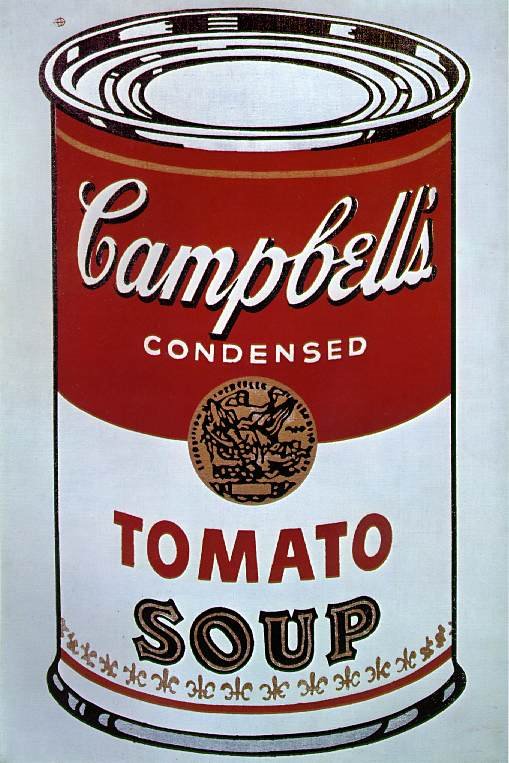
The reason for this is that for the last three days I've been getting a steady rain of Google inquiries for Andy Warhol's Campbell's Soup Can, of all things. Maybe 60 hits so far, most of them from Google Images, although also from Google. A passing soup can reference I made about five months ago seems to be the reason -- and that hyperlink is dead. So why now? Does all this have to do with my last name? Anyway, I thought I'd satisfy 'em.

FRIGHTFULLY ENGLISH!


Looking over a post I wrote a few days back, this sentence gave me pause:

Like many things printed-word literary in Anglo-Montreal, this one manages to be frightfully English! and not particularly renegade.

Now, what did I mean by “Frightfully English!”? (The exclamation point is essential.) Well, when I wrote that, I wasn’t thinking of The Sex Pistols nor Cat Stevens nor the Beatles nor the British Blues Invasion nor pub or soccer brawls nor BBC World News nor (to go into literature) Ted Hughes at his darkest nor Percy Shelley (nor Mary nor Mary Wolstoncraft) nor William Blake nor D.H. Lawrence… nor Shakespeare … although there are elements Frightfully English! about all these… even, in incipient quantities, in Shakespeare…

I was thinking of these particular, all too familiar tags and trappings that taken together create a powerful gestalt one can only call “Frightfully English!” Call this, if you will, a cluster of clichés and stereotypes, passé, more than depassé. But it is a gestalt still powerful, even today.

I am thinking of blue-haired ladies in pearl earrings and necklaces and flowered dresses, whose limited but exuberant language of emotion consists of “Oh, how lovely!”, “Oh, how awful!”, “Just charming!” “Oh dear, I do say, I quite like that!” Or any of the above, taken singly.

I am thinking of Wedgwood tea services and fine bone china and dainty little pastries and everything associated with, “Do come to tea!”

I am thinking of word “chesterfield”—the town, the piece of furniture. Also Manchester, and anything containing Chester, including of course the name Chester.

The hideous flowered wallpaper & brik-a-brack interiors of “Coronation Street.” “Coronation Street” itself, all that pale workingclass mimicry of that Frightfully English! aristocracy.

Tarts – all kinds. Including the “cheap little tart” you can pick up at the pub.

Ye Olde Pub. (That’s the chiefly boozy version of Frightfully British, enough Scottish, Irish and Welsh that it makes for a questionable inclusion … but read on…) All that lousy Industrial Revolution fare – fish and chips, pub food. The North American version is of course the hamburger and the hotdog. Hard to call these a cuisine. See notes (to come) on sensuality & the lack of it.

I am thinking of the Frightfully Stuffy, English! aristocracy, a guilded cage whose birds still flutter in such tight, pre-defined little circles. (Here in North America the circles we fly in have not been so confining or pre-defined – but we are definitely flying in circles, even if we haven’t quite defined them yet.)

The fox hunt, recently banned under the pressures of the equally Frightfully English! animal rights movement.

Dried flowers in a Wedgewood vase.

Rock gardens with lawn dwarfs and waterwheels.

The word persnickety. The word concoction. Peter Piper Picked a Peck of Pickle Peppers. All the fussiness and finicky drabness contained or implied in this list.

More, as I said, to come...

Friday, April 14, 2006

Sunday, April 09, 2006

DEREK WALCOTT

This afternoon I had the good fortune of seeing Derek Walcott read at the Metropolis Bleu Festival here in Montreal. This is one reading I'll remember for the rest of my life. Before today I really had no awareness of the enormity of this man's poetic accomplishment, and the four poems selected in my Norton Modern Poetry (well, it is the 1973 edition) which I read before the reading gave me the only the slenderest hint. From the vast and varied Collected to the epic Omeros, he opens up worlds. I'm brought to mind of Octavio Paz's distinction between "central" and "eccentric" poets. (Example: T.S. Eliot is central, H.D. eccentric) Although isolated on the margins in the Caribbean, Walcott manages to be a most central of poets not only in the authority with which he expresses the rich and vivid elementals of his native land, but the assuredeness with which he draws upon a rock-solid foundation in the Western mythological tradition. The analogy between the islands of the Caribbean and the journey of Odysseus is entirely authentic and natural -- I am brought to mind of George Seferis' Mythistorima or Pablo Antonio Cuadra's Songs of Cifar and the Sweet Sea. He reminds me that drawing upon traditional mythological sources can render a poet into an instant time traveller, giving access to depths -- and heights -- beyond the narrow here and now. Note to myself: must go back to that... back to that hoary Old Testament, perhaps something "new" from Buddhist or Aboriginal traditions... that'll be quite an excavation.

Walcott's reading was warm and understated but dramatic. He struck me in his verse and in his mien as a man who had seen "it all", who had gone through world-weariness to the other side that is wisdom -- sombre but luminous, bleak but in the end, not at all pessimistic. And I loved the lilt of his accent...

Can't quote right now from what he read (I remember he read selections of The Schooner Flight that were quite impressive) because by the time I arrived at his book table all his work been sold out. A friend of mine fortunately was able to buy and have him sign perhaps the last remaining copy of his Collected, which I'll get my hands on soon enough when my friend feels he can lay it aside for a while.

Thursday, April 06, 2006

National Poetry Month

I just learned through Amanda Auchter's blog that one of the ways the American Academy of Poets celebrates National Poetry Month is by posting a daily poem on their site as well as emailing it to interested subscribers (even uninterested ones). These are recently published poems by, of course, Americans. To see the poems published so far and to subscribe yourself, see here.


Up here April is also our National Poetry Month. (Is that what makes it the cruellest month? Joking aside...) It would be great if our League of Canadian Poets could get it together to do the same thing... an obvious and simple and probably not too expensive way to raise poetry awareness. Will suggest it to the "powers that be"...

Tuesday, April 04, 2006

POEMS IN TRANSIT

Remember this Jake Berry quote from a few posts back?

...many, most, of the poets outside the academy have [resigned themselves to obscurity]. They pass poems to one another and publish in the handful of publications that accept outsiders. Primarily they work and either self-publish or publish one another in small inexpensive editions that the general public would not even recognize as a book. Most of the poetry I read that might "matter" has almost no exposure at all to an audience beyond a few interconnected renegade cabals in what remains of the literary underground.

Case in point: Jan Jorgensen, the sweet, well-meaning soul who runs the Lawnchair Poetry Soirées I'm featuring in later this month, is publishing a short-run anthology of poems with train travel (which I took to be public transit) as a motif. She also publishes quite lovely commemorative chapbooks of material in her reading series. Lawnchair Soirées? Well, it so happens that at the Nota Bene Papeterie (that is, stationary shop) where the series takes place there are no chairs, so people are encouraged to bring their own lawnchairs, cushions, etc. or else sit on the floor. Hence the name, with a whimsical Lawnchair logo to boot. Like many things printed-word literary in Anglo-Montreal, this one manages to be frightfully English! and not particularly renegade. Even though Jan is probably of Swedish or Danish/American descent(I'll have to ask her), and quite open to a French (as well as other language) presence, which hasn't quite happened yet... en tout cas...

I sent her some previously published work that I thought might fit in her anthology. Here was our correspondence (published with her permission):

From: janette jorgensen
To: Brian Campbell
Subject: RE: submission of transit poems

hi Brian.

just wanted to say that I've received the poems... I really like the variety of tone.

cool. (just know that I am given to understatement)

I am tempted to move beyond trains just to be able to include that bus poem.

you know, no one ever buys my poems...
so what do you think I should do about this anthology I am putting out about the trains ? - do I give each participant money for each poem they've submitted? do I give each participant their percentage of the profit? right now I am publishing at a deficit... just for the pure joy of making
little books... what were your expectations?

see, for some of us this is about the only way to get published -

please let me know what you think

best wishes
jan

My answer:

Dear Jan,

Pay us in metro tickets -- or one Toronto Transit token of appreciation.

Pay us not by the word, but by the silence around our words. A com-mute, as it were.

Copies are appreciated, that seems fare.

As for the little books -- well, they're the transfers we need to our destination -- the reader (any reader, even if only ourselves).

Very best,

Brian

She wrote back,

what a lovely poem answer.
blessings
jan

Fun that was, indeed. Made my day!

Monday, April 03, 2006

SEVENTEEN THINGS I TOUCHED TODAY
-- RUTH ALTMANN Across the Big Map (2004, United Artists)

Soap, my wet soapy body all over.
Steel wool, an iron frying pan,
cool coins, green paper money
rough and torn from use, the radio,
potato chips in clear cellophane,
a glazed pottery mug of hot coffee,
the round glossy hard typewriter keys,
sheets of smooth white typewriter bond,
a paperweight, a Block Island stone
a child painted a face on, a telephone,
the black serifed typeface of Jimmy Schuyler’s
The Morning of the Poem, the poems, a friend’s
anger, rain on my face and in my eyes,
your hands hair lips velvety eyelids.


An obvious and very effective "constraint": list things you touched that day, fashion them into a poem. Some would call it a "list poem", and dismiss it with that. But this one draws you in like a magnet with it's implicit story line. So many flick sequences -- porn and otherwise -- begin with a lovely body in the shower (and yes, it seems lovely, doesn't it, even if that loveliness is evoked by the barest -- excuse the pun -- sensual description) -- but this one takes you in utterly surprising directions. I like, for instance, the way the friend's anger becomes something she has "touched". The way the poem comes back to another sort of shower and touching. I found this on Ron Silliman's blog some time back; he has an interesting if, in accordance with his psychological style, rather cerebral/sociological appreciation of it here.

If this poem is any indication, Across the Big Map is a very good first book by a promising poet from New York. So it may surprise you to learn that Altmann was born in 1920.

Saturday, April 01, 2006

Good news

Yesterday I got two pleasant surprises in my inbox: two poems were accepted by Nth Position (they'll be online in about 3 months) and one by Carve Zine, a local magazine devoted to Montreal writers.

Blog bog...

Old template problems in Explorer seem to have cropped up again. The sidebar (with profile, etc.) has been pushed down below the posts. I've rectified any posts that could have caused problems. The last solution, pasting a certain line into the template as kindly suggested by you AD here doesn't seem to be required. Do you see what I see in Explorer? i.e. that my blog is a mess?

UPDATE: I seem to have solved the display problem in Explorer at least for the front page of this blog by reducing the number of posts displayed here from 23 to 10. This will doubtlessly reduce load times as well, and make "culprit posts" that cause the display to go askew easier to isolate. I guess I'm attached to my posts -- at least the better ones -- and set the number high about a year back so as not to consign them too soon to the nether world of the back pages. On some previous months there are display problems, but at least the front page displays well...

SOME TECHNICAL NOTES, OF INTEREST TO FELLOW & POTENTIAL SUFFERERS:

Have been having all kinds of problems with Blogger of late. For the past three days, I have been unable to access this blog through Firefox; through Explorer, I could see the blog, but up to now, couldn't enter past the dashboard to post. This also for three days. Finally the problem seems to have been rectified, after several complaints to Blogger Support and the help group answered only by autoresponds. (Dozens if not hundreds of people, apparently, have had this problem...)

Right now though, I’m cutting/pasting all my writings here to Word as a backup. I discovered I can cut and paste the text, pictures, links, everything right from the display with a simple press of Select All and Copy. Saving a month takes about 30 seconds. Apparently there's a more sophisticated program available to do that more accurately, and perhaps I'll download and learn it eventually. All this as a potential stress saver. I wasn't exactly worried out of my mind -- Google for goodness' sake I was sure would come up with something, eventually -- but still, I was beginning to feel uneasy. Hundreds of hours have been invested in this blog, and I would hate to see it all go up in smoke.

My impression is that Blogger is understaffed, and that Google (despite it's oodles of $$$) is not giving its all to be a truly responsive or solicitous service. I've never gotten more than autoresponds to questions or reports of problems, never an answer more specific than general advice on their Help page provides. Eventually Blogger may screw up big time, as they almost did with me, and scandalized users will jump to Typepad or some other alternative service, and let the word spread loud and wide.

It seems a law of commercial (viz. human) nature that top dogs get complacent and fall asleep, then tumble to the bottom because they just stop feeling that necessity to be AWARE. Compare to Bill Gates & company winning the browser war, and then letting Explorer go to pot (no updates, security holes breached by hackers) because they haven't felt the need to fight it anymore. Compare to the fall of the Roman empire.

P.S. By the way, as a browser, I highly recommend Firefox, rather than this clunky, unstable thing the majority of you are using... I've said it before, but it bears repeating. Get Firefox. Opera, too, seems to be getting good reviews.