Showing posts with label Allen Sutterfield (Adze). Show all posts

Tuesday, August 11, 2009

"FIX" GETS FIXED INTO PAINT

Just got back from a painting class with my friend Sekai, where I did the above (& below) -- an acrylic interpretation of my prose poem "Fix" (seen here, in the Evergreen Review). "Fix" is included in my recent collection Passenger Flight, and here, fittingly enough, the text is affixed into the painting. This is the first of a series (I have two others, but they need a few touches to complete).

So, what do we call these: ekphrastic paintings? Usually ekphrasis is applied to texts that take after works of visual art, but according to this Wikepedia definition, it can be the other way around (i.e. a painting of a literary heroine, or even a painting of a sculpture). Here, though, the poems are included in the paintings that interpret them.

My friend Allen Sutterfield has a nice term, "text-visuals". His own "T-V series" consists of hundreds of poems paired with visual images that play off them in some way -- mostly magazine cut-outs, collages, photographs.

Whatever they be, I'd like to do a series of eight or ten, maybe put on a show somewhere. Or have them on display at a reading.

Beyond that, I have no painterly aspirations. With a bare minimum of technique, all I bring is raw sensibility to the canvas. But there you are.

Friday, May 30, 2008

GRENDEL'S POND

My friend Allen just sent me a note about his chapbook, Grendel's Pond. It includes an excellent resume of the Grendel legend, and some of its symbolic implications.


GRENDEL’S POND is the fourth in a series of small chapbooks comprised of selections from THE CITY OF WORDS, an epic work of more than 5,000 individual texts. There are 38 texts in Grendel’s Pond: poems, prose pieces, and pieces of writing which do not fit easily into any categorical genre. I call all the works ‘texts’ for the very simple reason that any piece of writing is literally a text, and there are many varieties of verbal expression in THE CITY OF WORDS. It is the writing itself, the language, that is the important part, not the category.

Grendel is a monster in the early English epic BEOWULF, the fiend whom Beowulf fights and kills. Grendel lives with his mother underwater in a fen or boggy pool. After Beowulf mortally wounds Grendel in their first encounter, the monster’s mother ravages the countryside even more fiercely in revenge. Beowulf then determines to complete his effort by seeking out and killing this second fiend. Their battle occurs underwater in this pool, and is a more desperate fight than the encounter with Grendel. My title refers to the choices a poet must make in pursuing his craft. While it’s convenient to think of the pond as a symbol of the Unconscious (personal and collective), I also have in mind the ordinary external world, whose surfaces must be plumbed to get at any kind of truth. There are plenty of monsters in both places. The poet here is seen as someone actively engaged in conflict, not a mere commentator on or describer of events. This engagement is largely invisible, just as Beowulf is fighting unseen by human eyes. The most valid poetry comes from such depths, and anyone seriously engaged in the effort to create poetry is entitled to a share of the epithet ‘heroic.’ Beowulf succeeds in slaying Grendel’s mother and re-emerges from the pond, having freed the inhabitants of that area from terror and suffering. Successful poetry also liberates us, the readers, if only by reminding us of a larger, more heroic world than the compelling surfaces of ‘the daily grind.’

Robert Bly’s very perceptive book IRON JOHN is a kind of echo of Beowulf, in that Iron John is discovered living at the bottom of a pond. He is brought to the surface by a less dramatic hero than Beowulf but still a very effective one. Iron John is immediately imprisoned in the local town, but eventually escapes, helped by the young son of the King. Ultimately Iron John reappears as a “Lord of Life’, having emerged from a kind of enchantment that had imprisoned him in the pond. This is a primary aim of poetry itself: to wake the reader from
the drowsy humdrum repetitive rounds of everyday existence into a sudden awareness of a world one does not usually see or think about but which is there all the time. The poet shares the same world we do, but he or she lives in it differently, beneath the surfaces most of us take for granted, and because of this ceaseless interactive struggle “in the depths” , poems emerge with the power to propel us, even if only for a moment or two, into that more real place we usually describe as ‘dreamland.’ The Poet’s dream is the dream of the Real, and the poet’s touch wakes each of us into a world of the ‘really Real’. These vivid moments enable us to return to ordinary tasks and involvements with a revitalized sense of ourselves, making possible a more productive, satisfying relation to all those around us. Poetry places us in touch with a larger feeling of both self and world. It is in this sense I find it a ‘heroic’ human action.

Grendel’s Pond is dedicated to a close friend of mine, who lives in Montreal, Canada. We met in 1983. I was hosting a weekly poetry reading series, at an art gallery. Brian was a scheduled reader for a Saturday night in late October. He arrived on time but alas, the weather was cold, wet and windy, it was a Saturday night and no one else came by! Brian and I spent a couple of hours talking, and I re-scheduled him for a later date, that proved much more successful. This is an example of the many disappointments any poet is in for, in seeking connections with the ordinary world. The poet soon learns to accept the loneliness of the poetic effort. It was Brian who, several years later, introduced me to Robert Bly’s IRON JOHN, on a trip we made to New York City, where among other things we attended a poetry reading in an apartment in Greenwich Village. Our own poems were well received by the people gathered there, all of whom were very creditable poets themselves, though unknown to the public at large. This, too, is part of the loneliness of the poet’s life.

Best wishes to all readers of GRENDEL’S POND! May each of you find in it a gleam or two of the ‘really real.’

Side note: I very much remember the poetry readings, or rather, encounters, he refers to. The first took place in his gallery, Gallery No, in Toronto (open for a year, our little in-joke was that it soon became No Gallery). The second one took place in Emily Glen's apartment in Greenwich Village in 1988. Her Sunday-night readings were advertised in the Village Voice. These inspired a series of readings we did in our apartments in Toronto; later transferred to the Art Bar at the Gladstone Tavern, they eventually became the Art Bar poetry series, which continues to this day. I wonder if anyone out there knows what became of Emily Glen? If alive, she's very old. On the net, I found this account by one of the sorry but lovely souls who took regular part in those readings: it sounds like it comes from about the time we were there.

Sunday, May 18, 2008

TEXT 518

I hear a distant bell and children singing. Below the carpenters handle delicately a mammoth pane of glass, so clear it seems they carry a piece of the Invisible. The radio squawks and gabbles, tuned on an outlandish frequency. In an outer corridor a woman walks down stairs, confusing the walls into a white silence. Magenta and blue plaster, the city on the hillside sits patiently in the rain, rife with a stolidity learned of centuries (the sun will come again). It is the moon's day, incipient and wet. In the small black-bordered room (No. 37-A) at the back of rain I play solitaire with a deck of live cards, faces contorting in mockery, the vain reflections of a thousand mirrors. The skin is rubbery and unreal, the numbers and symbols in black and red profusion weave and cross -- now there are thirteen where there were three, now two where once ten. The hour glass, brought from Arabia by camel, pours an endless stream of moments in a golden string. Suddenly an alarm sounds, the cards are abandoned to their private vices, I rush from the table to the windows -- the parade has begun. Slowly in spectacular file the myriads inhabiting the assorted rooms pass by. The day will end in a bloody sunset, despite the heavy promise of the clouds. Always a spectator! Always!

-- Allen Sutterfield (Adze)

Saturday, May 17, 2008

Adze (aka Allen Sutterfield)... alive & well

Allen Sutterfield at the launch of "Grendel's Pond" in Chengdu's The Bookworm.
-- courtesy of Della Marina


Was relieved to get this message the other day:
Thanks Brian, yep, I'm ok. I'll give you more details later but no real damage in Chengdu proper. Did you ever receive GRENDEL'S POND? aLLEN
And yes, Grendel's Pond, Allen's chapbook -- rubber-stamped April 11 -- arrived in the mail the same day. To my happy surprise, here was the dedication on the inside front cover:

FOR

"Montreal Bryan"

Poet, Friend and Companion
on many dives
into the depths
of
Grendel's Pond

The writing itself? Well, I have yet to give the chapbook a proper whirl, but I can say this much: although he's been a wonderful editor and mentor/friend on my own writing journey, his writing has never been entirely my cup of tea -- although I'm sure I understand the subtleties of its "taste" better than ever.

Basically, with some lyrical exceptions in his oeuvre, he's a kind of "language poet", branching off from people like Olson, Kerouac, Patchen and Ginsburg, although quite disconnected from, and possibly unaware of, prominent later or "other" members -- Zukovsky, Bernstein, Andrews, Silliman, et al -- of that movement. He's written over 5,000 texts -- poems, fragments, prose poem- or journal-entry like things --which he has paired with visual images, and which are connected together into a grand organizational scheme -- as yet, not totally realized, and probably impossible to "complete" -- that he calls "The City of Words". A central notion is of an ethereal (although always actual, he'd argue) world created by words into which writer (paired with the reader) enters on an open-ended journey of discovery. Process is the thing, which enables, of course, a kind of endless "anything goes" on the part of the writer. Demands on the reader, though, as he negotiates through this multilateral web and tries to parse intended from accidental meanings, can require an elite level of literary awareness. Frequently Allen's work consists of a conscious meditation on the process itself in the midst of the process, a kind of writing about writing. Many of these are unsatisfactory to me -- emotionally meager, sensually devoid. However, pieces marked by formal completion, trenchant observation, that are particularly"alive" in their awareness, delicate, airy, even visionary -- and there are a number of those -- can elicit my appreciation, even admiration. Flipping through the book, I see a few of the texts we argued about in his basement apartment in Toronto's Beaches two decades ago. Four pieces, all told, from a series he called "Runes" -- first words (or final words) of other poems strung disjunctively together, which themselves suggest a kind of narrative or at least, an intriguing juxtapositional dynamic. My response at that time: what the hell? Too mechanical. Now, though, I quite enjoy them in their polysemous serendipity. Here's one of my favourites:

TEXT 2659

for
is
catch
it
I
sleeper
inside
in
closed
bed
contained
trip
what
that
the
what
is

I see he also included this particularly astringent little text. To me it has resonance for all his work:

TEXT 5134

Poetry is more than lies on the surface.

-- Tram's APOTHEGMS

Here, a poem. And here, a prose poem, one of his strongest texts. My dialogues with him have figured prominently in this blog...although what can be found here is the tip of a pretty large iceberg. To sample some of his critical insight, which can be acute, click on the label below.

Tuesday, May 13, 2008

Quake

Only tonight did I learn that the epicentre of China's major earthquake is only 90 km. from Chengdu, where my friend Allen Sutterfield is staying. Poet and editor of my first book, he now teaches English at Sichuan University. So far, I have been unable to get through by phone, and he hasn't answered my emails. But from this article and this blog, I am relieved at least to hear that Chengdu, while badly shaken, was not severely damaged: a lot of plaster fell off walls, but apparently not a single building in that city of over 11 million collapsed, and none or very few died. As long as my friend didn't happen to be on an excursion anywhere near Dujiangyan that day...

Sunday, January 28, 2007

YOU, YOU, YOU, YOU, YOU, YOU, YOU Part II

... Actually, referring to the post below, what Allen is advocating (with qualifications of course) is first person singular as a kind of "default person", which I'd say it already is in contemporary poetry, and indeed, in lyric poetry of all the ages.

But, to explore you a little more…

In English there are many senses of you.

You can be plural you (speaking to two or more people at once) or singular you (speaking to one person); it can also be general (sometimes called indefinite) you, which is like "one", as in informal speech when we give instructions ( "to repair a flat bicycle tire you have to first determine where the leak is"), or a specific (sometimes called definite) you, as in "I want to speak to you."

What Allen is complaining about is an over-indulgence of the indefinite you, which can get more than a tad presumptuous if carried too far.

But here's an amazing poem written in the indefinite second person, that doesn't just "work" but blows me away -- because it is so vividly rendered, because it takes you into such surprising spaces.

WHERE YOU GO WHEN SHE SLEEPS by TR Hummer

What is it when a woman sleeps, her head bright
In your lap, in your hands, her breath easy now as though it had never been
Anything else, and you know she is dreaming, her eyelids
Jerk, but she is not troubled, it is a dream
That does not include you, but you are not troubled either,
It is too good to hold her while she sleeps, her hair falling
Richly on your hands, shining like metal, a color
That when you think of it you cannot name, as though it has just
Come into existence, dragging you into the world in the wake
Of its creation, out of whatever vacuum you were in before,
And you are like the boy you heard of once who fell
At the top swirling in a gold whirlpool, a bright eddy of grain, the boy
You imagine, leaning over the edge to see it, the noon sun breaking
Into the center of the circle he watches, hot on his back, burning
And he forgets his father’s warning, stands on the edge, looks down,
The grain spinning, dizzy, and when he falls his arms go out, too thin
For wings, and he hears his father’s cry somewhere, but is gone
Already, down in a gold sea, spun deep in the heart of the silo,
And when they find him, his mouth, his throat, his lungs
Full of the gold that took him, he lies still, not seeing the world
Through his body but through the deep rush of grain
Where he has gone and can never come back, though they drag him
Out, his father’s tears bright on both their faces, the farmhands
Standing by blank and amazed—you touch that unnamable
Color in her hair and you are gone into what is not fear or joy
But a whirling of sunlight and water and air full of shining dust
That takes you, a dream that is not of you but will let you
Into itself if you love enough, and will not, will never let you go.


For most of us, this you becomes a kind of I in a dream, an essential or existential I.

At least part of the effectiveness of you here, though, is that the narrator doesn't stay in that difficult-to-sustain voice very long: the poem soon becomes a third person narration with the description of the boy's experience of falling into the silo, and we only return to the you in the final lines. (That the boy's subjective experience of his own death can only be imagined -- that it is indeed the "stuff that dreams are made on" -- of course contributes to the dream-like quality of this poem.)

However Hummer brings it off, that attainment of a dream-like quality is, I would say, is the challenge of writing a poem in the general or indefinite you.

I have also, by the way, seen you begin as a kind of general you, and then turn quite accusatory as that you takes on the particularities of a specific you. That, too, can be quite compelling.

As a side note, in languages like Spanish, French and others, the English second person may be parsed into different pronouns which inherently specify whether one speaking hypothetically, to one person or to two or more. But in English, well, we do have this ambiguous or multi-purpose you which requires context to clarify. The effectiveness of the unclarified you depends upon the persuasiveness of that context, and ultimately, how you is used.

Tuesday, January 23, 2007

YOU, YOU, YOU, YOU, YOU, YOU, YOU!!!

Back in '05, Allen Sutterfield (a.k.a.Adze, one of my three or four honest friends/readers/critics) sent me a missive absolutely lambasting a poem I wrote in that rarest of persons, Second. After all this time, yes, I admit, I (almost) completely agree -- it's back to the drawing board with that one. Here's is the substance of the criticism:
This one…rubs me wrong at every turn… 2nd Person is a very weak viewpoint - the reader is immediately "double-distanced" from whatever is happening… it's rhetorical, not personal…
He goes on to say,
Second Person is all but impossible. Change your "second person" musings to First Person and feel the difference.

Think about basic honesty: there is only first person, really, for anybody.

Even First Person plural is difficult. It sets up awkward pronouns (We…from our previous life." & noun s/plural difficulties.

It is not that one can't or "should never" - not at all.

But it is good to look quite calmly and objectively at the

differences

involved when making these specific choices rather than just vaguely ascribing the difficulties to Poetry, Psychology, Creativity, etc.

By focussing on specific, concrete language choices and strategies, one can greatly improve the

writing

involved. As for the sensibility, that's a whole other matter. But writing is a controllable, adjustable, learnable discipline.

Only vanity argues this point.

Wednesday, June 07, 2006

CHAPBOXES

Got a fun letter from my friend and former editor Allen Sutterfield, otherwise known as Adze. For a man who's 60 + some, he sure manages to keep his vision fresh. It seems he's come up with a new publication format: TEA READING BOXES (ed. note: now he calls them CHAPBOXES, a much catchier term for 'em). For those who operate in the underground zine and chapbook realm, this should resonate. Read on:


Hi Brian,

It rained the whole day Saturday seriously dampening turnout for the book fair. I did sell $79 worth of "goods" (GUATEMALA was prominently displayed but alas, no sales), minus many little expenses. I was exhausted by the end of it though and even this week have just come from rehearsing with Wayne for a performance two nights from now at a new Coffeeehouse venus Nik Beat is starting. Am having a chili party on June 24, my one party of the summer. Wish you could be here for that! Montreal is most unlikely for me, I now realize--I always want to do too many things! Can't be helped! Anyway stay in touch and I'll keep tabs on any sales--I'm thinking of selling books on Janet's front porch on Saturday mornings! Yours will be out there for sure! Also I recommend you always carry one or two with you when you go out anywhere, you never know when a sale can manifest and at least that way it's a part of every context. I'm practicing that speaking tonight with a couple of my chapbooks along for the Art Bar!

The biggest hit Saturday was my "TEA READING BOXES"--you know those wooden tea boxes you buy in Dollar Stores, with 20 teabags inside? I took the tea out and put 20 texts in instead! Added one teabag, a table of contents and packing note. It's ADZBOX 1 and so forth--I made 24 so far, sold six that day. So for ten bucks one can buy my little chapbook AND a teabox! And one person did. I was only selling them for six bucks. It was fun. Feedback has been good. Keep me posted on what's happening with you this summer, even if it is similar to past summers in large ways. It never is in SMALL ways which then become large in turn! A.

Friday, April 14, 2006

Thursday, December 01, 2005

The Best Way to Read a Poetry Anthology


From a letter from my friend Allen Sutterfield, from two summers ago (our copious correspondance, Vol. Umpteen):

....Do you know and or have in your library an anthology called: THE CONTEMPORARY AMERICAN POETS, American Poetry Since 1940, a Mentor paperback published in 1969 (!!), edited by Mark Strand? It's a very good collection. I recommend it, if you do not have it. I have also finally discovered the best way to read a poetry anthology: put it in the john and read a few poems at a time, preferably by one author, or a couple if only a single poem is included, ALOUD of course. The particular circumstance enables an unusual degree of concentration on 'the matter at hand,' so to speak....! I shit you not.

Anyway, if you don't have this anthology, I may send you a few photocopies of some of the poems in it. Often I have said in the last 15 years "Who's writing today?" There maybe no dominating presence like an Eliot or Pound but there are a hell of a lot of good poets writing--and this book itself is 35 years old! All those people in it are now in their 70's and 80's if still around. I think one fun activity for us in the coming year in our Poetry focus will be to root out and find which of these and of the many others since them who are writing today are worth following up--and then go find their actual books if possible.

We never followed up on that idea. If my friend were more tapped into Poetry Blog World or the internet, he wouldn't feel quite at such a loss. But we've gotta love him for this "johnny on the spot" suggestion... one I'm sure Leopold Bloom would have taken to.

Wednesday, November 02, 2005

À la prochaine…


Tomorrow morning I'll be on the train to Toronto. The occasion is

Fri. Nov. 4 3:30pm "Reading in Two Voices" Brian Campbell + Francisco Santos @ Festival de la Palabra y de la Imagen / Festival of Images and Words, York University, Glendon Campus, York Hall 3rd Floor, Toronto

although besides sharing stage & conversation with Francisco, I will also be staying with my mother, spending some time in the hospital with what's left of my ailing father, whose Alzheimer's has become quite advanced, and taking a side trip to Guelph, Ontario to crash at Allen Sutterfield's and take part in his reading series there --

Sat. Nov. 5 1-5pm: Woolwich Arms, Guelph, Ontario
Will be back Lundi.

Mardi, by the way, I'll be reading at the Arts Cafe here in Montreal. That's what that poster up above is about... Cute, eh? So... what is blank poetry anyways??.......

Ciao, sundry all. À la prochaine…

Wednesday, October 26, 2005

THE DEPLORABLE FUTILITY AND YET ABIDING BEAUTY OF IT ALL

Exerpted from an email letter of a couple of years ago from Allen :

You and I have been over a lot of territory in the last 15 years about poetry and poems and publishing and the deplorable futility of it all and yet the abiding beauty of the effort and the results the effort yields--even if only for oneself and another person or two.

I would dearly love to "make some collections" out of those (ed.: that is, his) 5000 texts! The single volume is after all another level in that work (which has 7 levels but did I ever show and tell you those 7 levels, of which the 5,000 individual texts are only one level?). But I can't do that by myself, I need input from others, especially literate others like yourself. So there's plenty to talk about and plenty to do and I'm sure if we persist we'll get some good result, each of us and both of us. I respect your writing and always have, you are more than competent, you have the touch of madness necessary! If you think not, then just perform Latin Scholar in The Woods to remind yourself! Gotta go but there'll be more to say.

Allen

Yes, must continually remind myself... not just by re-performing the old, but making anew...but it's great to have a collaborator, a respect-worthy supporter, a cheering section of one or two. That's all one really needs...

Friday, October 21, 2005

MEN PLAYING WITH WORDS: CANTO PUBLISHED IN DUSIE

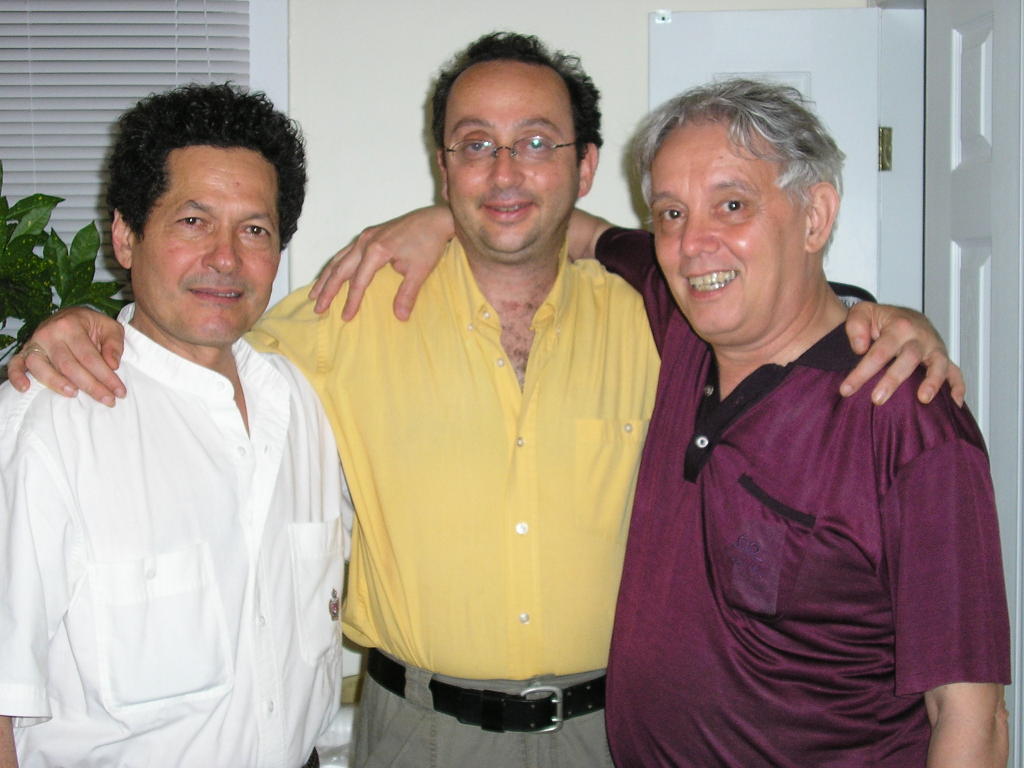
Francisco Santos, myself, and Allen Sutterfield
on the evening we wrote "Canto"


It was a suffocatingly muggy evening, June 14 of this year. Both Allen and I were in Toronto, and had arranged to get together with Francisco at a friend's place, where Allen, who resides now in Guelph, Ont., was staying. Since wine seemed a necessity (isn't it always where poetry takes place?), we made a long treck in the stifling heat along Danforth Ave. to the nearest LCBO to pick up a two litre bottle of cheap Italian red, and almost lost our evening in a pizza joint waiting for an excruciatingly slow with-the-works to go... as we waited, though, we did read and discuss a couple of poems from Anna Akhmatova' Selected, which I had picked up at a used bookstore along the way. By the time we got back to our friend's place, it was already closing on 9 pm. As Francisco and I were living/staying halfway across town, it seemed the evening was up almost before it began. (We had planned this get-together weeks in advance.) Over drooly pizza and sweaty juice glasses of wine (our friend's wine glasses were stored we couldn't find where), we laughed ironically at the inconvenience of throwing a party -- or doing anything worthwhile, it seemed, on the spur of the moment in Toronto. Suddenly something in our conversation -- I think we were talking about Creeley, who had recently died, and I remember now I even read out "I Know a Man" earlier that evening -- reminded Francisco of a verse he had written more than two decades ago, which he remembered as this:

LlĂŠvate este silencio
de
ave

para que conozcas
el
vuelo
de mi
canto


which I immediately translated as this,

Take this silence
of a
bird

that you may know
the flight
of my
song

Francisco wondered if I had included it in the bilingual selected which I was in the process of bringing together at the time. He had always had an affection for this verse because it brought together silence/bird/flight/song and notions of taking/knowing/possession in one brief utterance... great concentration of language was evidently a poetic ideal of his, too.

Well, I hadn't.

Allen, trickster that he is, suggested this possible alternative (he doesn't know Spanish), which he intoned in a deep south accent:

Take
the silence of a bird
that you
may know
how my song
flies

Then Francisco came up with another variation, and somehow or other, we were off: a game was created: to see how many variations on that verse we could come up with using those exact same words. These we jotted down in Francisco's notebook, which we passed around round-robin style. Each time we came up with a wilder and more improbable variation, we doubled over in gales of laughter. At one point -- after about fifteen variations, when it seemed there were no possibilities left, the notebook was passed to Francisco. After a moment of mulling, he came out with this:

Take

silence

this bird

know

flight

canto

"Hey, Francisco," we objected, "you didn't use all the words!"

"But this is an exception!" he said back with a raised finger. Gales of laughter again.

Henceforth exceptions, if exceptional, were allowed. I came up with a variation on his variation, and then we came up with six more conforming -- more or less -- to the original constraints. At this point, our friend came back. We all knew we had done something pretty significant artistically.... we were elated, minds on fire. A title sprang forth -- Canto -- and a dream of little chapbook and reading somewhere, at the Art Bar Poetry Series or Guelph's Woolwich Arms. In any case, it turned out to be one of the most enjoyable evenings of pure creative fun any of us had had in a long time. At our request, our friend -- Tony Marques, I'll let his name be known, another dedicated word craftsman who remains in an unpublished nether world -- turned on his computer and I transcribed what we had written into a wordpad file, and emailed it to all of us.

Tony took the picture above with my camera to commemorate the occasion.

That was that... or so it seemed.

The next week, looking through one of Francisco's earlier collections to find the poem and include it in the selected, I discovered that he had misremembered it: that he had written comprendas (comprehend, understand) el vuelo de mi canto, not conozcas (know). I called him up to see which version he preferred for the bilingual edition. He said, ah yes, but I much prefer comprendas. Subtler, he said. But know sounded better rhythmically in English, so I stuck with my translation of that evening -- but tacked the original Spanish version on as the concluding variation in Canto. After 23 variations, I suppose the singer would understand the song...

Anyway, Canto I later submitted to Dusie -- it struck me as down their particular alley -- and it was taken. You can read it here.

Thursday, June 09, 2005

I'm off...

Tonight I'm rolling down to Toronto, where I'll be taking part in the Canadian League of Poets' AGM for most of the weekend. I plan to be in my old hometown for a week. After the AGM (which is really a kind of poetry conference) I will be spending a lot of time with my mother, seeing my father in the Veteran's Hospital where he is spending his final days in an Alzheimer's ward, and finding emotional relief in the company of some old Toronto poet-friends.

For sure there will be an afternoon and evening wine-and-poetry get together with among others, Francisco Santos and Allen Sutterfield (aka ADZE), a Morelli-like figure (if you've read Julio Cortazar's Hopscotch, you'll know what I mean) who has appeared from time to time to time in this blog. That I'm especially looking forward to.

In the unlikely event that blogging fever overtakes me AND a computer with internet access happens to be standing by, there may be a post or two. Otherwise, bye bye until next Thursday....

Wednesday, January 19, 2005

A NEW STYLE OF READING (or How to Poeticize Prose in a Roundabout Way)

Was talking to my friend Allen Sutterfield (aka Adze) over the phone this evening for close to an hour and a half. We had one of those great conversations that brought out of dormancy insights of 17 years ago. Having come home from China where he taught for four years, for the last 20 weeks (to this day, he tells me) he's been staying with his mother in her mobile home in High Ridge, Missouri. In her late eighties, she still quite hale, but has trouble getting around, doing chores, etc. - so he has been helping her with that, although considerably worse for wear himself, having recently recovered from a gall bladder operation whose complications had him return to hospital just a few days ago. Understandably, he has not been in the best frame of mind to focus on things literary… despite the apparent tranquility, interruptions are frequent. Most of his writing (as well as computer, artistic materials) are stashed in Toronto. He has virtually no contact with other writers or artists of any kind in High Ridge, even virtual contact, as the closest internet access is quite a few miles away. Recently he acquired an anachronism from his sister, a used (of course) IBM typewriter, but has felt little motivation to pound things out. Nevertheless…

There at her house, he found boxes of 300 books, a fair number of which he had bought in the early 60's before he dodged the draft, including quite a number that to his surprise he had never gotten around to reading in any shape or form (quite a number he re-bought in Toronto and still hadn't gotten around to reading… his personal library numbered some 6,000 books…) Then he got the idea: since it was obvious he would never get around to reading many of these if he read them one at a time, why not read them ALL AT ONCE? To do this, he batched them into twenty-five groups of ten, mixing novels, poetry, and non-fiction prose in a random assortments. Then he'd read a batch every day or two, but just one, two or three pages from each book. Shorter books, when finished, would be replaced by remainders in the pile. The juxtapositions, he said, jumping from one style/genre/age to another, have been highly stimulating, to say the least. Today he started reading a batch he hadn't read since December 8. It included Thomas Sterne's Tristam Shandy, Thorough's Walden, my book (Guatemala & Other Poems), Hardy's Mayor of Casterbridge, one of Proust's volumes, Kenneth Patchen's love poems, a book by Agatha Christie, and Chaucer's Troilus & Cresseida, the Bible, and irony of ironies in this reading experiment, The History of Reading by Alberto Manguel. To his surprise it was easy to keep track of the characters in the novels because the previous reading had been so intense. Indeed, using this approach, he said, prose is poeticised, because the abrupt juxtapositions highlight stylistic & other assumptions. He even finds himself forming quite evolved impressions from authors of which he has read say, thirty pages. Take ten books you haven't gotten around to reading and try it yourself, he said.

Meanwhile, I myself finished my stint marking (we had quite a laugh sharing some choice student faux pas… which I won't share here, because I signed a vow against this kind of thing…), and have resumed teaching English evening classes, this time to an intermediate group at Marymount Adult Centre. This will give me time to get back to reading, writing and … blogging. Expect more entries in coming days!

Monday, December 20, 2004

"ORGANIC" vs. "NONORGANIC": the discussion continues (endlessly...)

Josh Corey has a thought-provoking series of posts from December 3-6, where he discusses "organic" vs. "nonorganic" poetry. For me, it is a real privilege to tap into his intellectual process, as he is tremendously widely read, very much in touch with elements of the contemporary scene that I am not, & has a working familiarity with critical materials like Peter BĂźrger's Theory of the Avant-Garde and Pierre Bordelieu's Genesis and Structure of Literary Field, neither of which I will probably ever read in this lifetime. In his consideration of those two works he allows me at least a peek at some of their key insights. The dichotomy he describes, however, is not unfamiliar to me. Adze (see bio, & poem) and I had lengthy discussions back in the late eighties around very much the same duality, as Adze, with his endless "city of words" text, TV (text-visual) series, and Big Pages (which covered entire rooms) tends strongly towards the "nonorganic" (what we called process-oriented art) and I - with my tinyman series, Biblical monologues, love poems series - etc. towards the "organic" (what we called product-oriented art). Over the years of our discussion, I became more open to admitting random elements in my work… but it seems I have a pretty well genetic predisposition towards the kind of singular, "accessible" expression to be found in, "organic" poetry, whereas he is equally predisposed to celebrate the surprises and superabundant possibility to be found in the "nonorganic". To which I say, vive la difference.

To summarize Josh's arguments, there are two rubrics poetry falls under (as described by BĂźrger, et al...NB, in this summary, I'm interpolating obs. of my own, which I'll indicate as much as I can considering the haste I'm in… as I'm doing this summary as much for me as for readers out there…if I distort or oversimplify Josh's views in the process, my apologies…)

Under "organic":

· Poems with definite unifying (and limiting) subject matter: this poem is about war, about love, etc. These are poems most people identify as "poetry": Poetry from the canon (Lovelace Keats Wilber Plath & beyond, inc. "popular" poets like Tate, Collins, etc. ) I would say (my interpolation) that the contemporary poetry in this vein is largely Romantic, with recognizable tropes: love, death, natural motifs, etc.
· Characteristics: quoting from Corey: "the work's elements refer primarily to itself and only secondarily to exterior contexts (whether those be the facts of its production or the work's subject matter)
· Ironically, although it is called organic, this has taken, "through force of tradition", Josh says, very artificial, "inorganic" forms: the sonnet, villanelle, etc. Josh writes: "the attitude of the author has a lot to do with it, I think: the ethos of making the poem look easy, effortless, never letting them see you sweat-the labor of concealing labor - associated with labour."

Under "nonorganic":

· Poems/poets of the 20th C. (21st C.?) "avant guarde": Language Poets (Bruce Andrews, Bernstein, Silliman, etc.), & others associated with that sort of "experimental" work. Predecessors like Olson, Pound could be grouped here, although they definitely had "organic" elements, as did TS Eliot, regarded as avant garde when he took the literary world by storm with "The Wasteland", although really a kind of "romantic/organic" poet in the spirit of his compositions…
· Characteristics: quoting from Corey, "in the nonorganic works elements retain some of their independence-which does not mean, I think, that these elements could necessarily stand on their own as artworks, only that they primarily refer to some external reality (again, the facts of production or subject matter) and only secondarily do they make a contribution to the integrity of the artwork they belong to. Hence expression through pastiche, fragmentation. My note: A critical (in both senses of the term) influence: deconstructionism (Derrida, etc.)
· While "concealing the labour" is a characteristic of organic poets, the nonorganic writer must "show their work." Quoting from Corey: "in nonorganic artwork the parts do not form a unity: it is an assemblage of pieces between which cracks are visible, and the pieces have some degree of independence from the unity of the total work. The more minimal (or the less intrusive) the structure of the whole is, the more independence the parts have, and the "harder" the poem is likely to be."
To quote further from BĂźrger: "It is true that at the surface level, automatic texts are characterized by a destruction of coherence. But an interpretation that does not confine itself to grasping logical connections but examines the procedures by which the text was composed can certainly discover a relatively consistent meaning in them" (79).
· I would tend to add (this is me, not Josh), that the procedures by which the text is composed is indicated encompassing "conceptual umbrella" titles that "nonorganic" poets tend give to their creative projects: Pound's the Cantos, Silliman's The Alphabet, my friend Adze's "City of Words" are cases in point. (Those who are familiar with Bernstein and Andrews can corroborate or deny… I am not yet very familiar with them)

Corey, while he considers BĂźrger's "provocative conclusion that… organic and nonorganic artworks are equally (in)valid for the present", & favours himself lyric and sensual elements in poetry, says

"I'm interested in at least trying to experience any text that in some way foregrounds its artifice and involves or implicates me in meaning-production. And I'm much quicker to reject bad or even good organic work than I am nonorganic writing because I feel like its form is a lie that won't admit it's lying. (I'm speaking of modern and contemporary writing, of course; I can love Keats without making any claims for his inorganicity.)

It's interesting how Corey, while conceding the personal nature of his preferences, cleverly draws us towards "non-organic" poetry by consistently describing "organic" poetry in unfavourable terms, and "nonorganic" poetry in favourable terms: Organic is easy, effortless, no sweat (at least for the reader), and nonorganic "difficult", showing evidence of the work involved, therefore, presumably, a greater challenge to read (and a problem that can be solved, as Cris puts it). Organic is a kind of duplicity, a lie "that won't admit it's lying", nonorganic is not clearly described as a lie, or if it is a kind of lie because it is "(in)valid", at least admits to its limitation; therefore it is implied that it is more expressly, honest & "true". Organic work is "driven by force of tradition," whereas nonorganic work is "experimental." Organic work, because it refers to "reality", is described as independent, whereas organic work refers primarily to itself (therefore insular), is dependent. Reading Josh's description, I begin to feel inclined myself to prefer "nonorganic" poetry any day. But do I in my poetry practice? It seems to me all his arguments can be turned on their heads. More on this later…

Sunday, December 12, 2004

ADZE: A POEM

I'm preparing a critique of Josh Corey's views on organic vs. nonorganic poetry, which I find very thought provoking, although I don't exactly share his take on the dichotomy… it may be a while, as I'm busy… it's kind of like preparing a debate with Clarence Darrow… so stay tuned…

In the meantime, here's a fine poem by Adze (aka Allen Sutterfield), and as he gave me a green light on publishing his stuff here, well, HERE GOES. This is one of five thousand-odd texts in his City of Words project…

THE POET

1.

"As above, so below."
…………..Hermes Trismegistus

I've got to breathe the alpine air
To stay afloat up here
But that's an air I know,
Glass-hooved goat of high peaks:
Words carry me across the crevasse
When air alone is underfoot:
World is there, where I land,
Page is my rock-shelf,
A page like this, showing words and world
Since both, not either, is where I trek and stand.

2.

"Bic in hand/is a magic wand!"
……………Tram's APOTHEGMS

Afternoon magic show under the trees
As the magician mixes elements in the breeze:
Water, Earth, and Air blend in Fire:
Light show extraordinaire!
Lawn party for the elite
Or carnival booth on the street
Magic is the frame
Of the picture that he forms.
No one can exactly say
Whether it is work or it is play
Yet all who see are made aware
Of the unusual happening there:
Equal measure in the scales,
Rite of passage to other worlds.


-- Allen Sutterfield (Adze)

Saturday, December 04, 2004

HOW BREAKING UP MAY BRING TOGETHER

Some well put advice by Adze (Allen Sutterfield), which I decided to type out before reconsidering (again) the poems he was responding to. In a way seeing the drafts of the poems in question is beside the point: I think the comments apply generally. I think. Generally speaking. If you weed thru the particulars...

Brian,

You can easily mix prose with lyrics, a time-honoured amalgam, that also frees up the saying by allowing for more breadth and depth. You are in fact already doing this in these pieces, & it is definitely part of their strength. I think making shorter sections - that is, making sections per se - rather than running it all together is a tactical change that would benefit the reader - a whole page of single-spaced print is too formidable and discouraging & also forces the reader to acknowlege the shifts & then remember them & keep them clear -- & nobody's going to want to or like to do that - besides, a page looks more interesting to my eye, when the text is broken up and the whole page is used - just visual arranging can do a lot & even say a lot. After all, the long poems do have "sections" already, whether acknowledged in print or not. Why not let the print be mirror rather than wall?

To go back over your poems with a more acute visual eye can also aid in your attention to the "attention field" any good poem is. You can look at the writing more objectively, and be less immersed in its content (tho this is not to belittle content at all, in fact, content will be enhanced, because it will become more nearly itself, rather than the habitual conventional expression-forms of itself). You actually don't need to do anything content-wise, the content is fine and plentiful. (You might want to add some bits in "Harangue", but that is not really new content so much as content presently missing!)

So. Let this be just a couple of opening remarks in an ongoing discussion. I'll stop trying to say everything at once, one or two things clearly said will be better.

Adze
Nov. 12, 04

Wednesday, November 17, 2004

FINAL LINES

Final lines have been accosting me lately. In a long-distance conversation with Adze, my own most careful and dedicated critic (lately we've been mailing poems back and forth and critiquing…) he was saying that that final line has to be the most crucial - and most difficult to pull off -- in any poem. It may not be difficult to come up with something approximately right in a first draft, but it's often very hard to get it right on, in a clear, wholly satisfying way. (Sometimes, of course, one can be right on right off …but as Sheryl Crow said about songwriting, "Inspiration's great, but knowing the craft will save your ass!" This little post is about craft…)

I have a tendency to sum up or round off poems with a cryptic or mysterious statement, or return to the beginning in a kind of "refrain" or circular movement repeating earlier elements or variations of one of the first lines (if not the first line). As methods for arriving at final lines go, the "circular method" is certainly the easiest and perhaps the most common. … but there are other ways to finish that are far more ingenious, can have more impact, or resonate more deeply. Ending with surprising image, one that somehow sums up the poem although it hasn't appeared before, is one way. Having a concluding image or idea that the whole previous poem "leads up to" is a related , probably rarer way. Victoria Chang's poem, Yang Gui-Fe, which recently appeared in the New England Review, is a superb example of a final concluding line that the whole poem leads up to and that encapsulates the whole thing. Or think of the final lines of Hughes' Thought Fox.

Adze was also telling me that in my own recent poems (or rather, drafts of poems) some of my concluding lines might be best deleted so as to allow that deeper kind of resonance to happen. I think he's right here … I don't pretend to be immune at times to final line deficiencies. For instance, one rather lengthy draft called Emblem, I end with

lines bars binds of thought blending into colours curves hues
memories time and now on a shelf
this picture, twenty-three years later, me smiling with you --
I had put the camera on the rock and set the timer, we had to do it
a few times to "get it right" --
around it stones and twigs we had picked from the shore, embedded with dust,
emblems selected from that day

(NB: because Blogpspot protocol doesn't recognize internal spacing and pushes all lines to the left, the lines quoted above end up being rather more compressed than I'd like ... to see them more faithfully reproduced, click on my blog-city link …)

Adze suggested, take out the final "summing up" line, and let it end with "embedded with dust", a final image which packs much more symbolic resonance… Emblem too becomes a more interesting title: because it is a word that no longer in the poem, and therefore sheds a more singular light on the poem (more about titles later). This tendency to "talk about" and "sum up" with a line like "emblems selected from this day" is a habit taken from literary analysis, he thinks… I tend to think though that it's just crude expression of our need for symmetry…

(For some of our correspondance, see Blog City, June to August. )

After this conversation, I looked up Mark Strand on Poetry Connection (that was just before the Strand reading I attended). What did I see?

Mark Strand - Lines For Winter

Tell yourself
as it gets cold and gray falls from the air
that you will go on
walking, hearing
the same tune no matter where
you find yourself --
inside the dome of dark
or under the cracking white
of the moon's gaze in a valley of snow.
Tonight as it gets cold
tell yourself
what you know which is nothing
but the tune your bones play
as you keep going. And you will be able
for once to lie down under the small fire
of winter stars.
And if it happens that you cannot
go on or turn back and you find yourself
where you will be at the end,
tell yourself
in that final flowing of cold through your limbs
that you love what you are.

This is one excellent poem about dying… right up to that final line. Hate to say it … that line is terribly trite. Certainly unworthy of Strand. "Tell yourself that you love what you are" ... did Oprah take over? What a shame!

Staring at the poem with this god-awful line as if it were one of my own, I thought, hey, maybe it could end something like this:

tell yourself
in that final flowing of cold through your limbs
that you will go on
that you are.

This is of course is following the common "final line" method: Going back, repeating a major element in a kind of refrain or circular return.

Maybe, though, there's a better way. A more cunning, ingenious way…an encapsulating image, perhaps… can anyone out there come up with one? (It's fun to test our editorial skills this way…)