 Here, in any case, is my take on the Google Search experiment chez David. (It's been posted there, along with David's and Thomas', since Sunday.)
GOOGLE SONNET 1: RAW GENERAL SEARCHWelcome to the Death Clock, the Internet’s friendly reminder that life is slipping away... second by second.
Would you like to increase your brain power today?
Have some Hallmark ornaments you just don't want anymore?
What is the impact of recent hurricanes on U.S. Oil Markets?
Stanford University scientists have discovered a potential new weapon in the battle of the bulge: a hormone that reduces the urge to eat.
At least 500,000 earthquake survivors in Pakistan still have no shelter.
The dust-up in the Dungeon video arcade began when a group of Jordanian teenagers cursed aloud about the television reports.
Love is when you look into someone's eyes, and suddenly you go all the way inside their soul and you both know it.
The first space mission in a decade to Earth's closest neighbour, Venus, has blasted off.
Sensational revolution in medicine! Enlarge your penis up to 10 cm or 4 inches!
"We rented an apartment," she said, adding that her husband taught her how to use her explosives belt.
We drowsed for a while in the gentle purling murmur of the river, until Demi spoke again.
Why are you jerking off to this ten-second video clip?
Welcome to the Death Clock, the Internet’s friendly reminder that life is slipping away... second by second.
I must confess, when I embarked on the exercise I was unfamiliar with
flarf -- there were links in David's post, but I hadn't really read them thoroughly. Perhaps so much the better. What I came up with was something more in the spirit of
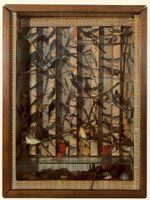
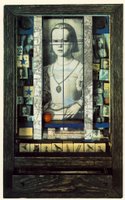
Cornell's boxes -- appropriating whole pieces from the random assortment and arranging them into a "sonnet" box, suggested, easily enough, by the title that David gave the exercise. (Notice -- the poem
does have 14 lines, if you disregard the wrap-around. I love that term
raw general search, by the way.) So you could say I took pretty darned laid-back approach to this one -- producing something more akin to sixties' or early seventies' style "found poetry" than to the intense parsing and mashing of pre-fab phrases we see in flarf-related poetries. (Probably you flarfist hipsters out there would find this terribly old hat.) And like the "found poetry" of the sixties & seventies, what I did flings the inane crap we're bombarded with pretty much back holus bolus at you dear readers out there, but in the context of a blank page which, like the gallery context of
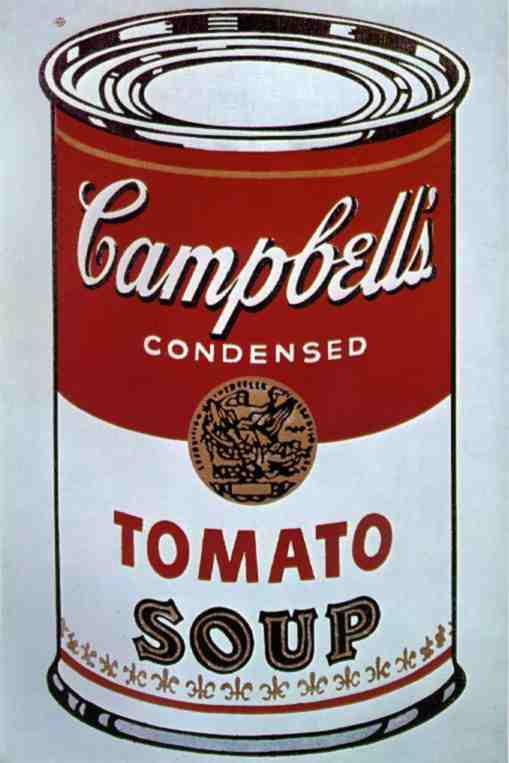
Andy Warhol's Campbell's Soup cans, gives them a false dignity and throws them into relief as the inanities they are. (Even the comparison to Warhol shows how "old hat" this approach is...) This of course is an electronic page, which undercuts the irony quite a lot... I think this Google sonnet would be more effective on high-quality vellum. As I cut and pasted it together, tho, I imagined it being read out loud. Big dramatic pauses between each sentence. That kind of thing.
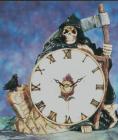
Of all the phrases provided, the "Death Clock" leapt out at me as particularly evocative, and an obvious one to start with. After that, with rapid selection of what struck me as the most interesting phrases I found myself shaping the thing into a question-declaration sequence leading back (obviously enough) to the "Death Clock" as a closing refrain. In following a highly traditional symmetrical pattern (yes, falling back on good old Death to keep things profound), I got the notion of giving a fairly representative survey of all that's out there that's bombarding us and poisoning us as our timeclocks tick away. I found this actually more exciting than perhaps it is. I think here the sampling falls down. I ended up seeking other sources: a piece of highly typical spam that hit me between the eyes that very morning + a phrase almost anyone gets blasted at them if they do the tour of porn on the net (haven't we all?), and then, because I wanted something gentle to counter all the violence I googled in "gentle murmer river" and the third last line is what I came up with, courtesy of someone's blog.
At this point I would like to replace that sentence about the Jordanian teenagers with something, say, from the realm of Sports. I love the evocativeness of "the dust-up in the Dungeon video arcade" -- "video arcade" is pretty sporty too-- but we already have another line from the same incident (I think it may be from the same article) which is darker still, and "video" is used in the second to last line . I googled articles on hockey , sports violence, Todd Bertucci even, but so far have come up dry -- that is, of anything with the requisite punch. (Despite the fact that Todd with his "sucker punch" broke another player's neck...) I guess eventually I'll come across one that seems right, if not right on. So much for randomness.
I of course am tempted to tighten the poem -- take away hanging phrases like "a hormone that reduces the urge to eat" and "and you both know it", but I also like leaving them in. They seem to me to me typical of the kind of excess of obviousness that beats middle brows into submission.
________________________
Of all our attempts, I think
Thomas Basbøll’s contribution to the experiment is the most vivacious and successful on its own terms -- if somewhat intellectually driven.
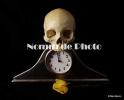
Welcome to the Death Clock: a friendly, second by second reminder to work out the percentage of memories that are designed, manufactured and tested to specifications.
Here are the updated graphs for October. As you can see, the fish leapt from the water. This framework only provides guidelines: a limited amount of content. There will be "more deep cuts".
Like me, he had the instinct to start with the Death Clock. I think that fish leaping from the water -- such a delightful surprise -- saves this piece from being irredeemably dry. The double-sense of "deep cuts" is cutting...
____________________
David's is perhaps more deeply parsed.
GOOGLED TRIPLE SONNET #1: COOKEDMemory
that is
designed,
manu-
fact-
ured and
updated graphs
explain
how
to
make
the opening
sonnet
a limited
amount
of content
available in
English please
visit
for more
Blue Steel
the areas of
pre-engineered
buildings and
a New York college
trapped
in
an existential
nightmare victims
of a cruel
and enduring myth Love is when you look
into someone's
eyes
information
does
not want
to be free
it wants
to be brief economics
bath water
deer
I'm not so sure about this one. I like the way "information does not want to be free it wants to be brief" is thrown into relief as a summative statement towards the end. (I considered using
that line, but couldn't fit it in... "sonnet" being such a "disciplined form", ;-)) The final four words are splashed on like dabs of paint -- that I enjoy -- and deer, read out loud, would be taken as "dear", a term of
endearment I rather like after all those arid explicative-sounding phrases (the bath water too is refreshing -- sex in the bath, perhaps? No I think I'm reading too much
into ...). "Graphs" though doesn't follow grammatically (that is, if you want a smooth splicing). I'm not sure why we need Blue Steel (the first vivid image in the piece), and if you're going to parse, "existential nightmare" seems a bit cliche-ish. Why is it called a triple sonnet? (Maybe this is my ignorance here... I'll soon google "Triple Sonnet" and see what I get.) I'm also not sure about "Cooked", although I can sense what you're telling us about the process. (
Half baked? Mine, too, though is a work in progress...) Oh well, David, you described it as an attempt, and I know you were probably less at leisure last week than Thomas and I.
Thanks for bringing us the exercise. Your last
two posts have been beautiful...
 The Wisdom of No Escape is the only Pema Chödrön book I've read through, but it remains a favourite. I also understand it's her seminal piece of writing.
 shopping is actually always trying to find security, always trying to feel good about yourself. When one sticks to one boat, whatever that boat may be, then one actually begins the warrior's journey. So that's what I would recommend. I particularly want to say that because as you may have noticed, I myself am at this point somewhat eclectic in my references and the things that inspire me, which might give you the impression that you could go to a Sun Dance one weekend and then to a weekend with Thich Nhat Hanh and then maybe to a Krishnamurti workshop. Basically it doesn't seem to work like that. It's best to stick to one thing and let it put you through your changes. When you have really connected with the essence of that and you are already on the journey, everything speaks to you and everything educates you. You don't feel chauvinistic any longer, but you know that your vehicle was the one that worked for you.






As Jean Clay writes somewhere in his great critical study of Modern Art 1890-1918, the introduction of "systematic randomness" left art virtiginously free. The trouble is, a process where the heart is absent for the creater offers little or nil for the heart of, in this case, the reader. Ibid for the rigidly stylized illusionist products of the Institute and the Salon. Contrast with, say, the poetry of Ilya Kaminsky.
P.S. Thanks for the flarf link. I think we have the makings of a blog post chez moi...
Brian, you might be right about pure randomness (and randomness in art is nothing new) will ultimately fail, or run its course, as an aesthetic project. So can a poem be whittled down from this raw material (which I think is what Basboll is suggesting)? Would the creator then be present in such a process?
However, randomness does create some interesting juxtapositions? Also, does it serve to eliminate the ego, the arrogance of the creator? Something Mac Low explored using chance. Does art, art we usually conceive it, depend on the ego, the individuality of the creator? Is art ego?
Of course, randomness does create interesting juxtapositions, and to the extent that life is random, there is a place for randomness in art. I really doubt though that the systematic use of randomness in art eliminates ego, and indeed believe the project of "eliminating ego" is not only impossible and undesirable, but the most phony and arrogant assumption behind such an aesthetic project. (Notice too how some of the purveyors of such "art" are so adept at promoting themselves and climbing into the art establishment...)
To me art only grabs me when it expresses the whole human being who created it -- ego, heart, lungs, belly, balls (or vagina), aspirations, cosmos. I'm not talking about any quality you can measure -- just the feeling you get when you read a poem by say Vallejo that "his whole life went into this poem". If my whole being is there to appreciate a given work of art, it is up to the being of the creator to be all there in his art, wouldn't you say? Personally, I have no choice in the matter: I just can't have it any other way. (And I don't think you can either, David...)
Interesting stuff.
 but, you're right, the trick is to see where workshopping them might lead, not simply to present the Google searches as poems.
To my mind, the Google searches you've done here are a bit too random (or arbitrary),
As Gary Sullivan notes, 'Not too long after 9/11, people began posting again, though now all of the flarfs-many of which were parodies of AP News items-in some way shape or form addressed the aftermath of 9/11, including media portrayal of same. I remember, for instance, Katie's "We'll rebuild the Twin Towers-on your Pizza" (which I think was published in the latest online edition of Arras). I started a "sadness" series-doing searches on "The horrible sadness," "the awful sadness," "the unending sadness," etc., in response to what was becoming a kind of stifling national(ist) mourning.'
There is nothing especially "random" about that procedure and part of the utility of Google lies in using it precisely as a search engine.
Since the poet will be "sculpting" the final material and will have made decisions (search terms) in finding it, there is no reason to think that Flarf poems have "no ego" or are unrelated to "the whole life of the poet". But there are specific reasons not dwell on the relation between a poem and the poet's biography.
Flarf is way of avoiding (though not a sure way) that "the feeling you get when you read a poem" is not taken as a representation of the feeling the poet had when writing it.
That said, I think Brian's idea that we use our "whole beings" to appreciate works of art is a bit unrealistic. Or maybe I would qualify it by saying I use my whole being such as it is to read poetry and I much prefer poems that clever people put together out of things lying around in plain view to poems that creators found in their hearts.
Thomas, what makes “the clever people’s” poem interesting? Is it just its cleverness? Or is there also something else that makes the poem tick/click/work whatever word you choice? From corresponding with Brian in the past, I think he is suggesting that poetry, and art in general, works on many different levels, not just on the level of intellect, an idea I agree with. Of course, if we had the definitive answer about how poetry works we wouldn’t be having this conversation, which is what made your original post so interesting – the implications of reshaping existing language in our own image.
Brian, I agree that you can never actually remove the “ego”, the “self” from art. That’s why I ended the last comment with that question. Art is ego, or at least the production of art, even the CHOICE to produce something randomly, evolves the “ego”/”the self.” But I’m not sure the desire to “eliminate ego,” even if it is in the end impossible, is always “arrogant” or “phony.”
 For instance, Mac Low was Buddhist and influenced by the teachings of D.T. Suzuki. And “randomly” opening Suzuki’s “An Introduction to Zen Buddhism” I saw this passage, which I had underlined:
“Life is an art, and like perfect art it should be self-forgetting.”
I think Mac Low was genuinely attempting to explore the possibility of “eliminating ego,” forgetting the self in the Buddhists sense. And as someone influenced by Buddhists thought I find the idea intriguing as well, even if, at least in my hands, it would be a project doomed to failure. I remember Peter Matthiessen writing about his conflicts between what he perceived as the egotism of his writing and his Buddhists beliefs. Maybe the only real way to eliminate ego from art is silence, to produce no works at all. Or is that also a choice involving the “ego?” Ah, it seems there is no escaping the bastard.
As for randomness as a technique I do find it interesting less for its ability, or lack there of, to mask the ego (the creator) but as a way to examine how language interacts, how surprising juxtapositions may create the shock of art and what that teaches us about how art works, and about the role of the artist.
Which I think is what Basboll was ultimately interested in. I think he was interested in how a poem is edited down/whittled/”workshoped.” Can the poet shape the raw material provided by the information age into a poem, the “ego”/”self” still very much involved in the process? I introduced the randomness as a way to generate the raw material, but not to really be the end product (though I think it was worth at least examining). Just as an experiment would you be up to (and any other poet could try it as well) attempting to create a poem from the mass of language I generated? Maybe choose the language from one search or from all three. I’ll give it a try over the next week – I’m traveling for work all this week, so I will have limited time to work on it, but will see what I come up with by the weekend. I’m not expecting this to be earth-shattering, nor just some sort of cheap “workshop” gimmick/exercise, but an exploration.