Showing posts with label Latin American Poets. Show all posts

Friday, August 01, 2014

Mariela Griffor: The Psychiatrist

Child’s Eyes

People say that children see and hear things
they themselves cannot see or hear,
and this child breaking into
the room to hug and kiss
his grandmother, Wilma,
hasn’t seen me yet.
I am afraid of his eyes,
touching like a hummingbird
the cornea of my eyes.
I don’t want him to see
the puddle of
old pain and rusty love
that grows inside of me,
the spider web of my disappointment,
a beaten heart that
has never overcome the loss of him.
I am afraid of this child
running around with his two frank
years, afraid of me breaking.
I’m sure he would scream
if I let my pupils touch his,
and the room would look
at me knowing the truth of
what he sees.
I am afraid and old,
smashing day after day
a memory of innocence.
I know too much.
My mind is fragile.

This is a favourite poem of mine from “The Psychiatrist”, Mariela Griffor’s latest collection, sent to me for review by Eyewear Publishing last year.  Searingly poignant, simply put, the poem expresses — in a way I don’t think I’ve seen elsewhere — how one can feel confronted and even intimidated by the innocent life force of a young child.  With this poem, I have only one — albeit small — quibble: it’s with the antecedent of the pronoun “him” in the line “has never overcome the loss of him”.  We can assume it’s not the child itself, but a man, an adult love to which she is referring — Ignacio, perhaps, mentioned in an earlier poem, or the unnamed subversive in “Love for a Subversive”, the unnamed lover in “Rain”?  There is probably some way around this, but at the same time, that pronoun in this poem has its own brute force. 

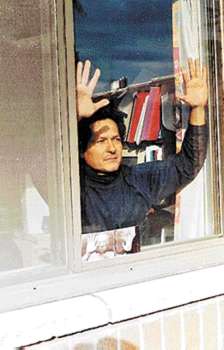
Mariela Griffor was born and raised in Chile, and came into adolescence and early adulthood under the Pinochet regime.  As a young woman, she joined a revolutionary group, and doubtlessly ended up on a blacklist.  In 1985, she left Chile for Sweden under involuntary exile.  Much later, in 1998, she moved with her American husband and two daughters to the United States, where she is now Honorary Consul for Chile in Michigan.

Here are poems of subversion, exile, and solidarity that ache to be told: elegies for friends who were tortured or disappeared, evocations of nights of insomnia, furtive meetings under code names, a character sketch of a relative who was a possible undercover agent for DINA (National Department of Intelligence.)

All contemporary Chilean poets – indeed, Latin American poets – write under the shadow of Pablo Neruda.  Indeed, Ms. Griffor will soon be coming out with a new translation of his Canto General, published by Tupelo Press. Her own style, though, doesn’t bear a trace of his lush, surrealistic influence.  She reminds me of certain Eastern European poets — Czeslaw Milosz, Tadeusz Rozewicz, Wislawa Szymborska among others  — or of her own countryman, Nicanor Para: poets that speak unvarnished truths with simple irony and measured declaration. In some later poems in the collection, the Griffor’s free verse becomes rather too prosaic for my taste:

My grandfather did not talk about what Mr. Monzalves said,
but it was clear that he knew that my grandfather
was a sympathizer of Allende and that he had come to deliver a warning.
Just before I left Chile the last person I met from the Front
in Santiago was my commander
His real code name was Wolf.
I told him I was planning to leave the country because I could not avoid the surveilland anymore and my good friend,
the lawyer Inunza, had arranged for me to go to Sweden or France.
                                    (Exiles)

In a patch like this one, I wish that the author had fashioned an introduction or searched more deeply for lyricism in her subject matter.   In most places, though, her straightforward style has its own strength and sensibility.

The title of the collection raises expectations that it will concern mental illness, or perhaps relate a series of psychiatric consultations.   The brief title poem, however, is the only one where a psychiatrist is featured; there he figures as a voice of authority in the narrator’s head that the poet summarily shoots down to get on with her life. 


Mariela Griffor’s “The Psychiatrist” is well worth buying and reading.  I look forward to seeing more of her work.

Thursday, February 08, 2007

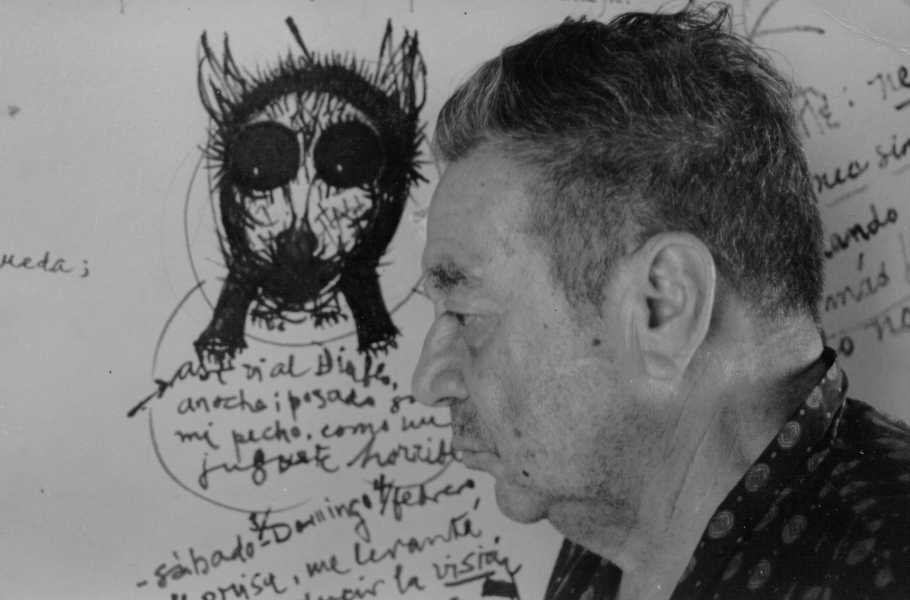
Carlos Martinez Rivas

CMR

Funny, about 6 months after this post on Carlos Martinez Rivas, I got this remarkable comment from a woman who apparently had been part of his and Octavio Paz's entourage more than 50 years ago in Paris. It lead to a rather touching exchange. At the time I meant to post it, but somehow that idea got lost in the woodwork of my own brain (ah, distractions, projects, love, work....). Anyway, looking over my CMR posts I saw our correspondance there, and thought I'd shed some light on it today -- almost a year later. The connective possibilities of the internet of course are now pretty well taken for granted, but exchanges like this do renew a sense of amazement at just how great those possibilities are.

Anonymous said...

I knew Carlos Martinez Rivas more than 50 years ago when both of us spent many evenings at Octavio Paz's apartment in Paris. Elena Garro, who was then married to OP, always called him El unico Carlito. I remember reciting Apollinaire's Chanson du Mal Aime one night looking towards the Eiffel Tower to him and to Ernesto Cardenal. Then, we all scattered, and some of us never met again. Some years ago a Peruvian friend gave me sad news of Carlito and the devastating drinking problem that was destroying him. (No judgment here, my own husband died of it.) That may be why he never again published. To my shame I did not know that he had published to book you mention. I just googled him by chance after having pulled out of a box a picture of Octavio Paz and myself taken by a street photographer in Paris at that time and wondering what had happened to Carlos Martinez Rivas. I did not expect to find this much. Thank you.
Monique Fong

Thursday, March 23, 2006 11:04:00 PM
Brian Campbell said...

That's a beautiful reminiscence, Monique. Thankyou. I'm really touched.

Francisco was telling me the other day was that CMR never published beyond that one book because he was fixated on the idea that a poet should only be known for one book -- like Whitman for Leaves of Grass, for instance. He intended to put out an expanded edition of Insurreccion Solitaria -- as Whitman had done with Leaves of Grass -- but was never satisfied with the configurations he put together. Certainly, though, he was also disabled by his alcoholism.

Thanks again for sharing that with me.

Thursday, March 23, 2006 11:23:00 PM
Anonymous said...

Drinking is always so complicated . . . Anyway, here's another "sweet" memory of Carlito. Some of us had spent Christmas eve 1950 (!)at Octavio Paz's place and were walking the quiet streets of Neuilly singing, in Spanaish, while CMR was playing the guitar. This was allowed on account of the holiday. Not much of a memory, but an image of another time and place.
Monique Fong

Sunday, April 16, 2006 4:39:00 PM
Brian Campbell said...

Thanks again, Monique. I think I'll make a post out of these reminiscences... something about how the net connects, and who would ever expect, etc.

Sunday, April 16, 2006 10:40:00 PM
Anonymous said...

And thank you, Brian, for reconnecting me with CMR, etc.And do you know Alejandra Pizarnik? I only discovered her recently even though we sometimeswere in Paris at the same time.

Monday, April 17, 2006 10:28:00 PM
Brian Campbell said...

No I don't. I'll have to look her up.

Today, at long last, I looked up Alejandra Pizarnik -- there is quite a lot on the net available on her, all of it in Spanish. She strikes me as another remarkable poet, well worthy of being brought into English by anyone willing to expend the time and effort...

Sunday, December 03, 2006

"the books within the eardrum"

David Leftwich, whose blog Eclectic Refrigerator was a reliable source of superb posts before he let it go into deep freeze about a year ago, wrote this appreciation of a poem in Francisco Santos' Undressing the Night back in Oct. 2005. Get a load of David's nifty collage.

Brian Campbell has been translating Nicaraguan poet Francisco Santos for several years and now has a book of translations coming out from a Costa Rican press. For those of you not heading to your local Costa Rican bookstore this week, Brian has posted some translations and the introduction at Undressing the Night. Here is a sample:

FIESTA

The glass beyond the fiesta
the books within the eardrum
the quotidian in the blood --
and the madman with his dirty fist
comes out of the mineshaft
waving a flower

-Fransciso Santos, trans. Brian Campbell

The line "books within the eardrum” really resonates – it seems to condence into one line the whole aural appeal of poetry, the sounds that unlock like skeleton keys the doors to deep memory. If Santos can do this in one short poem, I can’t wait to read more.


Thursday, March 16, 2006

FESTIVAL INTERNACIONAL DE POESIA DE COSTA RICA

Norberto Salinas, our editor, who founded and runs almost singlehandedly the Festival Internacional de Poesía de Costa Rica, tells us that some important poets like Ernesto Cardenal, Claribel Alegría and Thiago de Mello (the latter two I've never heard of) are coming to the 5th Annual Festival, which takes place this year from May 27 to June 4; each of 15 of this special guests will have a small volume of selected poems published for the occasion, and in addition 16 books will be published and launched by Editorial Lunes at the festival.

It seems that the Festival Internacional de Poesía de Costa Rica is indeed an enormous cultural initiative, and that's why it's attracting some of the biggest names in Spanish and Latin American poetry today. According to Norberto, who tells me he's already given 80% of his working time to the festival (and he's a self-described workaholic), he's organized readings to more than 40,000 rural , public school and university students as well as general public throughout the country. Talk about dedication! We have to credit people like him for helping make poetry matter, wherever they may be...

P.S. Norberto sent me the information about the festival, which is too exhaustive to summarize here more than I have done. But since the festival as yet has little Internet presence, I thought it would be of interest to post their guest list of internationally invited poets, since I'm sure it includes many names that those outside Latin American literary circles wouldn't know. I see also three poets who do not write in Spanish, including one Ron Riddel of New Zealand. I haven't bothered to change the Spanish place names:

1- El Salvador-Nicaragua: Claribel Alegría

2- Argentina: Vicente Muleiro

3- Brasil: Thiago de Mello

4- Colombia: Juan Manuel Roca

5- Cuba: Nancy Morejón

6- Chile: Raúl Zurita

7- Eslovakia: Lubica Somolayoba

8- Eslovakia: Martin Solotruk

9- España: Rodolfo Häsler

10- Guatemala: Héctor Rodas

11- México: Ernesto Lumbreras

12- México: Guadalupe Elizalde

13- Nicaragua: Ernesto Cardenal

14- Nueva Zelanda: Ron Riddell

15- Puerto Rico: Antonio Ramírez

Tuesday, March 14, 2006

Can Poetry Matter en español

In the comments to the post below, A.D. inspired me with a superb poem by Ernesto Cardenal. Also an apt quote of William Carlos Williams; thanks A.D. Obviously all that chatter on whether poetry matters is silenced by poems like these...

Francisco Santos, by the way, has a powerful take on the subject with this poem, an elegy for Leonel Rugama, a very talented young poet who died at the hands of Somoza's Guardia Nacional at the age of 20. Be sure to read the translation of Leonel's poem below in the same post.

The editing of Undressing the Night is almost done; the definitive edition will be off the press ... well, we hope, soon (although it may take a month or two more before I receive it). Some of the introduction had to be rewritten because we failed to mention Ernesto Cardenal. Cardenal had been one of Francisco Santos' poetic mentors. For several months in 1969, Francisco and his brother Mario (also a poet as well as short story writer) stayed in his artistic community in the Solintename archipelago of Lake Nicaragua. (They must have been among the first to stay there, since internet sources I've come across tell me that Cardinal started his community around 1970 or so...) For Francisco, it was a very productive time -- besides getting his first book manuscript together with editorial feedback from Cardenal, he read voraciously whatever poetry in translation he could get his hands on, particularly 20th Century American poetry (Eliot, Pound, the Beats), much of which had been recently translated by Cardenal and another Nicaraguan poet, Jose Coronel Urtecho (mentioned in Francisco's poem hyperlinked above). Apparently EC was quite taken aback when Francisco showed him our first draft of the book and the intro failed to mentioned him, although it described quite extensively Pablo Antonio Cuadra's shaping influence on Francisco. Oh well. I'm glad we can rectify it before it goes to print...

Sunday, October 30, 2005

CARLOS MARTINEZ RIVAS


Here's a poet to discover: Carlos Martinez Rivas. Considered by many to be the greatest Nicaraguan poet since Ruben Dario -- although others would contend
Pablo Antonio Cuadra would better deserve that description -- he only published one book in his relatively long life, a staggering masterpiece called La insurreccion solitaria, which would translate as The Solitary Insurrection (published in 1953, republished with additions in 1973 and 82). Critics compared him to Octavio Paz and Charles Baudelaire, he won international recognition, and when he died, was given a
state funeral. Just on the strength of that one book. (Talk about a different culture than this one...)

So happens he was a friend/mentor of Francisco Santos, who describes to me unforgettable meetings he had with him at a certain bar named "Buenos Aires" in Aranjuez, Costa Rica, where Francisco stayed for a time after the earthquake leveled Managua in 1972.
Francisco describes him as a flaming genius, the greatest poet he ever met.

It seems that Mr. Rivas left behind him over a thousand unpublished poems, the vast majority of which have not yet seen the light of day. The reason for his non publication? According to this bio, he had an almost pathological fear of errata -- and anticipated public rejection. After last week's experience, I can relate. (At least to the errata part... well, rejection smarts too!)

Friday, October 21, 2005

MEN PLAYING WITH WORDS: CANTO PUBLISHED IN DUSIE

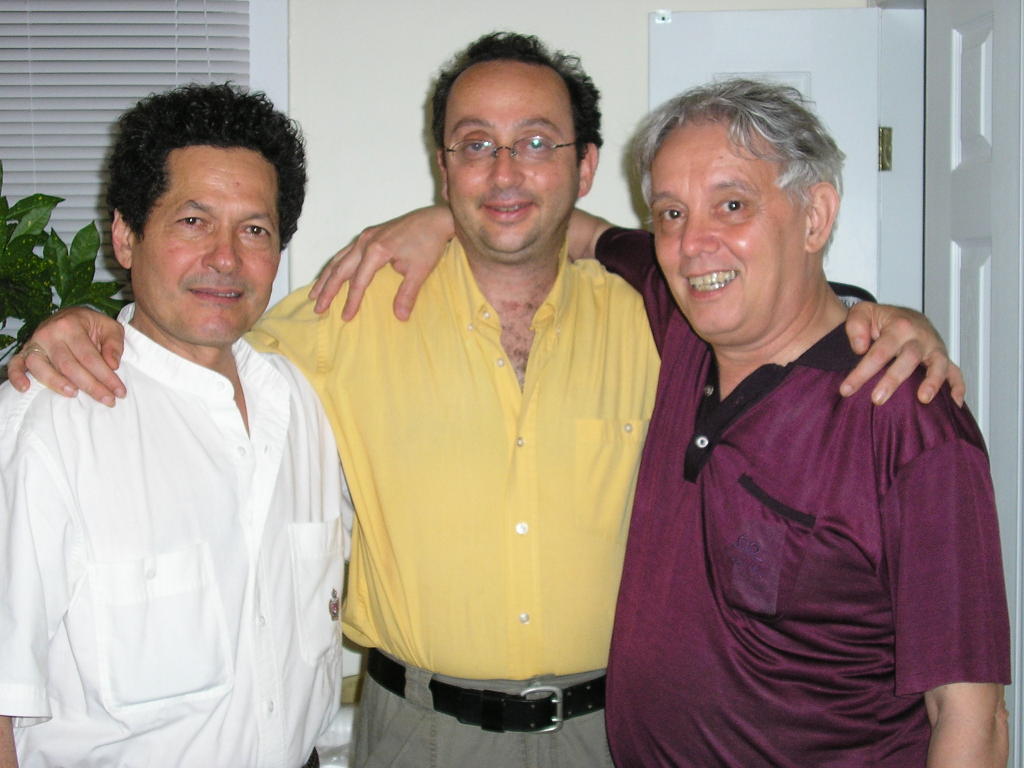
Francisco Santos, myself, and Allen Sutterfield
on the evening we wrote "Canto"


It was a suffocatingly muggy evening, June 14 of this year. Both Allen and I were in Toronto, and had arranged to get together with Francisco at a friend's place, where Allen, who resides now in Guelph, Ont., was staying. Since wine seemed a necessity (isn't it always where poetry takes place?), we made a long treck in the stifling heat along Danforth Ave. to the nearest LCBO to pick up a two litre bottle of cheap Italian red, and almost lost our evening in a pizza joint waiting for an excruciatingly slow with-the-works to go... as we waited, though, we did read and discuss a couple of poems from Anna Akhmatova' Selected, which I had picked up at a used bookstore along the way. By the time we got back to our friend's place, it was already closing on 9 pm. As Francisco and I were living/staying halfway across town, it seemed the evening was up almost before it began. (We had planned this get-together weeks in advance.) Over drooly pizza and sweaty juice glasses of wine (our friend's wine glasses were stored we couldn't find where), we laughed ironically at the inconvenience of throwing a party -- or doing anything worthwhile, it seemed, on the spur of the moment in Toronto. Suddenly something in our conversation -- I think we were talking about Creeley, who had recently died, and I remember now I even read out "I Know a Man" earlier that evening -- reminded Francisco of a verse he had written more than two decades ago, which he remembered as this:

Llévate este silencio
de
ave

para que conozcas
el
vuelo
de mi
canto


which I immediately translated as this,

Take this silence
of a
bird

that you may know
the flight
of my
song

Francisco wondered if I had included it in the bilingual selected which I was in the process of bringing together at the time. He had always had an affection for this verse because it brought together silence/bird/flight/song and notions of taking/knowing/possession in one brief utterance... great concentration of language was evidently a poetic ideal of his, too.

Well, I hadn't.

Allen, trickster that he is, suggested this possible alternative (he doesn't know Spanish), which he intoned in a deep south accent:

Take
the silence of a bird
that you
may know
how my song
flies

Then Francisco came up with another variation, and somehow or other, we were off: a game was created: to see how many variations on that verse we could come up with using those exact same words. These we jotted down in Francisco's notebook, which we passed around round-robin style. Each time we came up with a wilder and more improbable variation, we doubled over in gales of laughter. At one point -- after about fifteen variations, when it seemed there were no possibilities left, the notebook was passed to Francisco. After a moment of mulling, he came out with this:

Take

silence

this bird

know

flight

canto

"Hey, Francisco," we objected, "you didn't use all the words!"

"But this is an exception!" he said back with a raised finger. Gales of laughter again.

Henceforth exceptions, if exceptional, were allowed. I came up with a variation on his variation, and then we came up with six more conforming -- more or less -- to the original constraints. At this point, our friend came back. We all knew we had done something pretty significant artistically.... we were elated, minds on fire. A title sprang forth -- Canto -- and a dream of little chapbook and reading somewhere, at the Art Bar Poetry Series or Guelph's Woolwich Arms. In any case, it turned out to be one of the most enjoyable evenings of pure creative fun any of us had had in a long time. At our request, our friend -- Tony Marques, I'll let his name be known, another dedicated word craftsman who remains in an unpublished nether world -- turned on his computer and I transcribed what we had written into a wordpad file, and emailed it to all of us.

Tony took the picture above with my camera to commemorate the occasion.

That was that... or so it seemed.

The next week, looking through one of Francisco's earlier collections to find the poem and include it in the selected, I discovered that he had misremembered it: that he had written comprendas (comprehend, understand) el vuelo de mi canto, not conozcas (know). I called him up to see which version he preferred for the bilingual edition. He said, ah yes, but I much prefer comprendas. Subtler, he said. But know sounded better rhythmically in English, so I stuck with my translation of that evening -- but tacked the original Spanish version on as the concluding variation in Canto. After 23 variations, I suppose the singer would understand the song...

Anyway, Canto I later submitted to Dusie -- it struck me as down their particular alley -- and it was taken. You can read it here.

Tuesday, April 19, 2005

LOS BISABUELOS MURIERON DE HAMBRE

On this site, quite a vivid and, as far as I can see, honest account of a trek among the indiginous populations of Nicaragua (it certainly is corroborated by my experience of the country), we discover that

The Spanish arrived in Nicaragua in 1515. By 1550, 35 years later, ninety-five percent of the indigenous population had died as a result of disease, violence, overwork, and slave trade to the silver mines of Peru.

One more bit of contextual substance for the Leonel Rugama poem below...


Saturday, April 16, 2005

FRANCISCO SANTOS: R.I.P. LEONEL RUGAMA + poem by Rugama


R.I.P. LEONEL RUGAMA


One afternoon Leonel recommended
-- to improve my vitality, strength -- that I exercise
going on to say that by this he did not mean
"spiritual exercises."
We talked also about the girls
who passed on their way from work or school
about others that went into and came out of a certain
shoe store
about another on the corner selling fried pork
then he read me a poem about a young girl
who had died in Vietnam.
Today, another afternoon,
I see on the front page of a daily
the photo of his body riddled by the
G.N.
and recall how José Coronel Urtecho
once said to me,
"Poets? They're good for nothing."


That's my translation. Here's the original:

R.I.P. LEONEL RUGAMA

Una tarde Leonel me recomendó
-- para la flacura -- hacer ejercicios
aclarándome que no se trataba de
"ejercicios espirituales"
Hablamos acerca de las muchachas
que iban o venían del trabajo o del colegio
de las que entraban o salían de una tienda
de zapatos
de otra que pasaba vendiendo chancho
también me leyó un poema sobre una guerrillera
Vietnamita.
Ahora -- otra tarde que veo su cuerpo acribillado
por la G.N. en la foto de un diario
recuerdo que José Coronel Urtecho
una vez me dijo: "Los poetas no sirven para nada."


Leonel Rugama, Nicaragua's best-known Sandinista guerrilla poet, died in combat against Somoza's infamous Guardia Nacional at the age of twenty. José Coronel Urtecho was a widely respected older poet who survived peacefully through both the Somoza and Sandinista regimes.

Apparently (in a scene whose description irresistably brings to mind the denoument of Butch Cassidy & the Sundance Kid -- please pardon my semi-relevant synapses) Rugama and two others held off an entire batallion of armed regulars, including tanks and cannons, for quite a long while before they were finally killed.

His death profoundly affected an entire generation of Nicaraguan writers.

At least one talented contemporary -- Franklin Caldera (who has written some words of praise for the jacket of our upcoming bilingual edition, translated by yours truly) -- writes in a highly engaging account that he was so affected by Rugama's death that he stopped writing poetry for 30 years out of the feeling that as he himself didn't have the courage to die for his convictions as his friend had, he would always be unworthy to be a poet. Francisco Santos, also a personal friend, responded with the elegy above.

Looking up Rugama on the net, I discovered he was indeed quite a poet. A bilingual edition of his work can be found here. Quite a few poems of his -- as well the best portrait photo on the net -- can be found here.

This is a translation I just did of perhaps his most famous poem. Well, actually, it's a "composite" translation, because in researching what follows I came across at another translation of the same poem on the net, and as mine was still a bit rough in spots, I adopted a few nice turns of phrase (particularly the ringing final phrase) from that one.

A fact that is worth knowing before reading the poem: Acahualinca is the Nahua name of the area of present-day Managua. In the lower class barrio that bears that name (where Francisco's parents now live, incidentally), near Lago de managua (Lake Nicaragua, also known by its Nahua name Lago Xolotlan), anthropologists found a lengthy track of deep, perfectly preserved human footprints all going in one direction, towards the lake. The prints, buried under layers of hardened lava, have been dated at six thousand years old. Part of the excavation is on display -- a mysterious, peculiarly awe-inspiring site, if only because it is so old... I've seen it, and you can see pictures of it and a good account of it here. A number of Nicaraguan poets have written about it, and perhaps some day I will too. Anthropologists speculated for the longest time that the footprints were made by people fleeing a volcanic eruption. That's what it looks like to the casual eye. Now, though, it is known that they were simply walking.

Clearly, though, "the people of Acahualinca" are an extinct people -- but their blood flows in the veins of any Mestizo or native person from Nicaragua today.

Anyway, here goes. I hope I (rather, we) managed evoke at least some of the spellbinding qualities in the original.

THE EARTH IS A SATELLITE OF THE MOON
Leonel Rugama

Apollo 2 cost more than Apollo 1
and Apollo 1 cost a lot.

Apollo 3 cost more than Apollo 2
Apollo 2 cost more than Apollo 1
and Apollo 1 cost a lot.

Apollo 4 cost more than Apollo 3
Apollo 3 cost more than Apollo 2
Apollo 2 cost more than Apollo 1
and Apollo 1 cost a lot.

Apollo 8 cost an enormous sum, but no one minded
as the astronauts were Protestant
and from the Moon they read the Bible
to the joy and amazement of all Christians.
On their return Pope Paul VI gave them his blessing.

Apollo 9 cost more than all these put together,
including Apollo 1, which cost a lot.
The great-grandparents of the people of Acahualinca were
less hungry

than the grandparents.

The great-grandparents died of hunger.
The grandparents of the people of Acahualinca were less
hungry

than the parents.
The grandparents died of hunger.
The parents of the people of Acahualinca were less hungry
than their children.
The parents died of hunger.
The children of the people of Acahualinca will not be born
because of hunger,

and they hunger to be born, only to die of hunger.

Blessed are the poor, for they shall inherit the Moon.

Wednesday, April 13, 2005

FRANCISCO SANTOS: FIN DE SEMANA


FIN DE SEMANA

Esta noche en Las Vegas, Nevada
una colina de sal renace mujer
y abre de nuevo las piernas
y un Lot anónimo sufre raros sueños.


WEEK END

This evening in Las Vegas, Nevada
a column of salt retransfigures into woman
who once again, spreads her legs wide --
while an anonymous Lot suffers rare dreams


Why am I posting this poem on a Wednesday? Well, people do call it hump day-- although I've wondered about that, since most people hump on the weekend.

All kinds of discrepencies here. Those middle two lines would literally, word for word, go --

a hill of salt is reborn (with connotatoins of appears again as, aquires new vigour as) woman, even more literally rebirths woman
and opens anew its/her legs (literally the legs)

I had to make choices -- among pronouns, verbs, adjectives -- and for certain strict literalists among us, may have strayed unacceptably wide. "Colina" (hill) and "columna" (column) are similar in sound, and one subtly evokes the other here, unlike hill and column or pillar; "colina" is also more melliflous than "hill". At the same time, however, the literal translation of the biblical "pillar of salt" is "estatua de sal". Pillar of salt therefore wouldn't do -- just too hackneyed, and nor did he write the corresponding cliche in Spanish. Hill of salt to me was boring -- and I imagine there are lots of columns in those Vegas casinos; indeed, casinos are columns of sorts. So I went with column, to mirror the sonic values of the poem. "Retransfigures" -- well, that coinage has an exalting connotation that captures the invigourating feel of renacer better than simply "is reborn", "turns into" or "transforms into..." so there you go. I went rare. Including rare dreams.

Rare dreams could be more simply strange dreams, remarkable dreams, unusual dreams, uncommon dreams -- all perhaps more accurate on literal levels, but, as adjectives, boring as they proclaim they aren't. But then there are the Sp. expressions "rara excepcion" and "rara perfeccion", lit. "rare exception/perfection", and the use in physics meaning "rarefied". "Rare" also mirrored the original. So I went rare, as I said. Not just medium-rare...