Saturday, December 31, 2005

Tonerworks

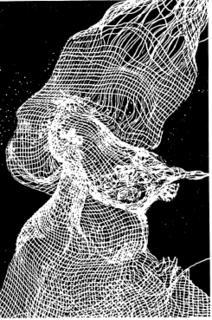
There's some fine photocopy-based artwork up at Reed Altemus' blog, in case you feel like taking a respite from the written and easing into the visual...

Happy New Year!

Friday, December 30, 2005

Thursday, December 29, 2005

COMMUNITY, ROBERT BLY, ETC.

The following is from an interview with Robert Bly on Bly's website -- it's a fascinating site... but then, I'm a huge admirer, esp. of his criticism and translations:

Donald Hall and I have been sending poems back and forth twice a week for forty years. At one time, we had a 48-hour rule: the other had to answer within 48 hours. My generation did a lot with letters. Galway Kinnell and Louis Simpson and Don and I and James Wright would often send five- and six-page typed letters commenting on and arguing with each others' poems. I'm amazed we had the time for that. Tranströmer and I exchanged hundreds of letters. The gist of it is that no one writes alone: One needs a community.
Voila! The way in which poetry lends itself to community -- glorious get-togethers with writerly company for sharing, feedback, wine, song, etc. -- is but one thing which brought me back into its fold after a haitus of nearly a decade (during which I wrote songs, recorded an album, even tried to get a music career off the ground...something I rarely talk about on this blog.) Trouble is, these get-togethers don't always manage to coalesce (this I write after yet another fell through earlier this month...). People are so busy these days, with family obligations, house repairs, etc... it requires a degree of commitment and availability that not many of us can muster at any given stage of our lives.

Hence the usefulness of poetry boards -- in particular, Eratosphere. Discovered this one through Whimsy Speaks (Jeff Bahr). In some post of his he mentioned that of 60 poems he had gotten published, only 2 hadn’t gone through the acid test of a poetry board like this one. That in itself was remarkable piece of information. Following the link, I was truly impressed by what I saw. The discussion is at a pretty high level -- as were a number of the poems on the boards. The site appears to have had the likes of Richard Wilber and Anthony Hecht as visiting “Poet Lariats” for a day. There is an interesting division between beginning and advanced levels of metric poetry (an area I probably won't participate in much -- there seemed to be a lot of light verse there, which I rarely enjoy). I also liked some of the open discussions. Most certainly in the coming year I'll be spending more time on on-line boards such as these -- even though, of course, that means an even more inordinate amount of time with my eyes glued to a computer screen.

Back to Bly though -- one thing you can say for him, with all those books, translations, appearances, review editing, etc.: he had (and has) one serious work ethic worked out there. Serious, yet joyful, as he obviously loves what he does. He's still got quite a gig-list going, for a man just shy of 80!

If you want to hear a recent Robert Bly reading, check out this site. I enjoyed this reading a lot.

Monday, December 26, 2005

Erica Jong: Buddha in the Womb

"...the soul expands through creation even if the created thing is impermanent. Permanence is not our business, but creation is."

-- Erica Jong, commenting on her poem "The Buddha in the Womb" in Introspections: American Poets on One of Their Own Poems

Friday, December 23, 2005

Bonnes fêtes...

Question for the fiesta times:

Is there a lit review (print, or online) that particularly excites you, that makes you look forward to each issue, that makes you actually
inspired to send your work to it? Two I like particularly are No Tell Motel (I like the attention they give to writers, esp. the opportunity they give to them to discuss their poems), and Octopus. What are your fav's?

Tuesday, December 20, 2005

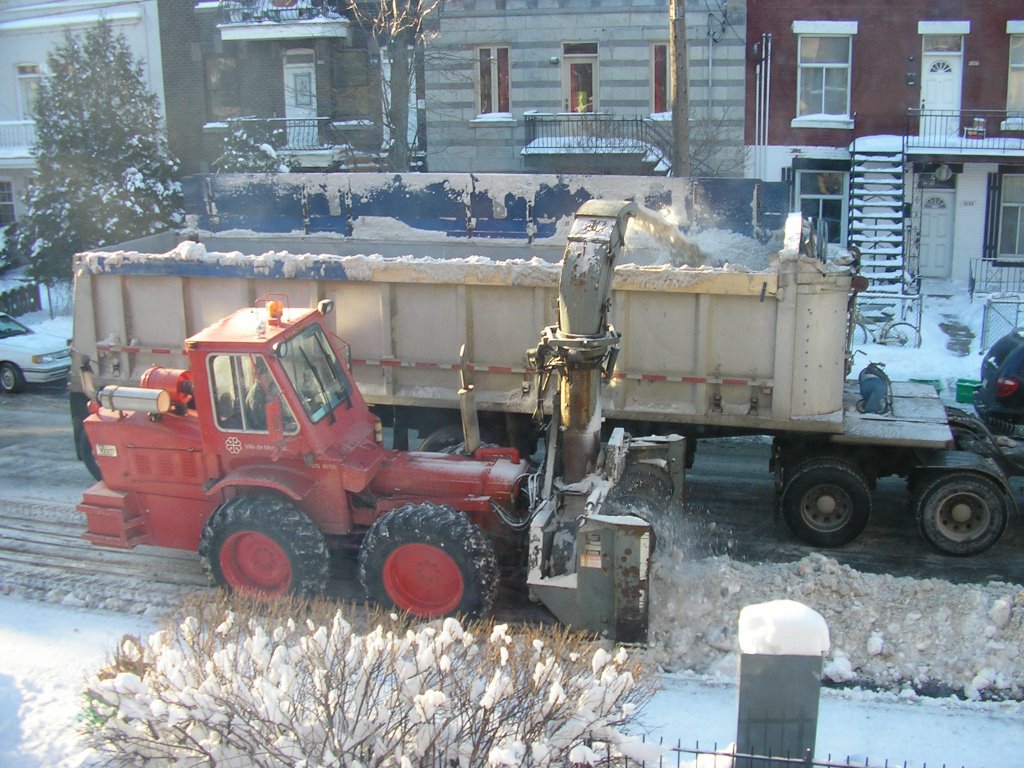
Betcha MY snowbwower's bigger than YOUR snowbwower...

View thru my front window again (picture taken last year; this time they thundered past in the middle of the night). No plow here (it just preceded), but I'm reminded of a rare memorable poem by rob mclennan:


snow. plow.

love, I compare you instead
/a snowplow not a summers day
completely unaware

of the cars you've set to burying
scraping fenceposts & fire hydrants
-- the long clear path
for everyone behind you

wham bam, the radio quotes 20cm
my body becomes ice
Sunday, December 18, 2005

MONTREAL VERNACULAR


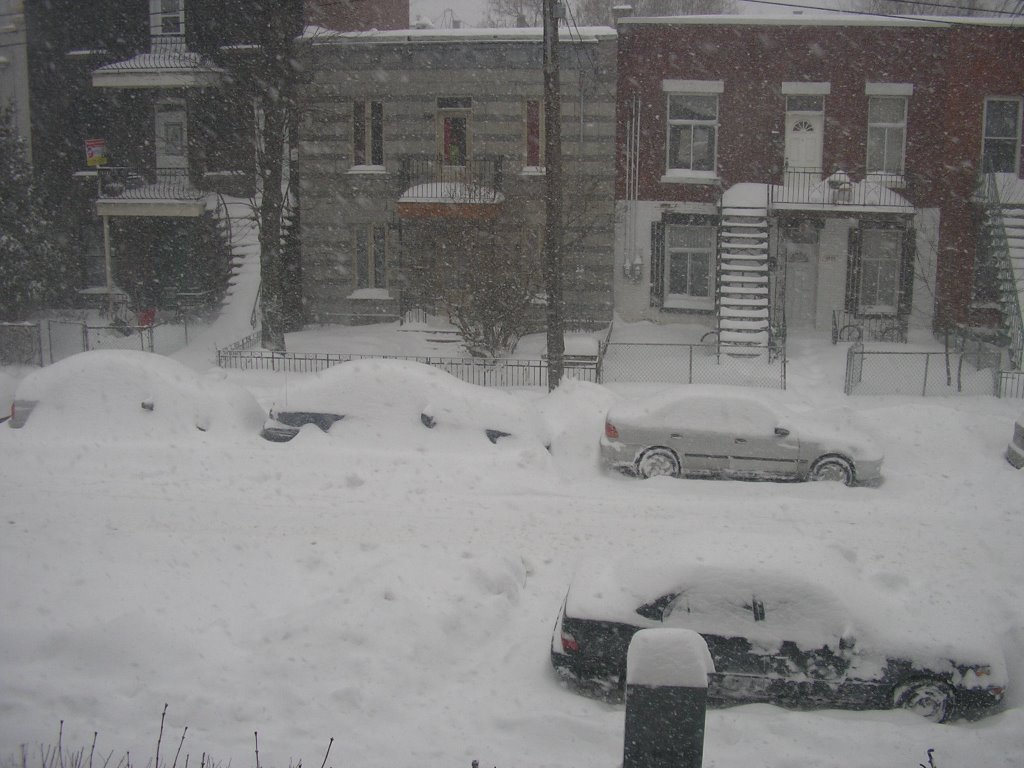
Photos taken around 9:30 in the morning of this Friday's snowstorm. Below, the drifts by my front door; above, the view from my front room window. About 20 cm had fallen in little more than an hour; about as much again was yet to fall. Yet the view is about as pristine as daylight afforded. Soon people would be shovelling their stairs and digging their cars out (some have already, presumably to go to work: two students of mine said they spent four hours in traffic jams that day). Ploughs (except for the little ones that do the sidewalks) haven't come by even now as I write.

These walk-ups, by the way, are humble examples of "Montreal vernacular" architecture. Far more spectacular streets of twisting spiral staircases, ornate balconies and funky cornices exemplary of the style are just blocks away... but this street is pretty typical of the Plateau and Mile-End areas of the city. (To see more Montreal architecture -- a major reason I enjoy living in this "ville des balcons" [city of balconies] -- check out this webshots site. Click on "View Slideshow" and you'll get a virtual "tour de ville".)

Saturday, December 17, 2005

Strand Anthology: Slight Return

Indeed with so few poems per poet and practically no background information, it's hard for any sort of identity to be established such as can happen when you have five, six, seven poems resonating together: the anthology as a whole becomes little more than an omnibus literary magazine. Good for reading on the toilet, as Allen so eloquently pointed out...

----

Lasagna with wine and belgian chocolate truffles and gazing out at the swirl and drift, as directed by a Canadian weather system. (40 cm so far.) Took some photos earlier today thru my office window: steps and rails swollen with snow, chandelier trees, cars like beached white whales. But will have to learn the simple operation of transferring images from my camera to my computer to share them here immediat...

Monday, December 12, 2005

Boys will be boys...

Last night, I went out to a friend of my girlfriend's place for dinner, and it turned out he has a table hockey set. What fun! It was hard to resist playing for a good hour or so. As a kid, I owned a set myself, played tournaments with friends, had a mock schedule with playoffs, etc. I used to spend hours practicing by myself. So what a rush it was to return to the game. It's been more than three decades since I last touched a hockey set -- enough, according to biologists, to replace most of the cells in this body of mine at least a couple of times -- & it was amazing to see all the same reflexes, strategies, etc. come back. (+ a Proust-like stream of memories.) My friend (now he's my friend) and I were evenly matched, and it wasn't long before we weren't keeping track of the score. It was just fun scoring goals.

Sunday, December 11, 2005

IRAQ

(AP Photo/Jerome Delay, courtesy of cbc.ca)

This is not normally a political blog, but who's to separate art from politics?

Today upon looking over cbc.ca for news on the fate of those four unfortunate aid-workers who have been kidnapped in Iraq (yesterday was the announced deadline for their execution, but as yet no word has been heard on whether their captors have followed through with their ultimatum), I came across this backgrounder on the history of Iraq. For me, at least, it was an eye-opener on a history of which I was at best only dimly aware.

According to this article, much of the the present misery can be dated from the carving up of the the Ottoman Empire by the British and French after WWI. As in Africa, this arbitrary divvying up lead to a kind of ongoing civil/international war -- which of course oil and American (OK, let's say Western) intervention have exacerbated to an unbearable degree. As much of the history of Canada can be told through the history of Quebec (an odd comparison, perhaps, but one which comes quickly to mind to one living here), so this is a very telling perspective on the history of the region. It's about colonization gone wrong. It's about feeding flames that lead to conflagrations. Etc. I won't say more. Just read.

Wednesday, December 07, 2005

10,000 VISITS...

Hall of Bisons, Altamira

Yesterday my site meter told me I passed 10,000 visits*, since I began a year ago late Sept. In addition to the previous incarnation of this blog at Blog-City, that makes about 14,000. Not bad for someone who had the sensation, when he began, that he was painting inside a cave -- to be discovered at some uncertain future date by some curious seeker armed with temerity and a virtual flashlight (not to mention lots of idle time). It's that cave feeling that made me choose black for my blog, so my words and images would become like the "silent whisperings of the arrayed handprints in the caves of Altamira," to quote a line from a poem by Francisco Santos.

Obviously there are a lot of curious seekers out there. These numbers sound like the attendance at a major art gallery show -- but what do they really mean? Right now, whenever I post, I get a spike of anywhere from say five to thirty hits from blogs I don't know and am likely never to see again -- names like Joe's Golf Blog, or Kill Kill Kill or Mitsuki's Day at School. I assume my postings appear on lists I'm unaware of -- not just the "recently posted" list at Blogger. The secret to inflating one's numbers -- if that were one's sole purpose -- would be to post several little tidbits a day. There have been days, though, when I've gotten a storm of visits for no apparent reason -- i.e. 35 in one particular hour last July, a month when I wasn't posting at all. This phenomenon was especially frequent during a short period when the blog spam-bots were blamming us like mad, before the advent of so-called "word verification" (that is, gibberish replication) in the post comment feature on our blogs.

By far my most popular post, by the way, in terms of Google searches etc., has been one entitled "The Largest Organism on Earth". I think I've gotten about 500 visits for that one alone. For some reason my post was listed at the top of that weird category for about two months. Another secret to increasing your numbers: post something that gets to the top of an unusual but relatively high-interest category. A post about Jon Stewart's Daily Show, of presumably much more popular interest, didn't get a single search hit... I guess because it's at the bottom of a stack of postings and URLs about him.

We with the site meters can become addicted to watching them. The meters become quite fascinating in themselves. My own site meter has a new feature where I can see the last 10, 20, 50, or a 100 visits I've had on a world map. I've seen visits from Cairo, Jakarta, Tokyo, Bangalore, Lagos, Copenhagen (I know who most of those are from -- a well-hit Basbøll), Sao Paulo, Beijing, Stockholm, Managua, Manila, Santiago. The vast bulk though come from North America, on average about 30% from Canada, 60% from USA. If my site meter is a true reflection, world-wide web is densely stitched over this continent, with a few strands stretching elsewhere. I'm surprised at how few of those strands come from England -- about as many as from Sweden, around 1-2%. What's with you Brits?

As for you, you, you, you and occasionally you who leave comments -- David, Pris, Nick, Peter, Lorna, Gina, Charles, A.D., AJP et al, thank you thank you thank you. It's for the likes of you I write. I truly enjoy and appreciate the feedback. But if I were always getting "O" in my comments box (as is pretty frequently the case, just scroll down), I'd be posting anyway. Anonymity, presumably, didn't stop the cave painters -- why should it stop me?

* as I remember, according to my site meter's definition, visits are not just hits, but include several hits from the same URL within a half hour period.
For those of you who might be wondering what happened to that post with a cobra's head, his fearsome maw held open by a stick, and words beside it about enjoying dark desires in poetry: well I started feeling sorry for the poor fellah...and for the words also. So I put them all out of their misery -- in one fell delete.

Tuesday, December 06, 2005

Land of Tranquil Light...

Neither the pure land nor hell exists outside oneself; both lie only within one's own heart. Awakened to this, one is called a Buddha; deluded about it, one is called an ordinary person. The Lotus Sutra reveals this truth, and one who embraces the Lotus Sutra will realize that hell itself is the Land of Tranquil Light.
-- Nichiren Daishonin,
from the gosho "Hell is the Land of Tranquil Light"
Written to Najo Tokimitsu's mother, July 11, 1274

Monday, December 05, 2005

I love this quote...

"When people have no shoes they want poetry; once they have shoes they need fewer poems." -- a central European poet (who might it be?), circa 1989, quoted in this article by George Szirtes in the Guardian.


Sunday, December 04, 2005

Saturday, December 03, 2005

Googlecise II

From Peter Pereira (or rather others, via Peter): Just go to Google and type in "(YOUR NAME) NEEDS" and collect the first lines from the first page of hits. These were my results:

Brian needs assistance (I don't live in New Orleans, but hey...)
Brian needs food, badly.
Brian needs your help for charity.
Brian needs an upgrade.
Brian needs to show what he brings to the table and the contribution he can make before we can give him more leads, more connections.
Brian needs to communicate more effectively and stop being negative.
Now what Brian needs is our prayers.

I was just procrastinating before doing another round of submissions, or rather (oops!) assertions. Weirdly spot-on.

Friday, December 02, 2005

REFLECTIONS ON CHARLES OLSON'S PROJECTIVE VERSE


An excerpt from my reply to the letter in the previous post (this was dated June 7, 2004):

Hi Allen,
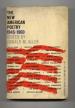
The best American anthology I have is the old 1960 Grove Press THE NEW AMERICAN POETRY edited by Donald M. Allen. Have been reading it lately -- Olson, Duncan, Ginsburg, etc. Love those statements on poetics. Has there been any real groundbreaker in that area since Olson's PROJECTIVE VERSE? (i.e. linelengths = breathlengths, the page as field...) It seems to me that pretty well all the formal possibilities within the static typewriter/typeface world of Olson's day (and pretty much our day) were outlined there. As we become digitalized, of course, we have juxtapositional possibilities of words and image or even wallpaper background that you could only dream of as you evolved your scissors-and-tape TV (text-visual) series a decade or two ago. Not to forget accompanying soundbites, as poetry enters the domain of multimedia. Even within the restrictive realm of print, variety of fonts and colours available to us -- consider these EXPRESSIVE POSSIBILITIES -- would have been unimaginable in Olson's day. Master a program like Flash and you can have those words going any direction you want, spiralling around, etc. All these are ways we can expand, slickly and seamlessly, on Olson's notions.

I've since acquired the Strand anthology Allen talks about below -- ordered it used from a Virginia bookstore through Amazon.ca for all of $3 (well, with shipping, $7 Canadian.)

Funny, without knowing it at the time, Allen and I were talking about what could be seen as the two key anthologies of post-war American poetry. (If there were others that may be considered key, I just don't know of them.) Between these two, the eleven poets they have in common -- John Ashbery, Gregory Corso, Robert Creeley, Edward Field, Allen Ginsburg, Le Roi Jones, Kenneth Kotch, Denise Levertov, Frank O'Hara, Charles Olson, Gary Snyder -- would suggest a considerable overlap, but both are big anthologies: the Strand anthology comprises 92 poets, and the Allen anthology 44. And indeed, the contrast in tone and argument couldn't be greater. The Strand anthology includes chiefly lyric poets, a lot of them celebrated professor poets that published with big "mainstream" presses and that Ron Silliman lumps into the SoQ (for those who don't know, School of Quietude), including AR Ammons, John Berryman, Robert Bly, Elizabeth Bishop, Donald Hall, Donald Justice, Anthony Hecht, Robert Lowell, Adrianne Rich, Sylvia Plath, Anne Sexton, James Tate, Richard Wilber, and Mark Strand himself. The Allen anthology includes a number of wilder shrubs like Edward Dorn, Robert Duncan, Lawrence Ferlinghetti, Jack Kerouac, Jack Spicer. The Allen anthology is a conceptually bolder and more powerful anthology, delineating for the first time groupings or "milieus" that -- however arbitrary and, as Allen himself put it, "for the most part more historical than actual" -- have remained sharply etched in our mental geography: the Black Mountain group, the San Francisco Renaissance, the Beat Generation, the New York Poets. With its essays on poetics -- including that benchmark essay by Olson -- it is definitely a precursor of Lang Po. The Strand anthology is a pretty typical good-poems -written-by-poets-in-alphabetical-order selection. Globally more inclusive than the Allen anthology, it draws a far diffuser picture. Even the poems selected in the Strand anthology of poets also in the Allen are, are formally speaking, the more conservative poems, or at least look more conservative within the constraints of the shorter selection (i.e. 1-3 poems for most poets) and smaller page size: these poets just don't stand out alongside the Hugos and Wilbers as they could. If anything would argue for the validity of the distinction Ron makes between the SoQ and Avant/post-avant, it would be these two anthologies -- however much he rankles by his obsessive harping on it (and however much I disagree with the way he flings that derogatory term - SoQ - around.)

-- a little post script: funny how much we can overlook in the heat of writing, i.e. when I wrote on that hot June day that "pretty well all the formal possibilities... within the typeface world" were outlined by Olson's essay. What about Concrete poetry? What about -- taking a step "backwards" a moment -- poetic forms or the so-called New Formalism? Actually, what I was referring to was a certain scope of free verse possibility that Olson had opened up for for me over the previous few years...

Thursday, December 01, 2005

The Best Way to Read a Poetry Anthology


From a letter from my friend Allen Sutterfield, from two summers ago (our copious correspondance, Vol. Umpteen):

....Do you know and or have in your library an anthology called: THE CONTEMPORARY AMERICAN POETS, American Poetry Since 1940, a Mentor paperback published in 1969 (!!), edited by Mark Strand? It's a very good collection. I recommend it, if you do not have it. I have also finally discovered the best way to read a poetry anthology: put it in the john and read a few poems at a time, preferably by one author, or a couple if only a single poem is included, ALOUD of course. The particular circumstance enables an unusual degree of concentration on 'the matter at hand,' so to speak....! I shit you not.

Anyway, if you don't have this anthology, I may send you a few photocopies of some of the poems in it. Often I have said in the last 15 years "Who's writing today?" There maybe no dominating presence like an Eliot or Pound but there are a hell of a lot of good poets writing--and this book itself is 35 years old! All those people in it are now in their 70's and 80's if still around. I think one fun activity for us in the coming year in our Poetry focus will be to root out and find which of these and of the many others since them who are writing today are worth following up--and then go find their actual books if possible.

We never followed up on that idea. If my friend were more tapped into Poetry Blog World or the internet, he wouldn't feel quite at such a loss. But we've gotta love him for this "johnny on the spot" suggestion... one I'm sure Leopold Bloom would have taken to.