Sunday, October 30, 2005

CARLOS MARTINEZ RIVAS


Here's a poet to discover: Carlos Martinez Rivas. Considered by many to be the greatest Nicaraguan poet since Ruben Dario -- although others would contend
Pablo Antonio Cuadra would better deserve that description -- he only published one book in his relatively long life, a staggering masterpiece called La insurreccion solitaria, which would translate as The Solitary Insurrection (published in 1953, republished with additions in 1973 and 82). Critics compared him to Octavio Paz and Charles Baudelaire, he won international recognition, and when he died, was given a
state funeral. Just on the strength of that one book. (Talk about a different culture than this one...)

So happens he was a friend/mentor of Francisco Santos, who describes to me unforgettable meetings he had with him at a certain bar named "Buenos Aires" in Aranjuez, Costa Rica, where Francisco stayed for a time after the earthquake leveled Managua in 1972.
Francisco describes him as a flaming genius, the greatest poet he ever met.

It seems that Mr. Rivas left behind him over a thousand unpublished poems, the vast majority of which have not yet seen the light of day. The reason for his non publication? According to this bio, he had an almost pathological fear of errata -- and anticipated public rejection. After last week's experience, I can relate. (At least to the errata part... well, rejection smarts too!)

Wednesday, October 26, 2005

THE DEPLORABLE FUTILITY AND YET ABIDING BEAUTY OF IT ALL

Exerpted from an email letter of a couple of years ago from Allen :

You and I have been over a lot of territory in the last 15 years about poetry and poems and publishing and the deplorable futility of it all and yet the abiding beauty of the effort and the results the effort yields--even if only for oneself and another person or two.

I would dearly love to "make some collections" out of those (ed.: that is, his) 5000 texts! The single volume is after all another level in that work (which has 7 levels but did I ever show and tell you those 7 levels, of which the 5,000 individual texts are only one level?). But I can't do that by myself, I need input from others, especially literate others like yourself. So there's plenty to talk about and plenty to do and I'm sure if we persist we'll get some good result, each of us and both of us. I respect your writing and always have, you are more than competent, you have the touch of madness necessary! If you think not, then just perform Latin Scholar in The Woods to remind yourself! Gotta go but there'll be more to say.

Allen

Yes, must continually remind myself... not just by re-performing the old, but making anew...but it's great to have a collaborator, a respect-worthy supporter, a cheering section of one or two. That's all one really needs...

Monday, October 24, 2005

MY LATEST TOY


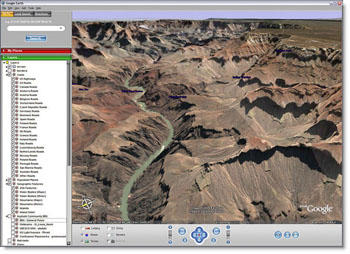
Here are some sample photos -- courtesy of Google Images -- from my latest toy, which I downloaded for free and spent about two hours with this weekend: Google Earth. Consisting of satellite photos that have been blended together into a composite 3-d photo of the Earth, you can fly anywhere within seconds -- even tip the world on its axis and glide over its surface as if in an airplane. This program is still in its early generations, but is already amazingly sophisticated. You can type your address into the "Fly To" window, free fall through space and within seconds be hovering over it at about 1,000 feet. Some places -- like the Eiffel Tower above or the Grand Canyon below, are really well photographed, and you can hover over them at 900 feet and see the view below at a pretty nearly perfect resolution. Other places -- in the midst of Africa, Siberia, Antarctica -- get blurry below about 20 or 30,000 feet. (Apparently an enhanced version, for which you pay about $20 a year, is better...) I can imagine in a few years we'll be taking virtual tours through cities, with scenes recorded in real time. Apparently the military doesn't like this, for obvious security reasons. But one thing I like about this program is that it reinforces the notion of the world as one ball in space -- and rather small one, at that. So we'd better take care...

Next time you look up into the sky, smile: a satellite may be taking your photo!

Sunday, October 23, 2005

CAESURA

One of my prose poems is up at Dusie, too. Yes, this one is a riff*, an early morning jotting where I let the words take themselves where they would lead... and here they lead into roundnesses, stillness, pause.

*see this this post of a few months back on a distinction of Charles made between spurs and riffs.

Friday, October 21, 2005

MEN PLAYING WITH WORDS: CANTO PUBLISHED IN DUSIE

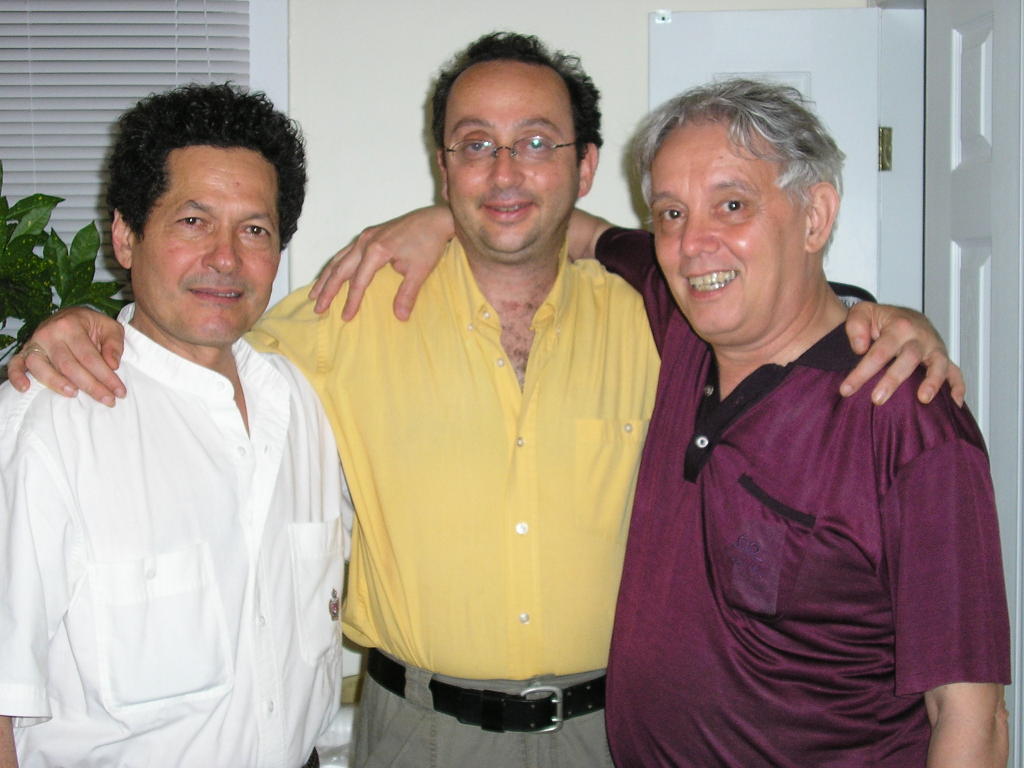
Francisco Santos, myself, and Allen Sutterfield
on the evening we wrote "Canto"


It was a suffocatingly muggy evening, June 14 of this year. Both Allen and I were in Toronto, and had arranged to get together with Francisco at a friend's place, where Allen, who resides now in Guelph, Ont., was staying. Since wine seemed a necessity (isn't it always where poetry takes place?), we made a long treck in the stifling heat along Danforth Ave. to the nearest LCBO to pick up a two litre bottle of cheap Italian red, and almost lost our evening in a pizza joint waiting for an excruciatingly slow with-the-works to go... as we waited, though, we did read and discuss a couple of poems from Anna Akhmatova' Selected, which I had picked up at a used bookstore along the way. By the time we got back to our friend's place, it was already closing on 9 pm. As Francisco and I were living/staying halfway across town, it seemed the evening was up almost before it began. (We had planned this get-together weeks in advance.) Over drooly pizza and sweaty juice glasses of wine (our friend's wine glasses were stored we couldn't find where), we laughed ironically at the inconvenience of throwing a party -- or doing anything worthwhile, it seemed, on the spur of the moment in Toronto. Suddenly something in our conversation -- I think we were talking about Creeley, who had recently died, and I remember now I even read out "I Know a Man" earlier that evening -- reminded Francisco of a verse he had written more than two decades ago, which he remembered as this:

Llévate este silencio
de
ave

para que conozcas
el
vuelo
de mi
canto


which I immediately translated as this,

Take this silence
of a
bird

that you may know
the flight
of my
song

Francisco wondered if I had included it in the bilingual selected which I was in the process of bringing together at the time. He had always had an affection for this verse because it brought together silence/bird/flight/song and notions of taking/knowing/possession in one brief utterance... great concentration of language was evidently a poetic ideal of his, too.

Well, I hadn't.

Allen, trickster that he is, suggested this possible alternative (he doesn't know Spanish), which he intoned in a deep south accent:

Take
the silence of a bird
that you
may know
how my song
flies

Then Francisco came up with another variation, and somehow or other, we were off: a game was created: to see how many variations on that verse we could come up with using those exact same words. These we jotted down in Francisco's notebook, which we passed around round-robin style. Each time we came up with a wilder and more improbable variation, we doubled over in gales of laughter. At one point -- after about fifteen variations, when it seemed there were no possibilities left, the notebook was passed to Francisco. After a moment of mulling, he came out with this:

Take

silence

this bird

know

flight

canto

"Hey, Francisco," we objected, "you didn't use all the words!"

"But this is an exception!" he said back with a raised finger. Gales of laughter again.

Henceforth exceptions, if exceptional, were allowed. I came up with a variation on his variation, and then we came up with six more conforming -- more or less -- to the original constraints. At this point, our friend came back. We all knew we had done something pretty significant artistically.... we were elated, minds on fire. A title sprang forth -- Canto -- and a dream of little chapbook and reading somewhere, at the Art Bar Poetry Series or Guelph's Woolwich Arms. In any case, it turned out to be one of the most enjoyable evenings of pure creative fun any of us had had in a long time. At our request, our friend -- Tony Marques, I'll let his name be known, another dedicated word craftsman who remains in an unpublished nether world -- turned on his computer and I transcribed what we had written into a wordpad file, and emailed it to all of us.

Tony took the picture above with my camera to commemorate the occasion.

That was that... or so it seemed.

The next week, looking through one of Francisco's earlier collections to find the poem and include it in the selected, I discovered that he had misremembered it: that he had written comprendas (comprehend, understand) el vuelo de mi canto, not conozcas (know). I called him up to see which version he preferred for the bilingual edition. He said, ah yes, but I much prefer comprendas. Subtler, he said. But know sounded better rhythmically in English, so I stuck with my translation of that evening -- but tacked the original Spanish version on as the concluding variation in Canto. After 23 variations, I suppose the singer would understand the song...

Anyway, Canto I later submitted to Dusie -- it struck me as down their particular alley -- and it was taken. You can read it here.

Wednesday, October 19, 2005

The Books Within The Eardrum


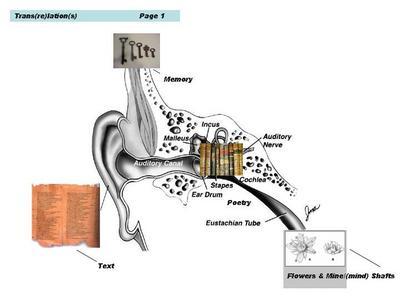
For some intriguing critical appreciation of Francisco Santos' poem Fiesta (trans. yours truly), check this post on David's blog (always intriguing). David, I don't know how you managed to make this montage, but it's really quite splendid. Scanner or clip-art trickery? (The original Spanish version + my own take on the translation of the poem is to be found on this post in the Undressing the Night blog. )

Monday, October 17, 2005

VIRTUAL ANGELS

Buried in all that technical talk in the post below is a quintessential expression of the boundless goodwill to be found on the internet. I had a technical problem; three others wrote extensively on how to solve it, one going so far as to investigate the html solutions for me and coming up with one; the problem seems to have been solved.

Porn, scams and sadism abound, but in this community and others I see a lot of utterly generous sharing and caring, dissemination of good for the mere joy of it.

There are times when this parallel world of "virtual reality" can seem like a society of angels who cannot touch or even see each other but nevertheless help each other in fulfilling their angelic tasks. Somewhere there's a poem in this; there's gotta be.

Sunday, October 16, 2005

A Question for you Microsoft Explorer users out there...

A question for you Microsoft Explorer browser users out there: how does this web site appear to you? Do you see the strip of posts only? Is the profile, archives, links etc. column all pushed down so that you have to scroll 'way down to the bottom to see it? I just discovered this when I looked myself up on Microsoft Explorer for the first time ever. (This after a couple of friends who use Explorer complained being unable to see my blogroll, or of finding the title with a black hole beneath.)

In Mozilla Firefox and Netscape, this blog looks like it should. Only in Explorer does it have problems. (So too do my other black blogs, Undressing the Night and Sky of Ink.) Going around my blogroll I noticed a number of other blogs using Minima Black have the same problem in Explorer only -- Lorna, you have problems, and so do you, Gina,and yet two others using Minima Black, namely you, Todd, and you, Laurel, look normal in Explorer. Is this my computer? Is there something I can do (i.e. with html) to rectify this? (I asked Blogger for help but no answers have been forthcoming.) Oddly enough, Geof Huth, who uses a template that is usually not affected, also looks bad in Explorer.

For those 50+% of my readers who still use that clunky old (and probably unsafe) Explorer browser, I urge you to stop patronizing Mr. Gates immediately and download Mozilla Firefox, the most accurate and easy-to-use browser I've found yet. But as long as you comprise my majority, this situation just bugs me.

Friday, October 14, 2005

David's onto something

David (Eclectic Refrigerator) has done a couple of exquisite posts lately in a blog-collage style we've dubbed blogollage, or webstiche. Check today's post about a certain amazing new poet named Ilya Kaminsky or more particularly, his commemorative post two days ago on Thelonious Monk.

Thursday, October 13, 2005

FRANCISCO SANTOS' UNDRESSING THE NIGHT BLOG

Francisco Santo's Undressing the Night, translated by yours truly, is still on its way. Some 100 copies were mailed to me and to Francisco -- 20 copies each by priority post, the rest by regular post -- on Sept. 20 from Norberto Salinas of Editorial Lunes, Costa Rica... and we're still waiting. Francisco received some ten copies mailed hot off the press (this expression is quite literal... the books come very warm off these presses) 2 weeks before, but DHL, a certain courier service in Costa Rica, has turned out to be very slow (what else is new? are all the others are slow down there, too.) "Ese DHL es un tormento..." wrote Francisco to me in an e-mail a couple of days ago. Are they reading and critically assessing each copy before they send them? I think a pony express would have made it sooner.

In the meantime, I've created a blog site -- undressingthenight.blogspot.com -- that brings together the forward, commentary, and other related materials on the book, most of which have appeared or will appear in this blog. A growing compendium of resources for that worthy few...

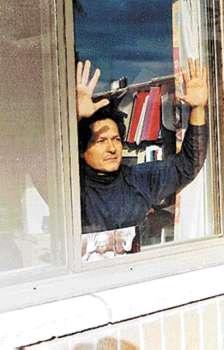
Above is a photo I took of Francisco when he visited me two summers ago here in Montreal. Together that day we had gone to an extraordinary card shop on Rue St-Denis where he'd picked up a rare photo card of Pablo Picasso, Pablo peering out, his hands against the window as if trapped inside. Here, Francisco Santos poses behind my office window doing the same thing. That was the idea anyway -- but the PP photo, down in the left corner of the window, is scarcely visible. Probably better that way -- how many know of that photo anyway? (Well, more do now.) A suitably cropped version appears on the back of the book. As soon as the book arrives, you'll see a scan of the cover. In the meantime, every morning finds me peering into my mailbox for that parcel delivery card.

Tuesday, October 11, 2005

Sound & Light Show Extraordinaire

For one of the finest flash & sound presentations on the net (or that I've seen, at any rate), check out the web site of Nicolas Ruel, Montreal photographer. If you can't afford a trip around the world right now, here's a pretty evocative substitute...

Sunday, October 09, 2005

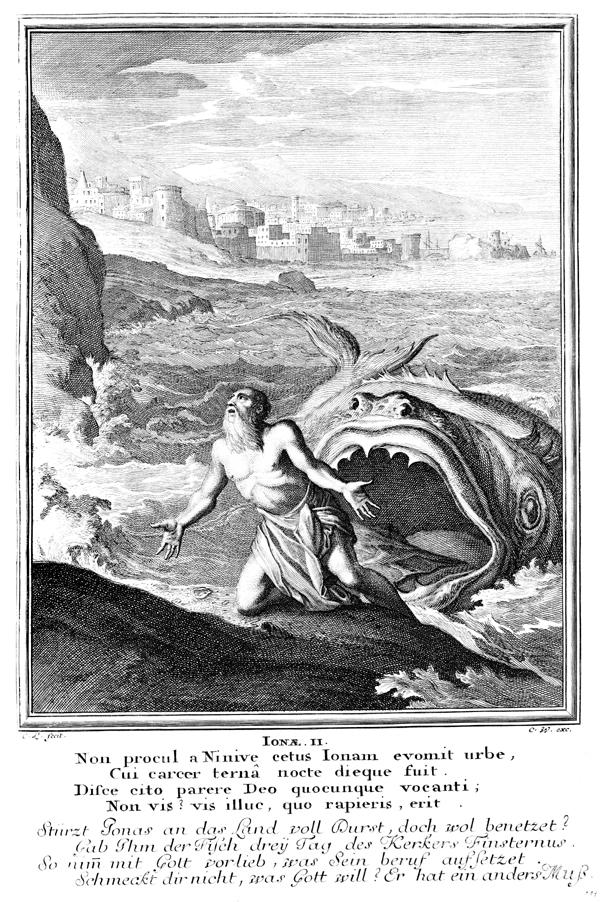
JONAH & JOSEPH CAMPBELL

Moyers: My favourite scene [in Starwars] was when they were in the garbage compactor and the walls were closing in, and I thought, "That's like the belly of the whale that swallowed Jonah."

Campbell: That's where they were, down in the belly of the whale.

Moyers: What's the mythological significance of the belly?

Campbell: The belly is the dark place where digestion takes place and new energy is created. The story of Jonah in the whale is an example of a mythic theme that is practically universal, of the hero going into a fish's belly and ultimately coming out again, transformed.

Moyers: Why must the hero do that?

Campbell: It's a descent into the dark. Psychologically, the whale represents the power of life locked in the unconscious. Metaphorically, water is the unconscious, and the creature in the water is the life or energy of the unconscious, which has overwhelmed the conscious personality and must be disempowered, overcome and controlled.

In the first stage of this kind of adventure, the hero leaves the realm of the familiar, over which he has some measure of control, and comes to a threshold, letus say the edge of a lakeor sea, where a monster of the abyss comes to meet him. Then there are two possibilities. In the story of the Jonah type, the hero is swallowed and taken into an abyss to be later resurrected -- a variant of the death-and-resurrection theme. The conscious personality has come in touch with a charge of unconscious energy which it is unable to handle and must now suffer all the trials and revelations of a terrifying sea-journey, while learning how to come to terms with this power of the dark and emerge, at last, to a new way of life.

The other possibility is that the hero, on encountering the ower of the dark, may overcome and kill it, as did Siegfried and St. George when the killed the dragon. But as Siegfried learned, he must then taste the dragon blood, in order to take on something of that dragon power. When Siegfried has killed the dragon and tasted the blood, he hears the song of nature. He has transcended humanity and reassociated himself with the powers of nature, which are the powers of our life, and from which our minds remove us.

You see, consciousness thinks its running the shop. But it's a secondary organ of a total human being, and it must not put itself in control. It must submit and serve the humanity of the body. When it does put itself in control, you geta man like Darth Vader in Star Wars, the man who goes over to the consciously intentional side.

Moyers: The dark figure.

Campbell: Yes, that's the figure that in Goethe's Faust is represented by Mephistopheles.

Moyers: But I can hear someone saying, "Well, that's all well and good for the imagination of a George Lucas or for the scholarship of a Joseph Campbell, but that isn't what happens in my life."

Campbell: You bet it is -- and if he doesn't recognize it, it may turn him into a Darth Vader. If a person insists on a certain program, and doesn't listen to the demands of his own heart, he's going to risk a schizophrenic crack-up. Such a person has put himself off-center. He has aligned himself with a program for life, and it's not the one the body's interested in at all. The world is full of people who have stopped listening to themselves or have listened only to what their neigbours to learn what they ought to do, how they ought to behave, and what the values are they ought to be living for.

The Power of Myth, pp. 146-47

__________________________
As one who has lived the the story of Jonah in a special way himself -- this poem is the expression of that -- I find it a bit simplistic of Campbell to say that Jonah comes out of the whale "transformed". Jonah comes out of the whale with his psychological baggage pretty well intact -- his pride, his expectations, his loneliness and profound self-hatred, which he projects on Nineveh, on the plant that grows to shelter him, on God and on life itself. When things don't go as he wishes them to -- when he discovers that he is an unconscious agent of a healing process that leads the big fellow upstairs to stay his hand although it ultimately betrays Jonah's prophesy, Jonah's self-esteem as a prophet is profoundly upset. He goes out to the desert to kill himself through exposure to the heat of the sun (could be seen as the heat of God, of course), but can't even succeed in doing that. Despite himself -- despite the fact that he is a truly screwed-up human being, as so many of us are, and as we all are on deep levels -- his life force is so strong that he keeps reincarnating into the same old griefs, staying very much the same damned (Biblically damned, as well as personally damned) person, while bringing salvation to others despite himself. The resolution of the story is famously inconclusive. What I find interesting is that Moyers found the walls closing in reminded him that story -- the very image to be found in my poem. I hadn't seen Star Wars when I wrote it, if that has to do with anything -- in fact, I still haven't (I feel like the only person in North America who hasn't). Walls closing in is not, after all, an uncommon metaphor for personal oppression. Actually I was writing out of the extremes of a personal depression, which for me at that time was the belly of the whale, so to speak... (By the way, the poem was written as far back as '88... it's at the point where it feels like another person wrote it, although that person is definitely still me...strange, isn't it?)

As much as I love the man and his work, I always felt a certain ambivalence about Joseph Campbell's interpretation of mythology, and this may explain why I haven't felt strongly motivated read more of him. The thing is, the interpretation is so prominent, and interpretation, while it functions to underline the contemporary relevance of myth, can be altogether too neat. With the help all those Freudian/Jungian concepts, all is kept safely under glass. We are of course so cut off from our mythological sources that J.Campbell serves, as I've said before, as an excellent bridge to those sources, but the bridge can all too easily get in the way. Far richer it is to go directly to primary sources oneself -- the texts are all there, even some of the practices -- and live and interpret them through your own life, rather than have them interpreted for you.

Speaking of the shortcomings of orthodox religion, Joseph Campbell could be speaking about himself: "The mystery has been reduced to a set of concepts and ideas, and emphasizing these concepts and ideas can short-circuit the transcendent, connoted experience. An intense experience of mystery is what one has to regard as the ultimate religious experience."(Power of Myth, p. 209)

Friday, October 07, 2005

OCEAN LIFE


Some time ago I found this piece by Greg Dilley, a Nichiren Buddhist writer and fellow-member of SGI, which I hoarded away and saved for an occasion like this one, when I don't feel like composing something of my own. Dilley, besides being an accredited Ninja of all things, is professional deep-sea diving instructor. The photo is by one Japanese underwater photographer named Sammy.
____________________________________

So who are we? Where did we come from and why are we here? One thing we know now that we didn’t know merely a decade ago is that perhaps as much as 97% of the inhabitable space on the planet is in the deep ocean. Most of the biomass on Earth resides in these depths.

Humans use terms such as “islanders” and “mainlanders” to separate themselves into tribes according to the proximity to the ocean and size of their terrestrial world when in fact we are all islanders compared to our relative place on this blue ball.

Even our mammal cousins such as the seals, seal lions and otters had the common sense to return back to their original home. It’s hard to imagine that the ancestors of whales and dolphins ever spent much time on land at all.

What is less known is that the previously dominant life forms originally residing in our oceans, microbial life, created their own extinction through the creation of the waste gas oxygen. Now mankind finds itself threatening the future of all terrestrial life as carbon dioxide levels rise threatening our atmosphere and everything it supports. As well, our coastal waters are being fished into oblivion as tons of unused, dead by-catch is dumped back into the sea in exchange for each meager haul of usable, edible fish.

Mankind is rushing towards our own demise. Unstoppable, the power of profit is mistaken for the quest for survival. It speeds us along like an evil destructive force, or perhaps this force is merely the eternal force of nature itself. Perhaps it is nature’s plan that each species has a limited time on Earth. At times when one looks at the damage we do to our world it seems that there is a global human consciousness at work, rushing to inflict as much harm as possible until our time runs out.

On the other hand there is that part of human awareness struggling to understand our true place in our biosphere and to find ways to coexist, therefore lengthening and extending our rule over our domain. Less than 20 years ago we had little idea of the extent of the diversity of creatures residing in the oceans we have lived next to since the time when we slept in trees and caves.

Since primordial ages men have searched the heavens for signs of God and have directed their prayers skyward. These same ancient men also regarded the ocean depths as a place of unknowable evil. Unseen, unknown, its depths foreboding and dark, the deep ocean realms represented hell incarnate.

For the underwater-traveling human being, the water world is Earth set upside down. To look up one sees the smooth glassy bottom of the world, to look down is to peer into a dark, limitless sky.

One thing is for sure, we live because the ocean lives.

Thursday, October 06, 2005

SPLENDID ISOLATION

Cut yourself off. Avoid any sort of human contact, any sort of distraction whatsoever. Live alone in your room, which is hopefully several miles underground or up in the air, and which you have emptied of all but a writing desk, a pile of blank paper, a pen or pencil, and yourself. Revel in the splendid isolation "built in" to this rarified activity of writing, to which so few allow themselves access. Have faith. The mind fills a void. It fills it. It does fill it...

Monday, October 03, 2005

NOMENCLATURE

After considering the foregoing discussions, here's my personal nomenclature for that wonderful/dreadful process of submission: submission in general will be called circulation; individual submissions assertions, rejections returns, and submissions of work turned back recirculations. In other words, I have lots of poems for circulation; some have been returned, and need to be recirculated. I have to work on an assertion now. Sounds good? À bientôt!